

The author is a public policy researcher who writes Fleeting Thoughts… in One Piece to escape the mundane life of writing policy briefs and project reports. This article reflects the author’s own analysis and views and does not necessarily represent those of his employer or The Reformist.
Ahmad Dhani, his Wonder Woman wife Mulan Jameela, his Roman Picisan vocalist Once Mekel, his Aku Jadi Aku co-composer Melly Goeslaw, and his son’s LDR castmate Verrell Bramasta. What do they all have in common?
They’re all rich celebrities — yes — but what we’re here to discuss today is that they are all currently sitting members of parliament (MPs). Our dear and esteemed political representatives. The people who make the laws that govern us.
“Gosh, no wonder our politics is a joke,” I hear you mumble under your breath. What will be of our country? What do these people know besides sounding or looking pretty on our screens? Have they even read a book in their lives?
Well, you may not be entirely wrong, but being smart isn’t mutually exclusive with being a good representative. If you disagree, this piece will likely disappoint you. And while I’d love nothing more than to join the bandwagon of making fun of politicians, what I’ve observed so far has led me to believe we really need more celebrities in parliament.
And no, I’m not kidding. In fact, I have never felt more serious than I am right now as I start jotting down my thoughts on this.
But why?
When this Prabowo administration started, I had a list of legislative bills that I suspected would get fast-tracked. But I’d be lying if I said that the Copyright Law amendment even made my long list. It has now been shot to the top of the parliament’s political agenda, largely thanks to the celebrity MPs who sit in parliament today.
What began as petty arguments between a few famous composers and performers had snowballed into a debate that at first seemed super technical: royalty payment.
Read this Reformist volume on music royalty if you’re not up to speed yet:

And while things have gotten a tad bit more complicated now — with artificial intelligence getting in the mix — the bill has proven one thing: an agenda can only be a priority when the people debating it have a real stake in the decision.
Don’t get me wrong. Copyright is a serious matter that should concern us. In today’s economy, however, the fact that these celebrity MPs have managed to champion a bill that concerns, first and foremost, their own livelihood is actually what they’re supposed to do with the power that they’ve accrued, which is to (surprise!) represent.
Have we gotten it all wrong?
The short answer is “no.” The long answer is “no, but we might have been guilty of underestimating celebrities who run for office and overestimating our own ideals.” By the end of this article, I’ll prove you’ve been guilty of one, both, or neither.
In the current House of Representatives, there are at least 23 MPs who made (or still make) a living in the entertainment industry, earning them a ‘celebrity MP’ status. That list includes the names I mentioned at the beginning of this article, alongside:
dangdut singers Ashraff Abu and Iyeth Bustami;
ABG heartthrob Tommy Kurniawan, Panji Manusia Millenium Primus Yustisio, Gerhana damsel-in-distress Dina Lorenza;
comedians Eko Hendro Purnomo and Denny Cagur, quizmaster Nico Siahaan;
Perwira and Ksatria star Dede Yusuf, racer Moreno Soeprapto, supermodel Arzetti Bilbina;
Ungu frontman Sigit “Pasha” Purnomo, Tenda Biru chanteuse Desy Ratnasari, Cinta Semu rapper Uya Kuya, Hati yang Kecewa minstrel Nafa Urbach, and Bajaj Bajuri sweetheart Rieke Diah Pitaloka.
If your gut reaction is to feel sad and concerned that these are the people representing our — the public — interests in parliament today, you’re not alone. After all, it only makes sense that the most capable among us occupy these high-stakes seats. If we took these celebrities from Senayan, everything would’ve been so much better, and politics wouldn’t be so frustrating.
… Right?
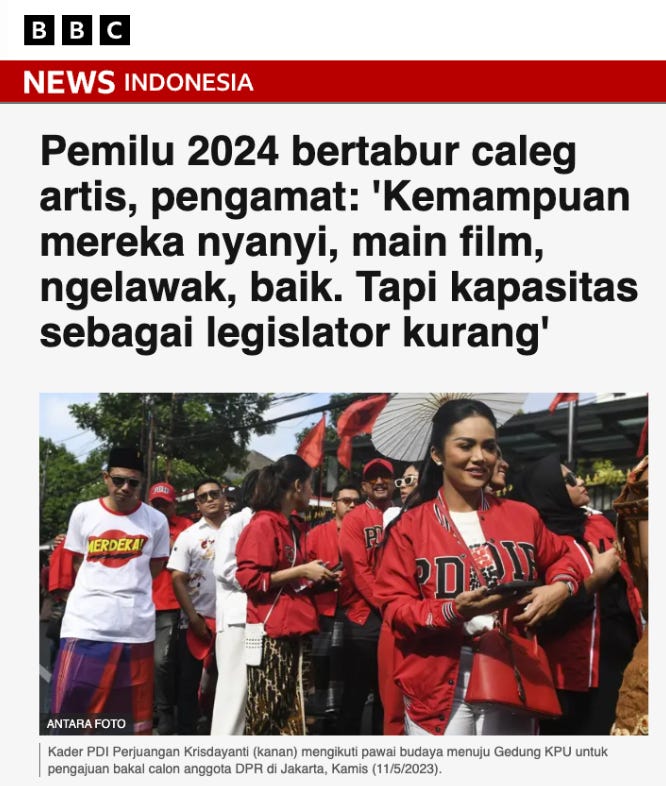
Of course not. But how many of you reading this have made fun of celebrities winning legislative elections before? Ahead of the 2024 elections, pundit Lucius Karus was quoted by many news outlets, including the BBC, as seen above, saying “They can sing, act in movies, joke on stage, but they’re not capable [of serving] as legislators.”
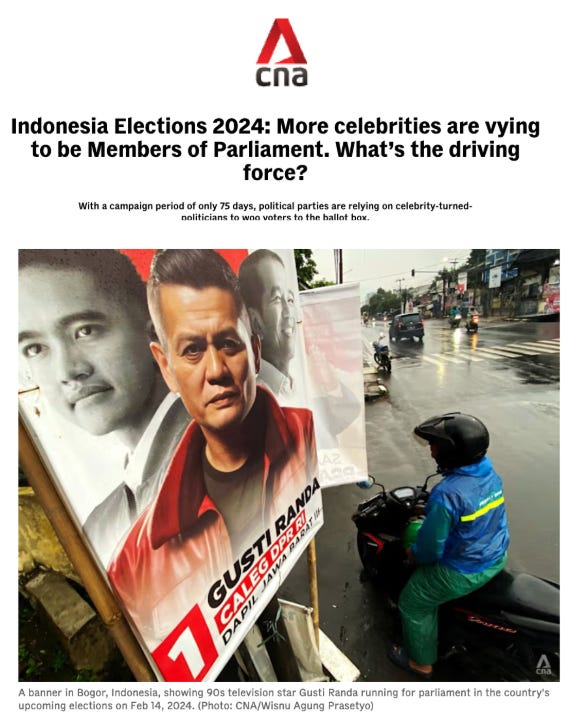
I’m not saying that they haven’t earned the cynicism. Khoirunnisa Nur Agustyati, then-chief of the Association for Elections and Democracy (Perludem), made a good case. “We have seen time and time again that some of these celebrity politicians do not take their new responsibilities seriously,” she said, concerned that “some of them still perform shows or appear in commercials.”
To an extent, I agree with these observations. But perhaps something else here needs closer inspection.
Why do we deride celebrity MPs so much?
I don’t know if there’s a single reason to explain why celebrities, collectively, are seen by many, if not all of us, as incapable, incompetent, or unfit for office. Hopefully, at least one of the following three hypotheses represents your view.
1. Celebrity MPs are shallow vote-getters
Even without the usual campaign posters and banners polluting the streets, many are already familiar with them. It’s almost unfair. If a regular politician has to spend billions to be acknowledged by the voters in their electoral district (‘dapil’), a celebrity joins the race having already built a ‘fanbase’ at best or a sense of familiarity at worst. This phenomenon earns them the permanent mark of a ‘vote-getter,’ meaning someone political parties nominate for no other purpose than to win as many votes as possible so they can pass the 4 percent parliamentary threshold.
In a country where celebrity news gains so much attention that it becomes an industry of its own — the ‘infotainment’ — any celebrity seeking to run in elections has an upper hand that other candidates don’t. Yet as we’ve already established, popularity is a disadvantage just as much as it is an edge.
Desy Ratnasari has a PhD in Psychology from Atma Jaya, with a dissertation on gender equality. But when she began her third consecutive term, some felt it was more appropriate to focus on the fact that she’s a widow.
Rieke Diah Pitaloka, also on her third consecutive term in parliament, graduated cum laude from Universitas Indonesia with a PhD dissertation on data governance. But, unsurprisingly, what makes the news is either her Instagram outfit or skincare regime.
This isn’t to say they represent most celebrity MPs, but they’re not outliers either. Beneath the glams and flashes, these celebrities are just like the rest of us. They are not a monolith defined by one thing. Ahmad Dhani is a controversial rockstar but also a Sufism observer. Nurul Arifin is a bona fide movie star but also a women’s rights activist.
I can go on, but I think I’ve made my point. Their visibility gives them a slight edge, but it also creates a problem the rest of the field doesn’t have to deal with (at least not as much): voters who assume their celebrity status automatically means a lack of depth.
2. Celebrities are in it for themselves
My next hypothesis is that people see celebrities as this group of rich, greedy opportunists who are using politics for their personal gains.
What’s another Rp 100 million a month for Melly Goeslaw, who in March 2025 posted on Instagram about receiving almost six times that from her collective management agency (‘LMK’) in royalties thanks to her massive pop song catalog.
But why are we so outraged about rich celebrities taking up space in parliament when the cost of politics in Indonesia is impossibly expensive? A research project I co-edited for the Westminster Foundation for Democracy (WFD) in 2024 estimated that the median cost of securing a parliamentary seat in Indonesia is 5 billion rupiah per candidate. For the average Indonesian, that’ll take 140 years of earning the national median income of Rp 36 million (annually) without spending a dime to afford a successful campaign. Well, at least theoretically.
My point is not that we should just sit idly by while politics continues to be a game exclusively reserved for and by the richest among us. Even the Finance Ministry’s most modest estimate still came out to Rp 1 billion in average spending per candidate — and that’s without even a guarantee of winning a seat.
Imagine spending that much money for a job that wouldn’t even earn you a net return after serving a full five-year term.
The argument that celebrity MPs are in it for themselves doesn’t hold up once we look deeper into the matter. What if it’s not as simple as a financial calculation? And while you’re at it, ask that same question to everyone who decided to run for Senayan, not just the celebrities.
3. Celebrities don’t have what it takes to make laws
Well, yeah, but it’s not like the remaining 557 MPs in parliament today are the most revered policy experts either.
Let’s get to the real point.
Representation is competence itself
Our political debate has completely missed the mark on this one. Every election season, we get into this heated debate over who is the most competent candidate to give our votes to. And every other election season, we bicker with online trolls and exit the unbearable family WhatsApp group chat because their political choices are not reflective of someone who prioritizes competence.
Deplorable.
Hold your horses. Entertain me for a second here. For every job out there, including being an MP, competence is never a fixed mathematical equation defined by a universal formula. By default, we expect competence to align with things like higher education, relevant experience, good standing, inspirational speeches, statistical mastery, language proficiency, and so on.
This is fair in most jobs, but in democracy — where the most valuable capital is a vote — I beg to differ. Competence comes in many facets, some of which will feel morally deprived and downright wrong.
Visiting the slums that never get attention, having photo-ops while climbing down into the sewers, slowing down your speech patterns so some voters relate better, plastering your face on rice bags so they remember who fed them that day, looking pretty while waving around on a campaign trail, organizing dangdut concerts at a village that only knows survival — all of these shouldn’t be dismissed as ‘cheap theatrics’ just because they don’t fit the list of skill sets we believe are necessary to run for public office.
If politics is a matter of who gets what, when, how — as American political scientist Harold Lasswell titles his seminal 1936 book — then celebrities have proven their competence for the job simply by winning in their dapil. Whether those who lost are more credible, have advanced degrees, and bring decades of public service does not change the fact that these celebrities have been chosen to represent. That, in and of itself, is the only competence that matters.
That, unfortunately, is the bitter truth. I don’t like it. Not at all. But not liking something isn’t enough to bring about change.
Every nation gets the government it deserves
“Toute nation a le gouvernement qu’elle mérite.”
A popular quote by Joseph de Maistre of Savoy, a historic region now in southeastern France. Often misattributed to Thomas Jefferson, many have misused it to shift the blame from a broken system to bad individual choices.
A counter-revolutionary, Maistre believed that a monarch is divinity itself and therefore should not be challenged. He did not mean that we are individually responsible for our own miseries, and it was never about voting in elections. Well, at least not in the way that we perceive it today. His writing, which I think would get him instantly canceled if published today, was much deeper: that a political system cannot be artificially engineered. Instead, he argued, whatever government rules a society is a direct mirror of the spiritual and moral state of its people.
But what does this have to do with celebrity MPs?
The celebrity MPs have proven one thing: if you want your priority to take precedence, then put your hand in it. Otherwise, we’ll keep relying on the people we’ve elected to represent us. Unfortunately for us, though, what they eventually represent doesn’t always align with what we believe when we make our decision in the voting booth.
Think about the three hypotheses I’ve presented above. We constantly undermine celebrities in politics because they’re shallow. We predetermine that celebrities are only in it for themselves. We reject celebrities because they’re not competent.
And despite all that, they are in parliament. And, as we’re witnessing with the advancement of the Copyright Bill, they are moving their priorities to the top of the political order.
Now I don’t assume that The Reformist readers are all the same. Each of us has different things we want to prioritize. For activists, it may be to pursue social justice. For women, it may be to be safe from violence. For the Indigenous people, it may be to protect their ancestral lands. For every one of us, it may only become a priority if we throw our hands in.
So, yes, I wasn’t joking when I wrote that we need more celebrities in parliament. But also more activists, even if everyone thinks that’s selling out, just like the celebrities who are shallow vote-getters; more women, even if their political party only nominates them to fill the 30-percent quota, just like the celebrities who are only in it for themselves; and more Indigenous people, even if their traditional wisdom does not come with fancy degrees, just like the celebrities who don’t have what it takes.
Perhaps this is what we’ve been missing all along: someone with personal stakes in the system. If we want to get the Indigenous Rights Bill prioritized, let’s get more Indigenous people in parliament. If we want the Human Rights Defenders Bill legislated, let’s get more human rights defenders seats in Senayan.
Just like the celebrities who stood up for themselves for their royalties, every single one of us should too. Even if chance says we’d end up right where we started.
Do it anyway.