


♪ Kini terasa sungguh
Semakin engkau jauh
Semakin terasa dekat ♪ —
— wait, stop the music!
We know Nuansa Bening is the go-to golden memory song to sing along to for many of you reading this, but let’s be careful. After all, we’ve seen how the late Vidi Aldiano went through a long legal battle with the original composer over the performing rights of the song he made famous again with his 2008 rendition.
Okay, we might not be in trouble for “singing” the song in this article – that’s not how copyrights work. Though now we are compelled to ask: how does it actually work?
Let’s look outward now with the megastar Taylor Swift, who has been re-recording her past albums since 2021, releasing them with a “Taylor’s Version” tag. This is not because she’s run out of ideas for new material, but because of the complexity of copyrights.
Early in her career, Taylor signed with Big Machine Records, which helped propel her into the limelight. But this partnership gradually became predatory, at least according to the singer, as she grew more popular. As is standard in most recording contracts at the time, the label owns the “masters” of her first six albums, giving it a larger share of future profits from the commercial use of Taylor’s songs.
When Taylor’s efforts to purchase the rights to these original albums entangled her in a high-profile dispute with the label, the artist took an alternative route: as she owned the publishing rights (rights protecting artists’ musical composition, e.g. lyrics, melodies, that is separate from recording rights, under US law) of her composed songs, she re-recorded these albums and released them herself so she could have full ownership of the new recordings of her songs.
But this article won’t tell the story of Taylor Swift’s copyright victory; it will tell the story of Indonesian artists’ copyright battle.
Unlike Taylor and her global pop-star peers, Indonesian artists have far fewer bargaining chips when it comes to rights to their works. They have to navigate murky waters to deal with the country’s outdated and convoluted Copyright Law. Last revised twelve years ago, Law No. 28/2014 has failed both to keep up with the increasingly digital creative industry and to mitigate royalty disputes, most recently between performers and composers.
The House of Representatives (DPR) finally included the revision to the Copyright Law in the 2026 National Legislation Program (‘Prolegnas’, a list of bills that the House will prioritize throughout the year). While the deliberation process is ongoing, it is clear that the revision will continue to address the issue of royalty distribution.
This edition of The Reformist will dissect the political economy of the music industry through the discussion of royalties, the economic rights a copyright holder is entitled to whenever their work is played or performed in a commercial setting. While the term may sound marginal compared to high-profile policies, beneath the seemingly boring bureaucracy is a sector filled with fiery political feuds, lawsuits, and competing ideologies. A much-needed discussion before revisions to the Copyright Law are set in stone, don’t you agree?
A brief history of Indonesia’s Copyright Law
The country’s Copyright Law traces its origins back to the colonial Dutch era. In 1921, the colonial Dutch East Indies government enacted Staatsblad No. 600/1912, a regime that only acted on copyright violations if the rights holder personally filed a complaint. This law persisted long after Indonesia declared independence.
An actual Indonesian Copyright Law (Law No. 6/1982) would only come into existence in 1982, after decades of false starts: ten separate drafting attempts across 14 years, cycling through the Education and Justice Ministry in 1958, the National Legal Development Agency in 1966, and the Indonesian Publishers Association in 1972, each stalled by a backlog of competing bills.
The law was amended again in 1987 to tighten enforcement, and again in 1997 to bring it in line with international norms. Five years later, the law was rewritten and became Law No. 19/2002 as piracy (CD and VCD bootlegging) became the era’s defining threat.
The 2014 revision (Law No. 28/2014) was explicitly intended to ensure the law kept pace with the digital era, but lawmakers were overly focused on digital piracy, failing to anticipate the meteoric rise of digital streaming platforms like Spotify and Apple Music.
This 2014 version is the Copyright Law in place today — the one lawmakers are now “rushing” to revisit and revise some provisions they deem critical. The main star? Music royalties.
Royalty governance has remained inconsistent even after the Law was enacted. The framework only became operational after the release of Government Regulation (‘PP’) No. 56/2021, which clarified how royalties should be managed for the commercial use of music across venues and performances, ranging from cafes and hotels to restaurants and live events. But the problem was never just the absence of clear rules, because tariffs for commercial uses had been set by other regulations before this PP was issued. The real problem, as is with most policies in Indonesia, is weak enforcement.
Who has the most reliable records of which songs were used for commercial purposes? How transparent is the collection and distribution of royalties among all the relevant parties? Who holds the collecting agencies accountable?
These are some of the questions that tell us just how much is still missing from our copyright governance.
The status quo: Centralized royalty distribution
As with many policy problems in this country, legal reforms may have taken place, but institutional enforcement lags far behind. The same can be said for the music industry.
Article 89 of the 2014 law established a collective royalty management mechanism, which was subsequently operationalized through the National Collective Management Agency (‘LMKN’). In addition to collecting, disbursing, and documenting royalties on behalf of every composer and musician in the country, it also serves as a mediating body when disputes break out between parties and documents royalty use across the industry.
LMKN was built to simplify royalty distribution, but in practice it has often been flagged for its opaque management and redistribution scheme. When LMKN receives royalty payments, that money is not directly distributed to the song’s creator. It is first pooled and transferred to one of the 17 government-licensed Collective Management Organizers (CMOs, or ‘LMK’), of which an artist must be a member to receive their royalty checks.
These 17 LMKs are divided into three categories: composers, performers, and producers. Among the 17 are Karya Cipta Indonesia (KCI) and Wahana Musik Indonesia (WAMI) on the composers’ side, PAPPRI and Star Music Indonesia (SMI) representing performers, and Sentra Lisensi Musik Indonesia (SELMI) and Pro Karindo Utama for producers.
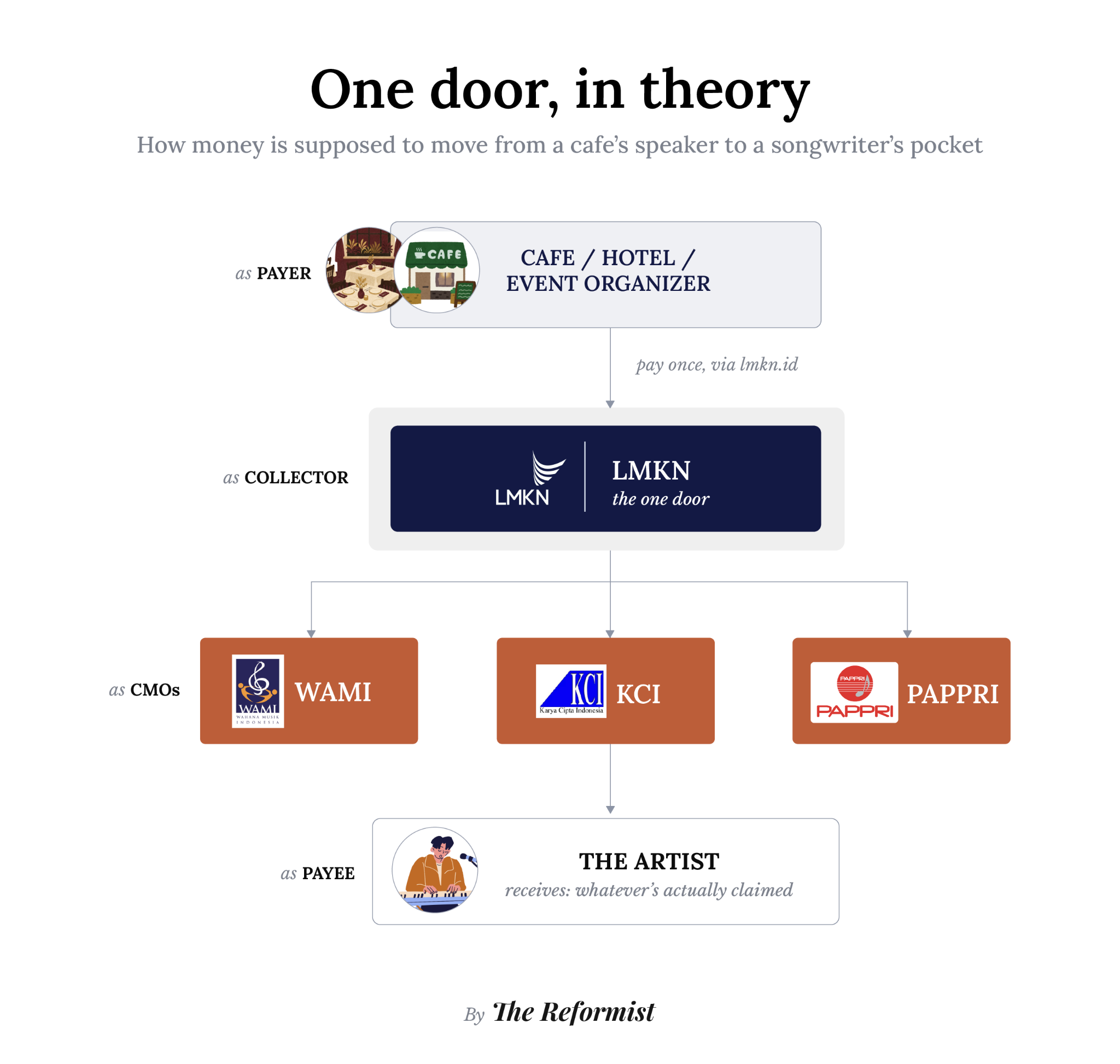
This means that if a composer or artist isn’t part of an LMK, there is no way for them to receive royalties. Once the money reaches one of the 17 LMKs, there remains a massive information gap over how the pooled money is then divided before being sent to individual artists.
LMKN officially released new digital mechanisms for distributing royalties only in April 2026. It comprises a ‘song usage system’ that counts how many times a song was played over a given year, and a ‘proxy-based’ Unlogged Performance Allocation (UPA) system for songs whose play record isn’t identifiable.
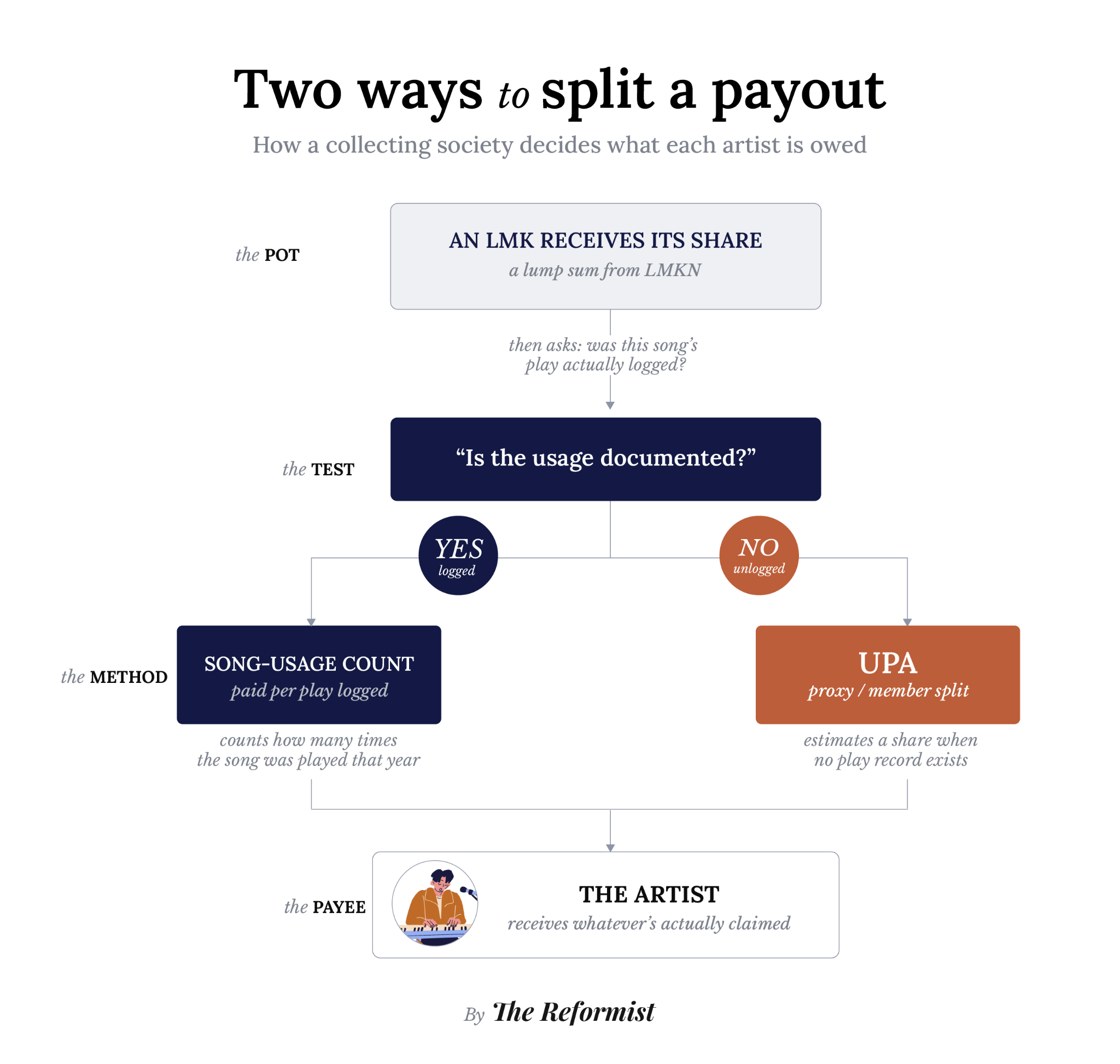
This creates greater confusion about what was exactly happening in the past. Was it the case that CMOs were distributing royalties arbitrarily?
The answer isn’t entirely clear, since information on the old distribution mechanism was never made public by any CMO. Singer Dewi Gita’s experience in 2024 over her minuscule royalty earnings compounds this confusion, even for individuals in the industry.
“It only says, for instance, that my song ‘Penari’ was only played 1 percent throughout 2024, and then I receive [a check for] Rp 150. That’s all… There’s no breakdown of where that 1 percent is from, what area, what scope,” said Dewi, describing a royalty statement that gave her a percentage — of which was unclear — and a payout with no indication of how that figure was calculated.
Another case in point was House member and singer-songwriter Melly Goeslaw’s, which shows how erratic this opacity could get. In March 2025, she received Rp 559 million in royalties. Four months later, in July, a payment for the same general catalog came in at just Rp 4.9 million.
Melly took the swing in stride publicly to press for structural change, explaining that “It’ll only feel good once the royalty governance is done right, transparent, and accountable.”
With the amount of backlash directed towards the agency, a degree of self-moderation, or at least self-realization, has begun to spread within the LMKN body.
LMKN supervisory board member and legendary composer Candra Darusman was quoted this year saying that refining how royalties are collected and distributed remains a priority, arguing the real challenge isn’t collecting the money but making sure it reaches the right rights holder through accurate data.
LMKN was a good reform, in theory
The irony is that the LMKN is a sound reform on paper. Compare it to the United States, where the music industry runs on an oligopoly of competing private CMOs, meaning that any commercial venue that wants to legally play music has to identify and pay licensing fees to all of them, since there’s no way to know in advance which organizational body represents which artist. Indonesia’s model sidesteps that mess entirely with one managing entity, which has failed to live up to expectations.
The question of whether this new digital distribution system will work or not remains to be seen. But the fact that it is difficult even for sitting House members to gather information on their own royalty dues suggests a systemic problem that has gone unnoticed by the public eye.
Performing rights at the heart of the problem
Royalty disputes in the music industry generally fall into one of three buckets:
Mechanical rights, which cover the reproduction of a song, pressing it onto a CD, licensing it for a streaming platform’s catalog.
Synchronization rights, which cover the use of a musical work in visual media, a film, an ad, a TV show.
Performing rights, which cover what is messiest in Indonesia’s case. The public performance of a song, whether through the radio, a cafe’s speaker system, or an artist singing it live on a stage.
It’s the last category in which nearly every fight this piece has traced so far actually lives.
For small-scale commercial spaces like cafes, pubs, and restaurants, there’s no way for the LMKN to track which individual songs are actually being played, so a blanket fee exists instead: a flat charge that pools royalties collectively rather than billing per song.
Larger events follow the same logic at a bigger scale. Event organizers pay LMKN a blanket fee relative to the size of the event itself: two percent of ticket sales for paid shows or total operational costs for free ones. The graph below shows the different fees commercial venues are charged by the LMKN.
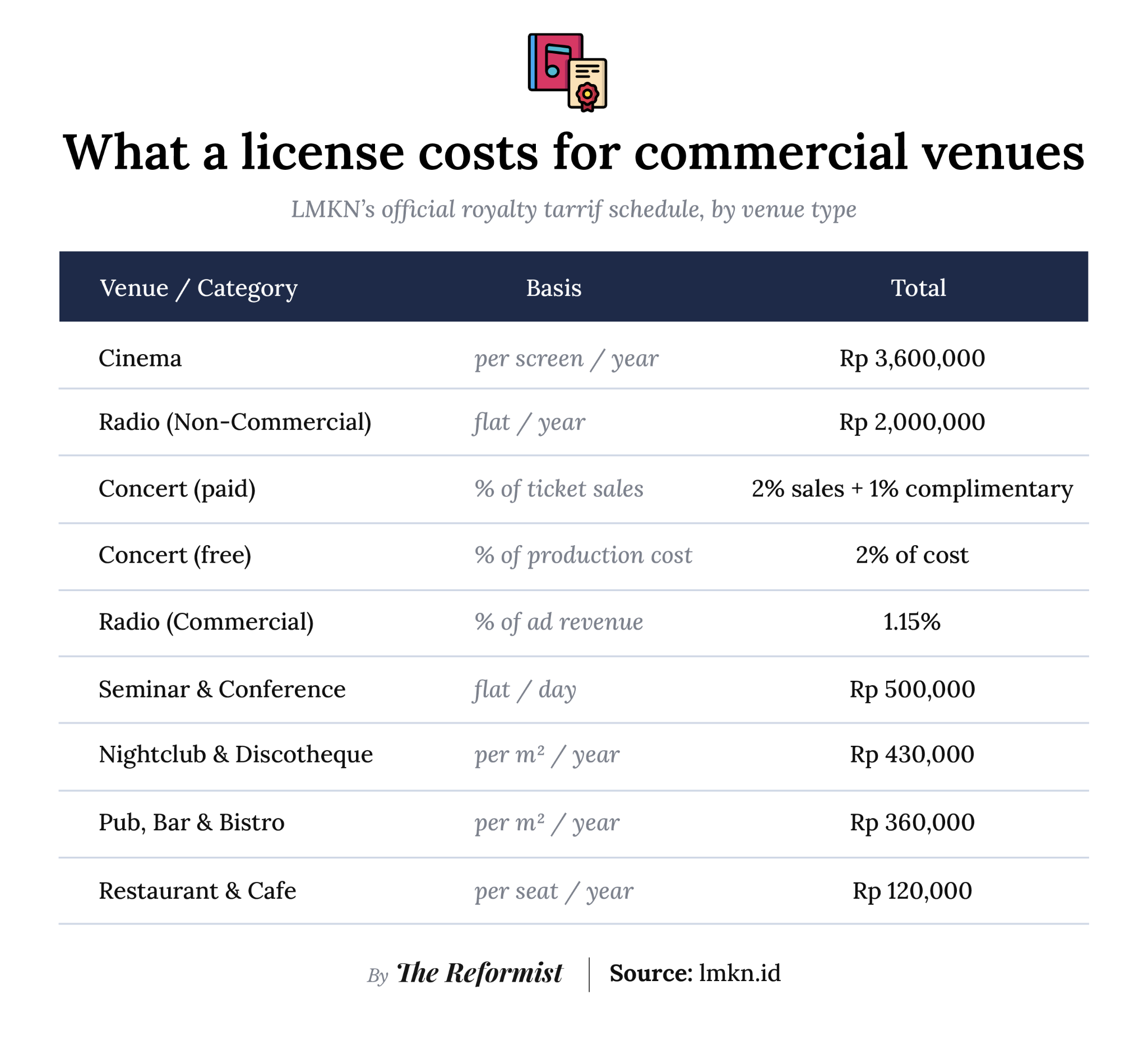
In a perfect world, once that money is collected, the LMKN and the LMKs beneath it are supposed to document exactly which songs were performed, so the correct copyright holders receive the correct share. But much like how distribution schemes aren’t made public by CMOs, neither are the mechanisms for collecting performing rights royalties (we couldn’t find any kind of reports on LMKN’s official sites).
The high-profile Nuansa Bening dispute
LMKN’s incompetence in settling performing rights disputes is best highlighted in the massive legal case between the late singer-songwriter Vidi Aldiano and music composer Keenan Nasution that we’ve mentioned at the beginning of this article.
Keenan, co-writer of the song Nuansa Bening — first released in 1978 — alleged that royalties from Vidi’s 2008 cover had gone unpaid for over 17 years. He filed a lawsuit over 31 concerts in which Vidi performed the song live, demanding more than Rp 24.5 billion in reparations.
Keenan argued that Vidi and his legal team failed to ask for explicit consent to perform the song in live performances. While the case was dropped in March, following Vidi’s passing, a Constitutional Court review of the Copyright Law late last year reaffirmed the Law for everyone that royalties for live performances are legally owed by event organizers, not by the performer.
So, in a case built on 31 individual concerts, 31 separate event organizers were each independently responsible for paying Keenan’s royalties, with no single body confirming whether any of them actually did so. This is compounded by the fact that Keenan only joined a CMO in 2022, making it all the more difficult for any performing rights royalties to be sent to the composer.
We are not here to decipher the intentions behind Keenan’s lawsuit, but his choice to take legal action against what he believed to be close to two decades’ worth of unfair economic redistribution indicates a glaring bureaucratic inefficiency in the country’s royalty distribution governance.
This performing rights dispute between Vidi and Keenan is the pandora’s box for a larger ideological dispute taking place in the country’s music industry.
The case for a decentralized rights regime
But centralization through LMKN isn’t technically the only model on the table. Article 81 of the 2014 law already permits creators to license their work directly to a user, bypassing the LMKN altogether, a mechanism known as direct licensing. Strangely, the Article remained unfamiliar for years, even to music industry players.
When Gerindra politician and ‘Dewa 19’ frontman Ahmad Dhani was asked about his thoughts on the Copyright Law, Dhani explained that he only found out about the possibility of direct licensing eight years after the passage of the 2014 Copyright Law. “I met Minola Sebayang, who explained that performers or songwriters could apply for a direct license. I learned about it eight years later, in 2022,” said Dhani.
If the country’s lawmaker and most vocal direct licensing advocate didn’t even know the option for it existed until nearly a decade into the Law’s passage, it says something about how buried the provision has been beneath the status quo.
Other countries have built systems that treat direct licensing and collective management as complements rather than rivals.
In the US, the Copyright Act of 1976 explicitly recognizes direct licensing contracts, and federal consent decrees prevent CMOs from blocking artists who choose to license their own work independently.
The United Kingdom takes a similar approach. PRS for Music remains the dominant collecting society, but the Copyright, Designs and Patents Act 1988 preserves a creator’s right to manage licensing on their own terms, particularly for large-scale digital and commercial use.
Australia goes further. The country’s antitrust institution, the Australian Competition and Consumer Commission (ACCC), advises that collective licensing agreements should never impede copyright holders’ ability to engage in direct licensing agreements.
It’s not hard to imagine what a system like that would have meant for the legal dispute between Vidi and Keenan. Vidi’s rendition of Nuansa Bening was a career starter for the late artist, lighting the way to what would be years of success as a solo artist. Perhaps a direct-licensing framework would have let the two settle the matter between themselves, a straightforward agreement over a single song, rather than an entire dysfunctional ecosystem.
The messy politics behind music
Beyond the Vidi-Keenan dispute, the broader music industry feud is split between two camps (performers vs. composers) over how royalties should be regulated in the country.
The VISI organization — comprised mostly of singers like Ariel Noah, Armand Maulana, Raisa, Bunga Citra Lestari, the late Vidi, Bernadya, and many more — belongs to a group that believes royalties should continue to be pooled and distributed through a single entity like the LMKN.
On the other side is AKSI, an organization of old-timer music composers like Ahmad Dhani, Keenan Nasution, and Fariz RM that believes copyright holders deserve greater licensing rights and economic compensation for the usage of their work outside the centralized LMKN system. Disgruntled by the current system and unfair economic redistribution policies, this camp has grown frustrated over the centralized status quo.
In August last year, Ahmad Dhani joined a House meeting held by Commission XIII — which handled regulatory reforms — to discuss royalties with Ariel and members of VISI, despite being a member of Commission X, the cultural sector of the House.
Last year, the VISI clique, led by Armand and Ariel, filed the judicial review that helped the late Vidi push the legal battle in his favor. The Court partially ruled in their favor, affirming that royalties from commercial performances are owed by event organizers rather than individual performers. Moreover, the Court ruled that consent for live performances is not required, provided dues are paid to the LMKN.
What is most intriguing about the royalty discourse is that these lobbying activities in the House became so active, in part due to the sheer number of the country’s singers who have turned to politics.
Dhani’s former Dewa bandmate and sitting Indonesian Democratic Party of Struggle (PDI-P) lawmaker, Once Mekel, is not only a party in opposition to Dhani’s Gerindra, but sits across from him in the royalty debate. Dhani backs the direct-licensing crew, while Once backs the centralized LMKN model.
The feud between the two started all the way back to 2023, when Dhani demanded the former Dewa vocalist either stop singing Dewa’s songs in live concerts or pay Dhani royalties each time he performed them.
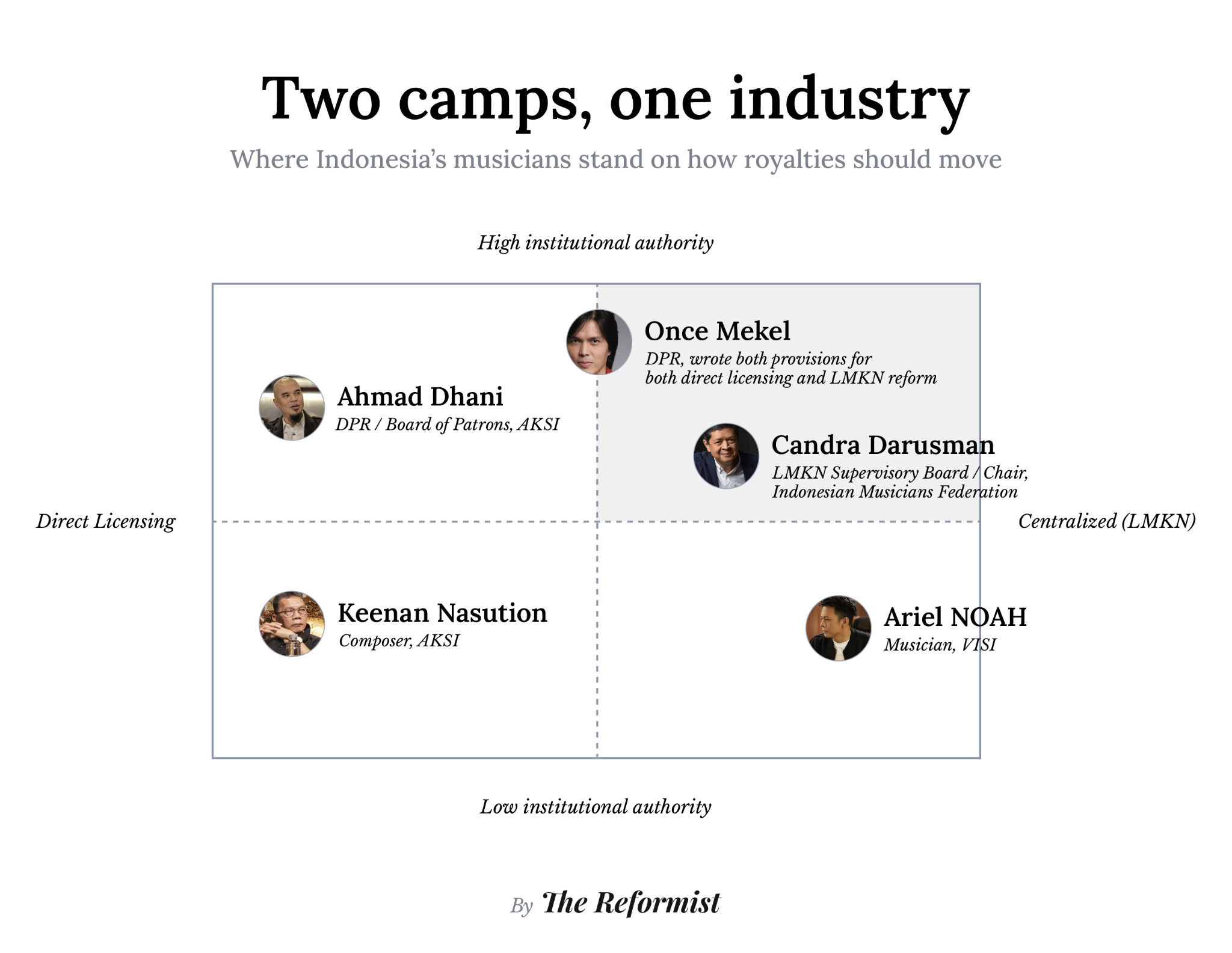
Like the VISI group, Once argued that event organizers are responsible for paying their dues, as they are often the ones requesting singers to perform certain songs, at least in his case. In March, Once reaffirmed his stance on a centralized model following discussions on the Law’s revision, but is also in agreement with Dhani that there should be stronger provisions governing direct licensing agreements between singers, composers, and rights holders.
From the way deliberation is shaping up in the House, it appears that the centralized model leads the ideological caucus in revising the Law. In August last year, Deputy House Speaker and Gerindra politician Sufmi Dasco Ahmad — informally known as the fixer in the House — put his foot down, stating that royalties would continue to be centrally controlled through the LMKN, while also affirming that the agency would be audited simultaneously for greater transparency.
What should be done to tidy up this mess?
As the House looks to finish a revised Copyright Law, it must ensure the mess from LMKN’s lackluster royalty distribution governance and transparency, or rather lack thereof, is tackled.
We at The Reformist are in the camp that it would be a shame to get rid of the LMKN system entirely. The bureaucratic hassle of a completely decentralized model could discourage the creative industry, with singers becoming selective of song choices in performances, wary of legal disputes and picking a fight.
There’s a beauty in artists paying homage to their peers, whether of the present or the past. Overly policing their ability to sing the country’s rich catalog in fear of persecution will not fare well for the overall creative ecosystem.
At a smaller scale, without a pooled model, small artists and composers with little bargaining power could find it difficult to collect royalties without costly legal and bureaucratic fees.
But this isn’t to say that a decentralized model should be ignored entirely. Other countries have proven that direct licenses can work in tandem with a pooled system. Perhaps with a precedent in place, legal disputes like the one between Vidi and Keenan’s could be resolved and handled without one party suing the other for billions of rupiah.
Despite ideological differences within the music industry, they both agree that structural reforms must take place within the LMKN body.
Deliberations on the revised Law have now been taken over by the Legislative Body (‘Baleg’) of the House since the start of the year, with Committee XIII of the House assigned to lead the formulation process alongside the Directorate General of Intellectual Property (‘DJKI’) of the Ministry of Law. The draft supposedly called for the creation of a National Collective Management Committee (‘KMKN’), a centralized body that will govern the country’s royalty collections and distribution.
How this agency will differ from the LMKN is still a complete mystery. It appears to serve the same purpose as the existing agency, and it is unclear whether the LMKN will be replaced or work alongside it.
There is also a new detail in the draft bill that hints at where lawmakers’ attention actually lies. In Article 29 of the bill, it proposes a “royalty endowment fund” to hold a portion of payments for works whose creator can’t be identified, whose ownership is disputed, or that draw on traditional cultural expressions with no single owner at all.
In other words: a preemptive measure for hypothetical disputes in the future.
That said, instead of repurposing the same ‘solution’ of creating a new agency every time something doesn’t work, we think the lawmakers should look into:
fixing what already exists by revitalizing the LMKN and the CMOs beneath it instead of replacing it wholesale; and
expanding provisions for direct licensing, not as a replacement for blanket licensing but as a supplement for specific cases.
A performer like Vidi, requesting a direct license to cover one song from a composer’s catalog, wouldn’t have eliminated the need for blanket licensing elsewhere. It would have instead settled that one dispute in advance.
Until then, royalty disputes will always be a matter of when, not if. The new Law presents crucial momentum to get things right, but perhaps the bigger question is: Who does copyright law actually want to protect?
Now go ahead. Cue the music in and let’s sing the rest of that Nuansa Bening chorus.
Taylor Swift trailblazing copyright discussions worldwide… truly an icon. What a great piece! I genuinely didn’t know this was the condition in Indonesia!