

Our previous edition explored the music industry’s political economy, full of personal feuds, ideological splits, and fiery legislative hearings. All because of the government’s chaotic approach to music royalty distribution.
The piece makes it clear that the ongoing royalty debate is rooted in ownership. Who owns the right to a musical creation? Who gets to benefit from it? How do we make sure the economic gain reaches the rightful owner? Between the performers and composers — including some who now sit in the House of Representatives — it’s hard to really pick a side because both seem to have good arguments for their respective cases.
While we’re not done figuring that out, the ownership debate is about to get messier — or rather, it already has — as artificial intelligence (AI) enters the copyright battlefield.
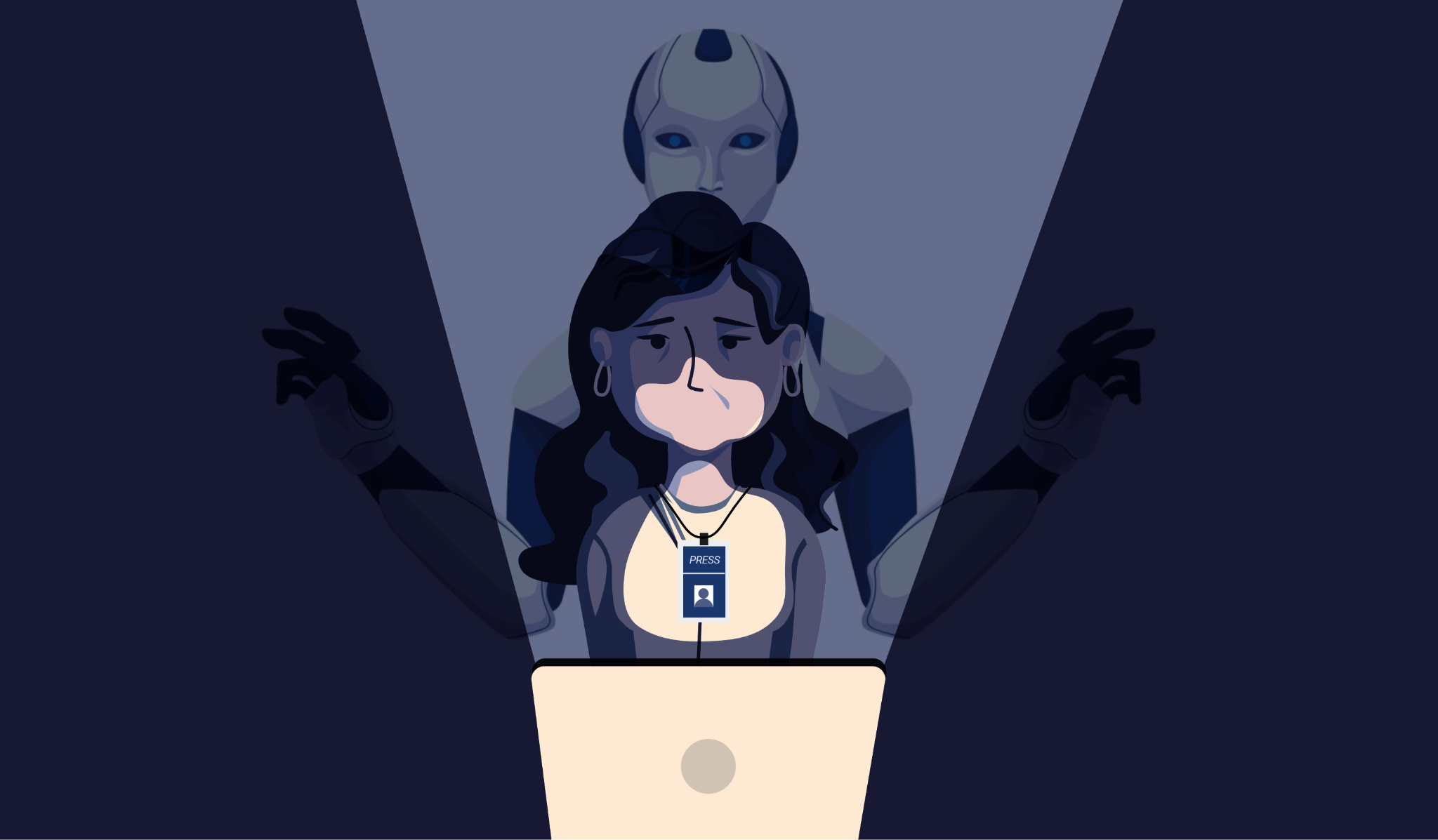
Musicians, journalists, and other creators alike have raised concerns about how generative AI can produce writing, artwork, and even music in the blink of an eye. Whether these AI-generated works compare to those that went through the human process of trial and error (and frustration, as we experienced while writing this piece) is irrelevant. The concern isn’t simply that creators have to compete with AI in the creation process, but also about ownership of a creation and the economic value it brings, including in derivative form.
The main questions are deceptively simple, but more complicated once you go below the surface.
The first is on input. Can an AI company copy and process copyrighted work to train a model without permission from its original creators? Second is on output. When an AI model produces something new, at what point does that output reproduce or infringe on the work it learned from? Third is on authorship. If humans use AI to create something new, how much human contribution is needed before an AI-generated output can itself receive copyright protection?
Indonesia’s ongoing effort to revise Law No. 28/2014 on Copyright (‘Copyright Law’) grapples with all three questions at once. However, the most politically contentious question that we have been able to gauge so far concerns mostly the first problem: who gets to benefit economically when copyrighted work becomes an input into commercial AI systems? What started as an attempt by House lawmakers to fix music royalty governance has now shifted toward striking the right balance between protecting creators and publishers and keeping the development and legitimate use of AI technology from becoming prohibitively difficult.
We have heard it all. AI is dangerous. AI is changing the way we live. AI is reshaping our societies. And most fundamentally: AI is taking jobs away from humans. But while these worries are not unfounded, we believe a key debate is missing: how the ethical and financial concerns around AI translate into specific, enforceable rights, duties, prohibitions, and remedies for humans and our societies. Refusing to do so may not serve our interests. Remember the pushback against the World Wide Web at the turn of the millennium? Yeah… that didn’t exactly work in our favor now, did it?
In this edition of The Reformist, we attempt to shed light on these dilemmas. Can AI use copyrighted works freely without disrupting the economic rights of creative work, including journalistic outputs? If AI companies must pay to use copyrighted work, what distribution model is most appropriate? How do we define AI’s fair use, and what lessons can lawmakers take from other countries on how to govern it?
Let’s get right to it. Into the unknown!
I. Economic rights in the AI age
The proposed revision of the Copyright Law has drawn attention to how the government will begin regulating AI use. With AI-generated content flooding the internet, musicians and legal experts have also called for additional safeguards to protect the economic rights of creative works from AI’s alleged illicit use.
This is where things get blurrier, as AI legislation, even across the globe, is new, uncharted territory that lawmakers everywhere are still improvising their way through.
Journalists have become an outspoken, influential force in the bill’s discussion. The Press Council has called for lawmakers to make AI companies pay royalties for training their AI models on journalistic work.
The catch is that journalistic work does not currently sit outside the Copyright Law altogether, which is the case for ‘written works’ and ‘photography’ (Article 40). But the law doesn’t construct a distinct economic right for journalistic work to have its own category when used to generate output by AI models.
This matters because the revision should not end with granting journalists copyright. It’s about defining more clearly what counts as a journalistic work and which economic rights media companies may hold or exercise. Most importantly, it’s also about when AI platforms must obtain permission and/or pay royalties.
Other countries have begun experimenting with royalty licenses that let AI companies legally use copyrighted work, albeit more in the music industry than in journalism. STIM, Sweden’s largest music organization, for example, launched the first AI royalty license last year to combat the surge of AI-generated music in the country.
Interestingly, it isn’t a blanket license.
STIM negotiates it with each AI company, splits it into separate layers for training and generation, and requires a new license every time a model is retrained. AI companies must use a STIM-approved attribution provider that traces which recordings and compositions influenced any AI-generated output and reports that back to STIM. Companies must ensure third-party payments for generated music are collected and passed through, and commit that AI output won’t erode the royalty pool that pays conventional musicians.
AI-generated music is also barred from entering Sweden’s music charts, creating a clear distinction between what is and isn’t AI content. In January, this ruling came into effect when the Swedish song “I Know, You’re Not Mine” (Jag vet, du är inte min), with millions of streams, was erased from Sweden’s top 50 songs after it was revealed that the song was wholly AI-generated by a group of Danish AI engineers working under the pseudonym ‘Jacub’.
Perhaps more interesting, Indonesia already has a similar ministerial regulation. Under Law and Human Rights Ministerial Regulation No. 15/2024, book publishers can receive royalty payments when AI models are trained using their work.
While there is no record of this regulation’s effectiveness, national legislators could use this sectoral ruling as a starting point to develop AI regulations at a larger scale.
II. In search of a fair compensation model
Scaling this regulation appears to be the government’s interest. The most recent versions of the bill (not officially released to the public) show that journalists are finally on track to receive the compensation they have demanded for years. In July, Law Minister Supratman Andi Agtas reinforced this sentiment, claiming that “journalistic work is one form of copyright that must be protected.”
Now that journalists’ demand is acknowledged, a more nuanced question has surfaced: how should they be compensated?
From the publicly available October version of the bill, it appears a centralized collections model will prevail, using the same model used for music royalties, in which right holders would join a Collective Management Organization (CMO) to negotiate, collect, and redistribute them.
But as we discussed in our previous edition, this model hasn’t proven to be the most effective or efficient. Music composers have felt disenfranchised by the opaqueness of a centralized distribution model, instead calling for larger provisions for a direct licensing model that would guarantee greater economic compensation.
Horror stories from the music world seem to have spread among journalists and other parties affected by the Law’s revision.
While a centralized model is practical and, in theory, more redistributive —allowing even small news publishers to receive compensation — both journalistic advocacy groups and tech platforms affected by the Law’s revision have publicly opposed a sole centralized mechanism.
The Alliance for Independent Journalists (AJI) and the Indonesian Digital Media Association (AMSI) have called for a hybrid model that blends centralized collection with the freedom to license their work directly.
It is perhaps an odd position for publishers to hold since a centralized system is the version of the bill that at least guarantees everyone something. But AJI and AMSI’s calculus is that the biggest platforms, the ones capable of paying real money for real traffic, are exactly the ones with the leverage to negotiate directly, and a mandatory CMO risks capping what those negotiations could otherwise yield — especially in the age of AI, where digital traffic for news has reportedly dropped by as much as 70 percent.
Then again, this is an existential debate over whether journalistic work is considered public or private goods, but that is a debate for another day.
On the other side of the lobby is Google. In June, the tech giant released a statement opposing the bill, arguing it would force platforms to depend on a centralized, government-linked institution rather than the direct commercial partnerships it already runs. That objection resurfaced a month later, when Google representatives met with Deputy Communications and Digital Minister Nezar Patria, reportedly pushing for the bill to explicitly preserve business-to-business licensing as an option that can run alongside, not just underneath, the centralized system.
Google’s objection therefore seems more about the government monopolizing compensation terms than the compensation itself. A mandatory collective mechanism would shift bargaining power away from tech platforms and media companies, forcing them to go with the common licensing architecture the government has set. Preserving business-to-business (B2B) licensing, by contrast, allows both media companies and tech platforms to negotiate prices and terms directly.
No lawmaker has — at least not publicly — argued that tech companies shouldn’t pay their dues. The devil, as they say, is in the details. Who will come out the victor in the tug-of-war between centralized and decentralized royalty regimes?
But making AI companies pay shouldn’t be conflated with regulating the growing AI industry. The question is — also posed by journalists — what can AI companies use for free before any compensation obligation applies?
III. The fair-use debate
Indonesia’s Copyright Law does not explicitly use the term ‘fair use’. Instead, it lists specific limitations and exemptions that determine when copyrighted material may be used without permission. This sounds somewhat similar, but it’s not.
Articles 43 and 44 of the law cover the requirements to give ‘attribution’ for the use of current news for the specific purposes of education, research, academic activity, news reporting, archiving, preservation, and more. But giving attribution does not make copying lawful. Depending on which limitations and exemptions are being cited, what matters most is whether the use of copyrighted work prejudices the reasonable interests of its original creator and rights holder.
Because the law was written before generative AI existed, it raises difficult questions about AI training. Whether training AI models constitutes “research” or another form of “fair use” is the crux of the debate among lawmakers and the many parties with an interest in this matter.
In the the current publicly available draft of the bill (October 2025), ‘penggunaan wajar’ or ‘fair use’ is now explicitly defined as “the use of a work without prior permission from the copyright holder, provided that such use does not harm the reasonable interests of the creator or copyright Holder, and serves purposes of education, research, criticism or review, news reporting, parody, or other non-commercial purposes consistent with the principle of fairness.”
It certainly reads more as a copy of the previous version, now with a new name stamped onto it. But this is not just a textual change. Where the House goes from here will shift the architecture of Indonesia’s copyright regime quite significantly.
Article 59 states that “training material for Artificial Intelligence models shall be subject to the provisions on fair use or to an agreed license,” meaning that the bill would allow interpretations that AI’s use of copyrighted works can be considered fair use to an extent. But if the bill doesn’t define the limitations well, we’re pretty sure this provision will be a culprit in many future royalty disputes.
“Why?” you may ask. Well, for one, the chronic royalty dispute between music composers and performers is a strong indication. To be blunt, if the government has yet to figure out a way to regulate royalty payments in the music industry, which is complex but nowhere near as unpredictable and ‘unknowable’ as AI, how can we be sure that they’re actually looking at this from the best vantage point?
During a working session in December 2025, the House’s Legislation Body (Baleg) was still arguing over how to define “fair use” in the revised bill. Prosperous Justice Party (PKS) and Baleg member Ledia Hanifa Amaliah pointed to the central debate over whether the bill wants to approach fair use as an ‘exemption’ norm — which is how Articles 43 and 44 of the current law are written — or as a ‘positive’ norm — which is more akin to the American legal doctrine of fair use.
While Ledia mentioned that the bill’s proponents lean towards writing fair use using the positive approach, Indonesian Democratic Party of Struggle (PDI-P) lawmaker Once Mekel, a proponent of this bill, initially to reform music royalty, suggested that fair use should clearly define the limitations of what is considered ‘non-commercial’, such as education, research, voicing criticism, and reasonable quotation.
What Once described is more similar to the way it is currently governed, in a form of ‘limitations and exceptions’, as governed in international copyright regimes such as the Berne Convention and the TRIPS Agreement. This contradiction signals confusion among the lawmakers themselves.
Another takeaway from this discourse is that if AI training were classified as fair use, companies would have no legal incentive to negotiate a license with copyright holders. We’re no psychic, but rushing the bill feels like it will guarantee a future full of disputes between journalists, media, and tech platforms — the same way composers, performers, and event organizers have been for decades.
The global search for legal precedent
In the US, the battle over fair use has been divisive, with crucial lessons for Indonesian lawmakers. It offers a useful comparison because even in the US, where the copyright debate between AI platforms and copyright owners has already materialized into legal disputes, much remains to be determined. US copyright law applies what it calls the ‘four-factor’ fair use test, and several recent cases have begun asking how it applies in AI training.
Two particular cases in 2025 from the US Court for the Northern District of California resulted in victories for AI platforms on the ground that the use of copyrighted work is considered “transformative”, meaning that it doesn’t serve as a substitute for the original work it was trained on, but neither established a general rule that training generative AI on copyrighted work is always fair use.
We saw this reasoning applied in Bartz v Anthropic in June 2025, where Anthropic’s use of copyrighted books to train its AI platform Claude was found to be fair use because the output was “spectacularly” different from the source material. The court reasoned that “everyone reads texts, too, then writes new texts,” an act that a copyright holder cannot prohibit other parties from doing. However, Anthropic settled, paying US$3,000 to 482,000 authors — a total of US$ 1.5 billion, the largest copyright recovery in history, according to the plaintiffs’ lawyer — because it used pirated copies of those books to train its AI.
But that ruling did not set a singular precedent. In Kadrey V Meta, decided by the same district court that same month, the presiding judge dissected the same fair-use question. It ultimately sided with Meta because the authors sued the tech company without building their case on what the judge considered to be a stronger argument: sufficient evidence that training on their books could let Meta’s AI flood the market with new competing titles, potentially crowding out the human authors whose work made that flood possible.
This is because fair use can only be attributed to activities that do not harm a copyrighted work’s economic and market value, and the court made it clear that damage doesn’t require the AI to copy a book, only to out-compete it. For example, if an AI model has impacted a book’s overall sales and a plaintiff can prove a direct link, the court could rule against AI companies for violating fair use principles.
Closer to home, Singapore took a more explicit statutory route before the AI boom, having amended its Copyright Act in 2021 to introduce a computational data analysis exception, which allows the use of legally obtained copyrighted works for text and data mining as well as machine-learning training.
The unprecedented rise of the AI industry then led the Singaporean government to consider whether its updated regulations were sufficient to safeguard the country’s intellectual property. On 26 August 2026, the Singaporean Law Ministry stuck with its initial judgment. They announced that any legally obtained work used for AI training is considered fair use. A big legal win for the tech industry, but a gut-wrenching blow for creatives. However, it is also a good sign that Singaporean lawmakers are treating the issue as worth revisiting as the context evolves.
In contrast, the European Union (EU) has built a far more stringent AI regime. Under the EU AI Act, enacted in 2024, the region has opted for a transparency-based regime rather than restricting AI-created content. The Act contains an impressively large list of regulations for such a nascent industry.
First, providers of general-purpose AI models must adopt and publish a policy for complying with EU copyright laws — comprising 13 directives and 2 regulations — and commit to identifying and respecting any rights reservation a creator has attached to their work. This means a copyright holder can withdraw their work from AI training if they wish (‘opt-out’), which is interesting to us as it gives the right holders the agency to make their own decision.
Second, AI companies must prepare and publish a sufficiently detailed summary of what they trained their models on, using a template the EU’s AI Office provides. Third, under a transparency rule, providers must mark AI-generated content — text, images, audio, video — in a way that’s machine-readable and detectable as artificially generated.
It’s worth being precise about where these rules actually sit, because the AI Act didn’t invent Europe’s approach to AI training and copyright. The “opt-out” standard, which lets a rights holder withdraw their work from being used as training data, comes from the EU’s 2019 Copyright Directive, which already carved out an exception allowing text and data mining unless a rights holder explicitly reserves their rights against it.
The regulation’s effectiveness is evident today. In early August, Anthropic, the company behind Claude, released a press release stating that any content generated by Claude’s AI model — text, images, videos — will be watermarked in response to the EU’s Code of Practice on Transparency of AI-Generated Content. Anthropic announced that it will implement this directive worldwide, not just for EU users.
IV. Where does Indonesia go from here?
Indonesian lawmakers have plenty of external regulations to benchmark against as they decide what kind of AI fair use regime to implement. As we’ve established, however, the question is a lot more complex than whether the government is pro-AI company or pro-creators.
One option would be to place the burden primarily on AI platforms. Require them to obtain permission from copyright holders for every instance their work is used to train AI models. This would give copyright holders control over how their work is used, but at a price tag that could stifle AI advancement and innovation.
Another option could be to look at the EU: allow certain cases by default, but give copyright holders a legally enforceable opt-out mechanism to retract their work from training models. This lowers the initial cost for AI companies, which should, in theory, incentivize more innovation, but in practice it may be more complex, requiring multiple legal frameworks rather than one.
The other option would resemble Singapore’s broader exception regime, in which the starting point is lawful access rather than individual permission. Combine this, say, with collective or sectoral licensing — such as Sweden’s STIM experiment — but individual negotiation would effectively be impractical.
If you take only one thing away from these examples elsewhere, we hope it’s that this entire AI–human copyright debacle is far more complex than simply collecting payments by default for every instance where copyrighted work is used in training AI models.
AI is a growing industry, and we likely don’t yet know its full extent. As such, it requires an adaptive legal and policy framework that can adjust as needed. Any new legal changes introduced in the upcoming revision of the Copyright Law must take this into account. After all, we know how tedious the legislation process can be in Indonesia, and while the momentum is here, let’s make sure we actually get this right. Otherwise, we’ll end up playing catch-up, revising the law every time AI technology hits a new milestone and throws us another curveball.
If you are a journalist, musician, writer, or artist, we would like to hear what your take is: Where do you stand on AI’s use of copyrighted creative works? Drop in the comments below!
Credits
Writer: Rayhan Kalevi
Editors: Nea Ningtyas, Nathaniel Rayestu, Ravio Patra
Visual designer: Liana Tan