


In our previous edition, we asked why Indonesia’s decentralization feels like a myth. Why, despite the autonomy, have our localities not succeeded economically? We argued that centralized fiscal structures have largely disincentivized regional governments from creating any meaningful economic growth for their respective localities. But what if one of our regions does have a special privilege over most and is actually allowed larger fiscal autonomy? Would it be more economically successful?
These questions have been asked more frequently in the wake of last year’s Sumatra disaster. Many viewed the government’s response as slow and inadequate, including us. But a major debate particularly ensued on the old-age motion of whether the primary duty ultimately falls on the central or local government. In Aceh, specifically, this debate struck a nerve given its special autonomy status.
To answer these questions, we took a closer look at the special autonomous region of Aceh. In theory, it should be the antithesis of our proposition that decentralization is a myth. It has greater ‘autonomy’ by law, enacts Sharia Law, has its own local political parties, and is even allowed to represent itself in international sports competitions separate from the Indonesian national team.
Quick context
After decades of bloodshed and separatist ambitions, the Free Aceh Movement (GAM) and the Indonesian government negotiated in Helsinki, Finland. With the historic Helsinki Memorandum of Understanding (MOU) in 2025, Indonesia did not just agree to an administrative ‘anomaly’. Jakarta’s decision to grant Aceh special autonomy did not just end decades of armed struggle for independence, but redefined what it means to be a united republic.
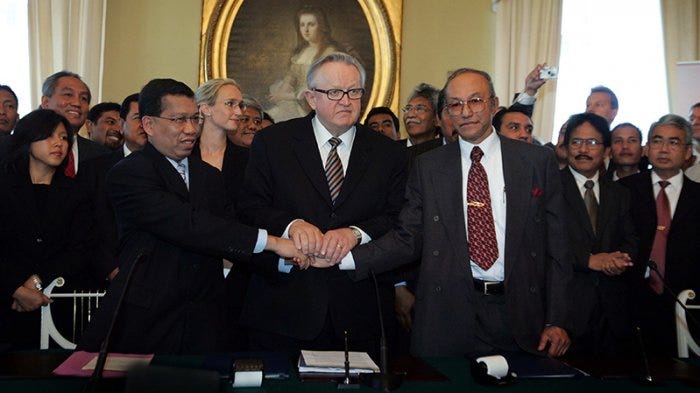
The following year, these commitments were codified under Law No. 11/2006 on the Governance of Aceh (’UUPA’). This became the constitutional backbone of Aceh’s special autonomy.
With UUPA set to be revised this year by the House of Representatives, we believe it would be helpful to look back at what has happened over the past 20 years—what worked and what didn’t—to ensure that any changes made by the House uphold the values of Aceh’s long march towards decentralization.
I. Hyperlocal politics, beyond Sharia Law
Most people know Aceh for being one of the only administrative regions in the world that enacts Sharia Law. Yet, there is so much more to it, including a political landscape that allows for a level of self-governance found nowhere else in Indonesia.
While Sharia Law is a significant pillar of this identity, mentioned 34 times in UUPA, another distinctive political feature of Aceh is the right to establish and field local political parties.
Local Political Parties
The Aceh Party, founded in 2007 and the political vehicle for a majority of former GAM combatants, has dominated the local legislature, consistently gaining a plurality in Aceh’s Provincial Legislative Council (DPRA) since local legislative elections were held in 2009.

Of the four Aceh governors who have come to power since 2005, three were former senior GAM officials, and all were fielded by local parties. This includes incumbent governor, Muzakir “Mualem” Manaf, who was GAM’s commander-in-chief during the height of the insurgency in the early 2000s and became Chair of the Aceh Party since its inception in 2007 following the Helsinki MOU.
If there is one success that can be attributed to the peace treaty, it is its ability to shift the way former rebels demanded political change, away from the battlefields and into the local political structure.
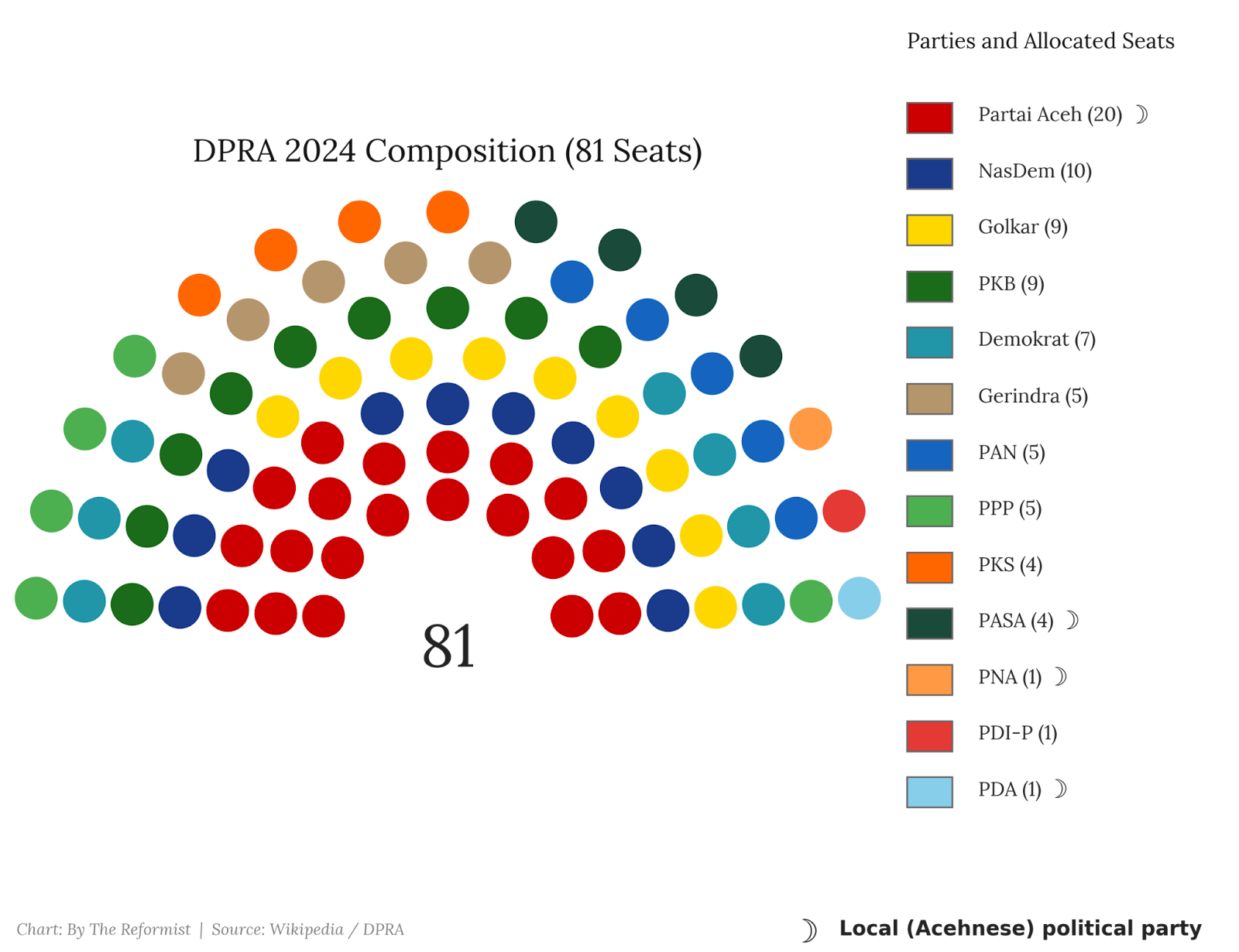
This raises the question of whether a similar model could be applied elsewhere in Indonesia. While not tested at scale, this decentralized model provides a more direct channel for societal aspirations that often get diluted within the default framework offered by ‘national’ political parties.
Qanun and the Wali Nanggroe
Administratively, the province is governed similarly to other provinces in the country. The governor leads the executive branch, while the DPRA drafts local regulations (‘Perda’), known as qanun in Aceh. While other localities base their regulations on the 1945 Constitution (‘UUD’) and laws (‘UU’), qanuns are shaped by Sharia Law and local customs. Under Article 23 of the UUPA, the DPRA possesses sole authority in drafting qanuns, with the governor acting as a deliberating partner.
The province also has a special customary body, the Wali Nanggroe, which is led by a senior Acehnese figure of high standing. Its mandate is given under Article 96 of the UUPA to protect the unity and integrity of the Acehnese people.
While the role of Wali Nanggroe remains symbolic, its creation is an important prerequisite in the Helsinki peace talks.
Twenty years on, the presence of local political parties and the Wali Nanggroe is now fully entrenched within Aceh’s version of democracy. By restoring traditional terminologies (e.g., subdistricts to Mukim and villages to Gampong), Aceh ensured the integration of its historic identity into the present. Culture and customs that were once repressed are now able to take center stage. That said, these cultural victories have yet to translate into functional governance and material gains for every Acehnese to enjoy.
II. The rights to woo foreign investors
From the outset, the UUPA grants several autonomous rights allowing for greater Acehnese representation abroad. The provincial government is not only allowed to create and seek economic partnerships with foreign institutions, but also represent itself in international cultural forums and sports competitions, as well as regulate its own foreign investment.
Article 9 (1): The Aceh Government may establish cooperation with foreign institutions or agencies, except for those falling under the authority of the Central Government.
Article 9 (2): The Aceh Government may participate directly in international arts, cultural, and sporting activities.
Article 165 (2): The Aceh Government and regency/city governments, in accordance with their authority, may attract foreign tourists and grant permits related to investment in the form of domestic investment, foreign investment, exports, and imports, while observing nationally applicable norms, standards, and procedures.
Presidential Regulation No. 11/2010 further regulates international cooperation between Aceh and foreign entities, granting them “full power” to finalize overseas partnerships independent of the Indonesian Foreign Ministry. Meanwhile, Article 186 of the UUPA allows Aceh to seek external loans from outside Indonesia, albeit with the central government as an intermediary and prior approval from the Finance and Home Ministries.
As a caveat to this newfound freedom, the provincial government is prohibited from managing and engaging in cooperation that is “national in nature,” which includes “foreign policy, defense, security, justice, national monetary and fiscal matters, and certain matters in the field of religion.”
But despite its special autonomous rights, foreign direct investment (FDI) remains significantly low.
Source: GRDP, FDI (FDI values were converted to IDR at January 1, 2024’s exchange rate of Rp 15,510/USD)
In 2023, Aceh’s FDI to Gross Regional Domestic Product (GRDP) ratio of 1.7 percent ranked 23rd among Indonesia’s 38 provinces. Legal uncertainty, pervasive corruption, central government overreach, and ambiguity over how foreign capital aligns with Sharia Law continue to constrain its economic growth.
III. Special fiscal structure
Extractive sector revenue-sharing
The UUPA prescribes a special revenue-sharing scheme for the exploitation of Aceh’s vast oil and gas reserves.

To an extent, the creation of GAM could be attributed to Aceh’s historic inability to claim credit for its own natural resources. As this grievance paved the way for a structural overhaul of Aceh’s finances, reclaiming a favorable revenue split with Jakarta became a non-negotiable prerequisite during the Helsinki peace talks, eventually granting Aceh a 70-percent share.
Yet, even with these hard-earned concessions, oil and gas revenues contribute an insignificant amount to Aceh’s regional income in the present day, accounting for only a pitiful 0.6 percent of Aceh’s total budget.
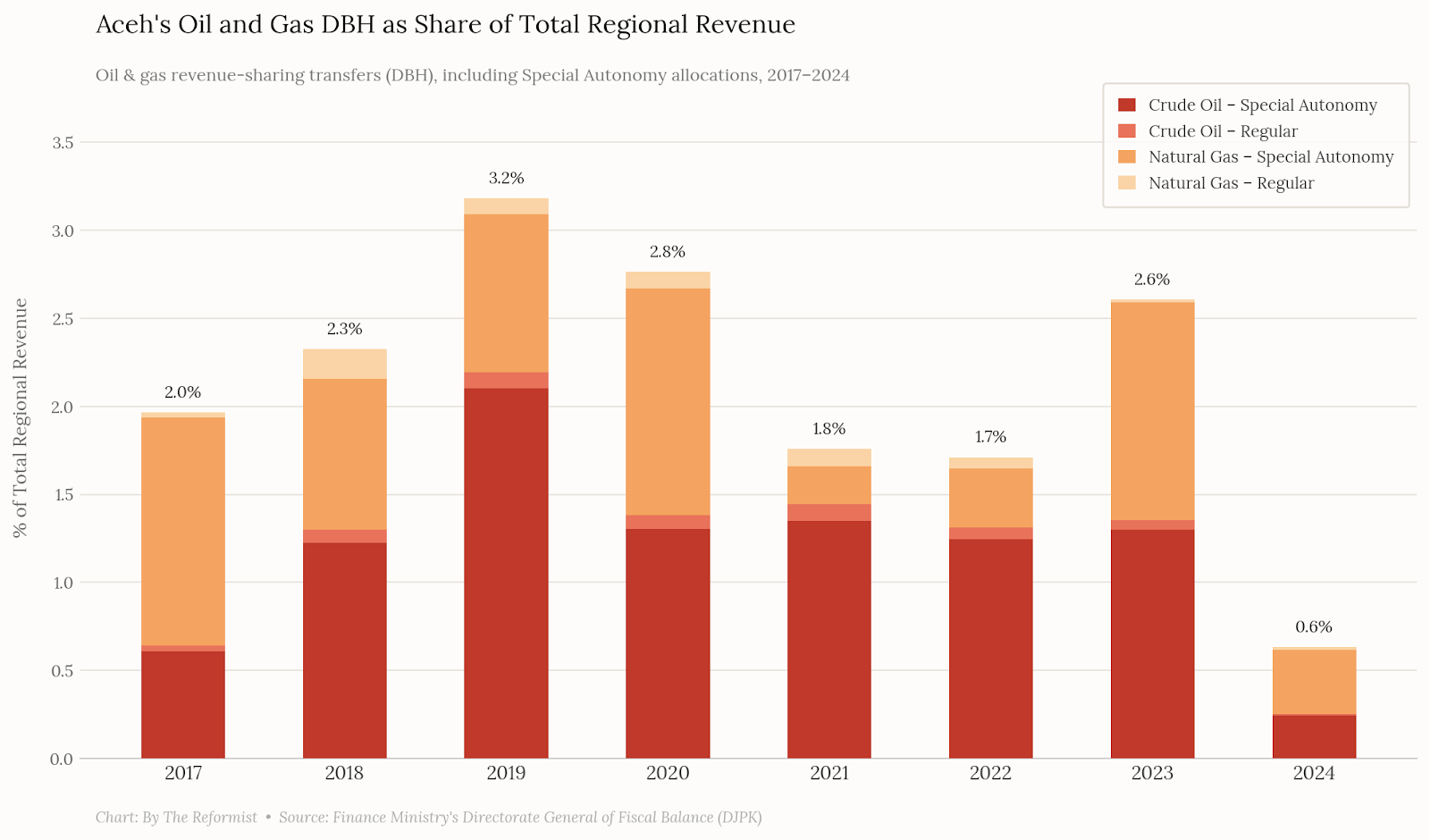
Aceh must face the reality of its resource trap. As natural reserves deplete, the energy sector no longer provides a significant boost to the local economy.
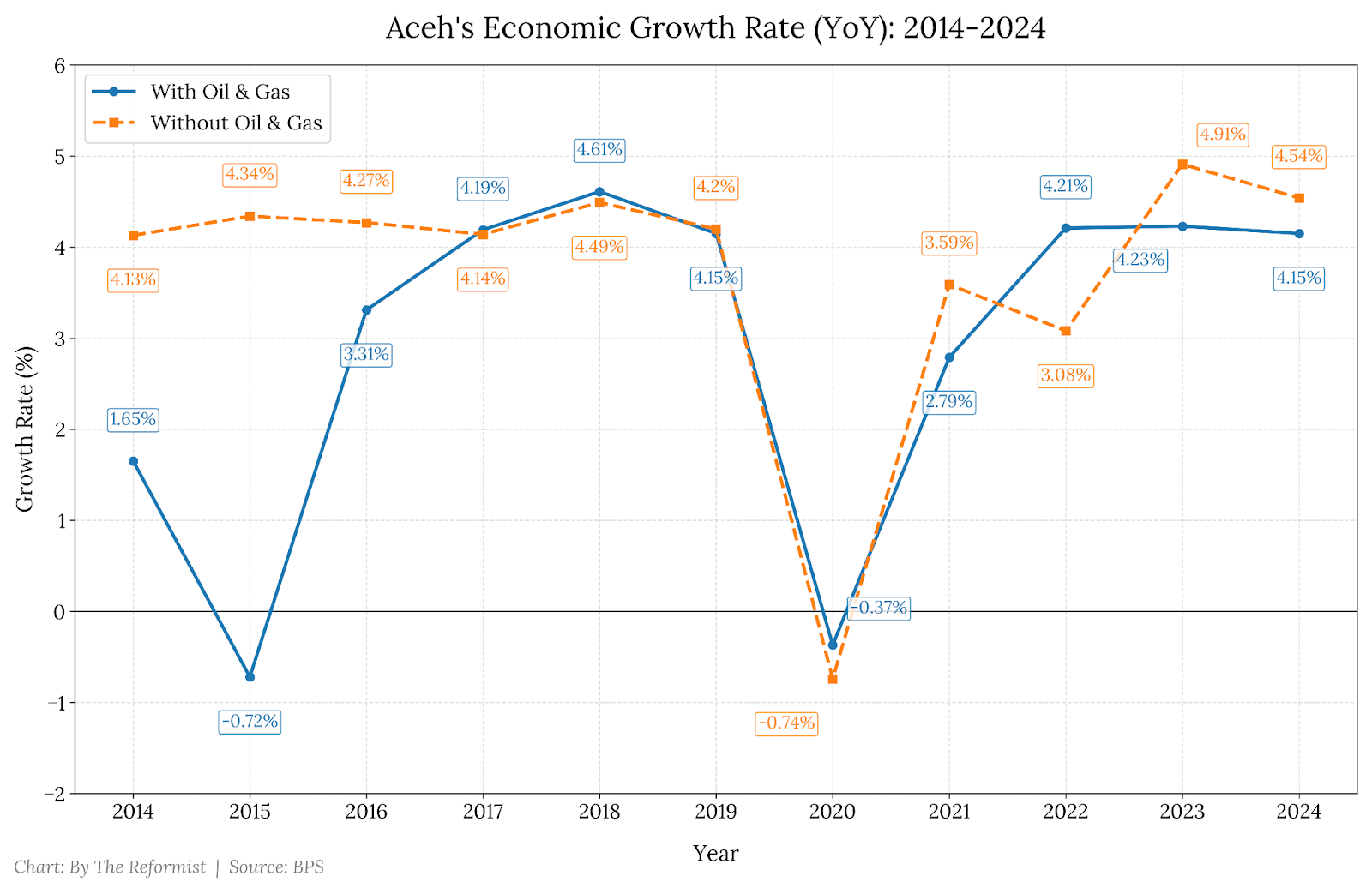

Over the past decade, economic growth excluding oil and gas has performed better than with it included. Even when growth is larger with oil and gas, its effect on the overall economy is minimal at best. Except for 2022, when oil production exceeded the annual target, oil and gas production have dragged the local economy significantly.
Simply put, Aceh’s extractive sector is shrinking faster than the rest of the economy is growing. Diversification is therefore essential if Aceh wishes to realize its economic potential, especially considering how much oil and gas prices fluctuate in the global market.
Special autonomy fund
The true backbone of Aceh’s economy lies in its dependence on central government aid. On top of the normal central government cash transfers (‘TKD’), Article 183 (2) of the UUPA guarantees 20 years of special autonomy fund allocation from the national budget. These comprise an equivalent of 2 percent of the state’s general allocation fund (DAU) for the first 15 years and one percent for the final five years.
The special autonomy fund has profoundly shaped Aceh’s public finances to this day. In 2022, the final year of the two-percent allocation, the province generated Rp 13.7 trillion in local revenue. Of that amount, Rp 7.5 trillion (54 percent) came from the special autonomy fund. When the allocation was reduced to one percent the following year, Aceh’s annual revenue fell by approximately Rp 3 trillion.
For Aceh to become sustainable moving forward, it must find ways to maximize the different provisions endowed to it in the UUPA. It simply cannot rely solely on the special autonomy fund if it wishes to truly be self-governing.
But Jakarta is hardly an innocent party here as it uses the special autonomy fund to exert control on the local government apparatus.
Jakarta’s encroaching hand
It is important to preface that Aceh’s 20-year development cannot be separated from its proneness to natural disasters. After ratification of the UUPA in 2006, the local government only began inheriting the economy from the Aceh-Nias Reconstruction and Rehabilitation Agency (BRR) in 2009.
Since then, Aceh’s economy has grown steadily, albeit rather slowly, at around 4 percent in the last decade. Significant work remains to truly realize Aceh’s unfulfilled potential, especially on these three stubborn problems:
Pervasive corruption
Nothing illustrates systemic corruption in Aceh better than the case of Irwandi Yusuf, its first directly elected governor post-Helsinki. In 2018, during his second term in office, Irwandi was arrested by the Corruption Eradication Committee (KPK) in a high-profile sting operation. He was convicted of accepting bribes and embezzling over Rp 42 billion, including from the special autonomy fund.
The absence of technocrats
However, “bad actors” only account for half of the story. The second hurdle is a lack of technocratic capacity within Aceh’s bureaucracy. While the peace treaty successfully moved former combatants from the battlefields to the bureaucracy, it did not automatically endow them with the technical expertise required to govern and develop the region. Most especially, the province lacks economists and practitioners capable of implementing long-term development programs.
Half-hearted decentralization
As established in our previous volume, Jakarta tends to half-heartedly grant true autonomy to local governments. Aceh is no exception, even with its special autonomy. Over the last decade, a wave of centralizing national regulations quietly chipped away at Aceh’s special autonomy. In 2013, then-President Susilo Bambang Yudhoyono threatened to revoke Qanun No. 3/2013 for using the GAM symbol in Aceh’s official flag. It was eventually revoked by the Home Affairs Ministry in 2016 without prior consultation with the DPRA.
Jakarta’s “invisible hand” came into play again in the saga of PT Emas Mineral Murni (PT EMM), which received a 10,000-hectare gold mine concession across Nagan Raya and Central Aceh in 2017 from the Investment Coordinating Board (BKPM).
Using Law No. 23 of 2014 on Local Governments (‘UU Pemda’), Jakarta bypassed Aceh’s local authority, arguing that it possessed complete authority to issue permits for foreign investment. The DPRA viewed this as Jakarta undermining Aceh’s special autonomy as mandated by Article 156 of the UUPA.
In 2019, the controversial Omnibus Law on Job Creation was opposed by the local labor force on the basis of Qanun No.7/2014, which provided fairer work hours to Acehnese women, bank holidays to commemorate the tsunami, different compensation schemes for bonuses, and stricter regulations on foreign workers. This, however, fell on deaf ears.
Meanwhile, Government Regulation No. 3/2015 shrinks Aceh’s autonomy by unilaterally rendering an additional 32 areas of governance as national affairs. Among others, these include land administration, education, health, environment, forestry, as well as energy and mineral resources. Central government oversight varies from leading direct implementation to setting norms and best practices for local government to comply with.
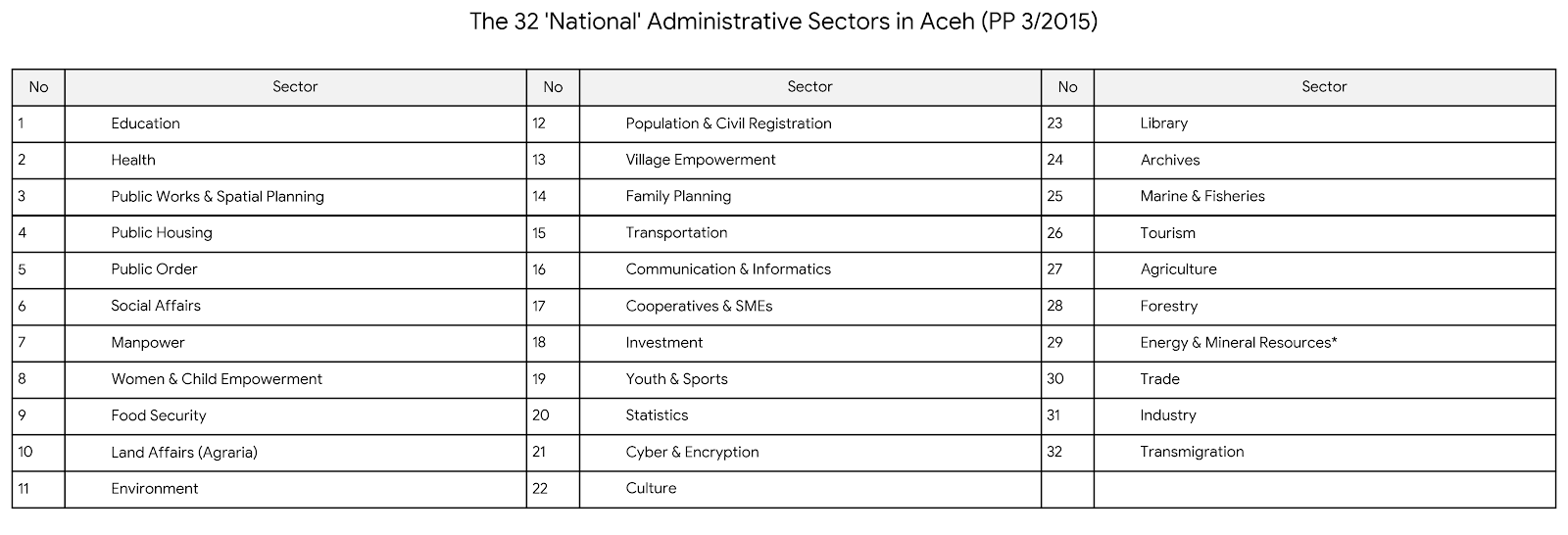
While the UUPA was a breakthrough in reimagining decentralization, Jakarta’s overreach and inconsistent regulatory approach showcase the central government’s reluctance to release its tight grip on the region.
The way forward
With revision of the UUPA already underway, the main talking point will center around Aceh’s special autonomy fund. Some factions within the House of Representatives in Jakarta will seek to reduce it, while the Acehnese government and its few allies will seek to retain it, especially as the region rebuilds after the 2025 disasters.
What we do know for sure is that any changes to the special autonomy rule must be paired with greater decentralization in practice. Jakarta needs to trust Aceh to address its corruption problem, reform its bureaucratic ranks, and attract investment within the agreed corridors.
Politically, the UUPA revision must seek to strengthen and fortify local political parties in Aceh, which have played a pivotal role in ushering peace for the last 20 years.
While nowhere near perfect, Aceh is a reminder that autonomy is possible under Indonesia’s unitary framework. And for that to continue to be the case, Jakarta must fulfill its end of the bargain and refrain from reclaiming power back to the central government.
Special mentions:
We consulted Muhadam Labolo, Chair of the Indonesian Society for Government Science (MIPI), and Rozi Beni, an alumnus from the Faculty of Law at Universitas Indonesia, to ground our analyses in the writing of this piece.