


Local autonomy in Indonesia has been under continuous attack since President Prabowo Subianto took office, from the 2025 austerity measures that devastated local budgets to the recently growing talks of scrapping direct local elections. While local governments are frequently blamed for weak and corruption-ridden governance, a more fundamental question is often ignored: are they politically inadequate, or were they never given the economic space to succeed in the first place?
Two decades ago, decentralization was hailed as a new hope for post-reform Indonesia. When students marched their way onto the steps of the House of Representatives in 1998, the call for greater political liberty was at the forefront. After decades of authoritarian rule, local governments were finally able to dictate how they wished to govern themselves and their people without the outstretched control of the central government.
After assuming the presidency in 1998, B.J. Habibie introduced sweeping reforms to stabilize Indonesia’s fragile political landscape and restore public trust in government. A year into power, Habibie introduced Law No. 22/1999 on Local Governments, giving provincial, regency, and municipal administrations greater political and, in theory, economic freedom.
Article 7 of the law states that local governments are given full autonomy to plan and formulate their own development plans aside from the fields of foreign policy, defense and security, the judiciary, monetary and fiscal affairs, and religion.
Under Megawati Soekarnoputri’s presidency in 2004, the same Law was revised to introduce direct local elections, providing local communities the right to choose their governors, regents, and mayors.
While this era of political liberalization opened new civic opportunities for the Indonesian people, economic freedom and decentralization, on the other hand, have remained a constant hurdle, as a large majority of local administrations in the country are fiscally dependent on central government transfers (TKD).
Decentralization is not a static endpoint. It’s a pendulum that swings through financial crises and political power struggles. The question we seek to answer in this piece is not whether decentralization works, but whether its implementation has honored the objective set out after Reformasi.
In this edition of The Reformist, we unearth the hidden economic realities of Indonesia’s subnational governments and the lessons Indonesia can take from an unlikely neighbor up North.
Political autonomy without fiscal capacity
The issue of economic decentralization lies in the amount of revenue that flows away from local governments and into the hands of the central government. While industries, factories, and mines are built on local land, their tax revenues are fully directed to the national government. Levies like the income tax (PPh), value-added tax (VAT/PPN), and luxury tax (PPnBM) are all managed by the central government, leaving subnational governments with no money to show for their labor.
Within the income tax regime itself, central control extends across nearly all major subsectors. Personal income tax (PPh Orang Pribadi), corporate income tax (PPh Badan), and income taxes derived from strategic sectors such as oil and gas (PPh Migas) are all collected by the national government. While portions of these revenues are later redistributed to provinces and districts through revenue-sharing arrangements (DBH, Dana Bagi Hasil), these transfers are deliberated without the involvement of local governments.
Taxes collected by the central government constitute an overwhelming majority of total government revenue, amounting to Rp 2,309 trillion in 2024, around eight times the Rp 273.15 trillion collected by all local governments combined.
The following table summarizes how taxes collected by the central government are distributed back to the localities. While the term “revenue sharing” implies fair redistribution, the real revenue-making heavyweights, the VAT and corporate income tax, are enjoyed solely by the central government.
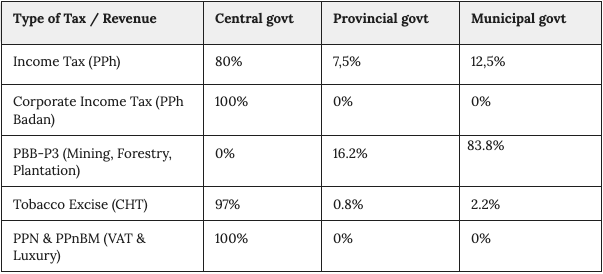
As a result, local governments are left with a narrow, commercially driven tax base for their locally-sourced income (PAD). Local governments rely on hotel, restaurant, entertainment, advertising, parking, and street-lighting taxes, alongside vehicle-related levies such as the motor vehicle tax (PKB), vehicle title transfer fees (BBNKB), and fuel taxes (PBBKB).
While local governments have also gained authority over land-based taxes such as the land and building tax (PBB) and the land and building title transfer duty (BPHTB) since 2014, these sources have been insufficient to increase fiscal autonomy—how much expenditure (not revenue) budget is available for local governments to spend at their own discretion.
What has occurred in recent times is not a reinvention of what it means to have fiscal autonomy, but a gradual erosion of resource availability. This makes localities depend much more on TKD, as was the case with President Prabowo’s sweeping austerity measures, but without a corresponding reduction in responsibilities.
The disparity between high local production and low revenues can be visualized through the graph below.
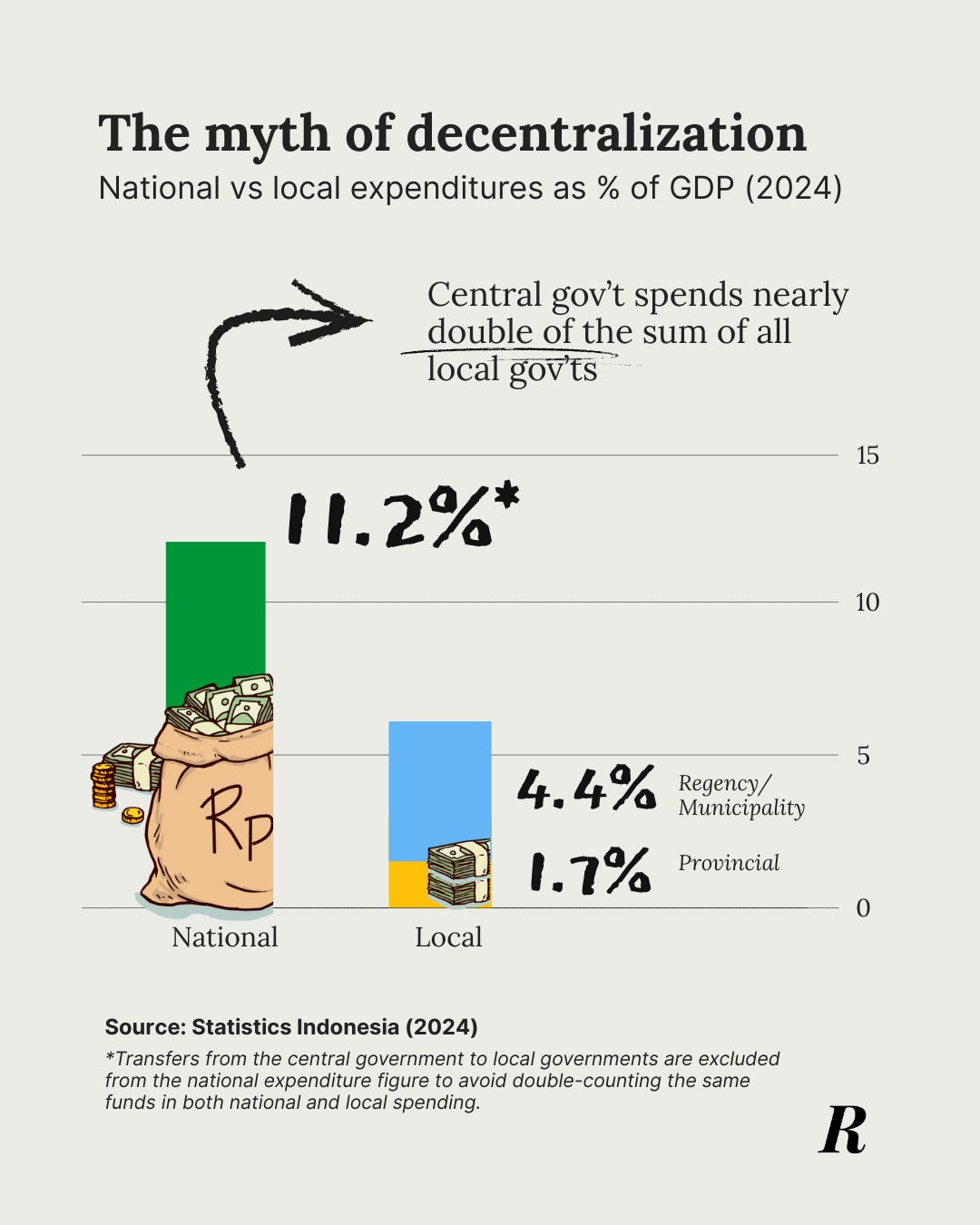
Public expenditures from all three levels of local government amount to only around six percent of the country’s total GDP. This is despite the economic activities occurring at the subnational level and the hundreds of trillions of rupiah that flow to localities through the DBH and TKD. In contrast, central government spending accounts for over 11 percent of Indonesia’s total GDP, almost double the combined local share, underscoring how fiscal capacity remains overwhelmingly concentrated in the hands of the central government.
This stark divergence illustrates the core imbalance of Indonesia’s decentralization framework: while economic activity is geographically dispersed across localities, fiscal power remains highly concentrated at the center. In other words, the current local autonomy setup effectively decentralizes political risks but not fiscal responsibility.
Without fiscal independence, politics are messy
Data from the Finance Ministry reinforces how far economic decentralization has lagged behind its political counterpart. Despite a gradual rise in average local fiscal independence, most local governments remain structurally dependent on TKD.
As of 2024, 298 out of 552 local (provincial, regencies, and municipal) administrations rely on central government transfers for more than 80 percent of their total revenues.
This structural dependence became painfully visible when President Prabowo rolled out the aforementioned austerity measures in early 2025, slashing local transfers by up to Rp 50.59 trillion from Rp 919 trillion to Rp 848.52 trillion. For many local governments, the cuts exposed how little room they had to maneuver fiscally.
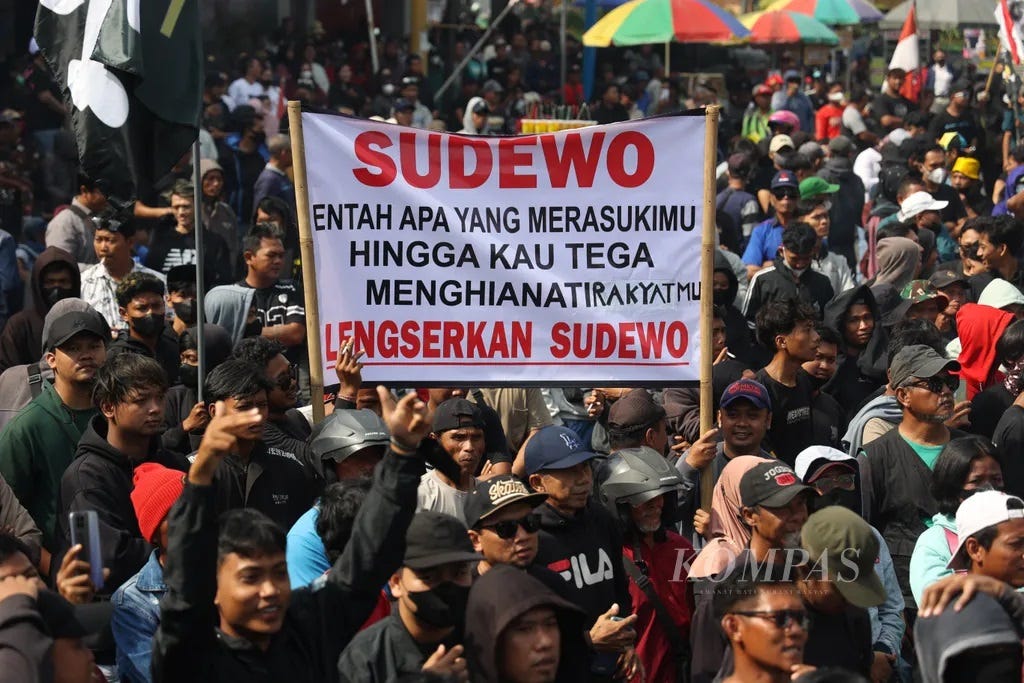
The fallout was most vividly illustrated in Pati, East Java, where regent Sudewo raised the PBB tax by as much as 250 percent after the locality struggled to meet its Rp 2.87 trillion revenue target, which largely came from already-reduced central transfers.
The tax hike in Pati snowballed into one of the largest political scandals last year when over 100 thousand protestors filled the streets calling for Sudewo’s impeachment. The protests generated nationwide sympathy and amplified public distrust of the central government’s lackluster economic policies, culminating in the August 2025 demonstrations.
Instead of reconfigurating its fiscal policies, the 2026 APBN has reduced local transfers even further, falling to Rp 693 trillion. While the current administration has framed these measures as necessary “shock therapy” for poor-performing local administrations, they are unlikely to resolve Indonesia’s long-term structural problems.
If anything, President Prabowo’s approach signals a renewed inclination toward economic centralization rather than a serious push to strengthen local fiscal capacity.
Economic decentralization, the Chinese way
Critics have often labeled local governments’ economic dependency on the central government as a mere symptom of the unitary system under which Indonesia operates. A federal system is often seen as a just alternative, given its foundation on greater separation of powers. In the United States, each of the 50 different states is allowed to enact its own set of taxes and regulate intrastate commerce.
While the system has its merits, improving local economic autonomy doesn’t have to begin with such a drastic constitutional overhaul. A more pragmatic set of lessons can be drawn from Indonesia’s giant neighbor to the north: China.
China is a unitary, authoritarian one-party state that often finds itself at odds with the West. Yet, at the same time, it is one of the most economically diverse and dynamic countries in the world. Following Deng Xiaoping’s “Opening Up” reforms in 1979, China experienced decades of rapid growth, driven in no small part by reforms that reshaped the fiscal relationship between Beijing and its provincial-level governments.

Under China’s economic model, local governments are strongly incentivized to grow their own economies. Provinces and cities retain substantial portions of locally generated revenues and are encouraged to attract foreign investment, expand industrial bases, and increase employment.
Local administrations are even permitted and encouraged to seek foreign investment abroad, equipped with their own foreign affairs delegation. The more companies, industries, and investors that enter a locality, the greater its fiscal returns. This makes local governments thrive economically, though we acknowledge that there is a separate debate to have on democratic accountability.
In one example from last year, a local delegation from the export-heavy Zhejiang province was sent to the United States to seek business opportunities for its local industries, despite growing geopolitical tensions between Beijing and Washington over tariff disputes.
Funnily enough, Aceh province’s special status allows the country’s westernmost locality to do just this.
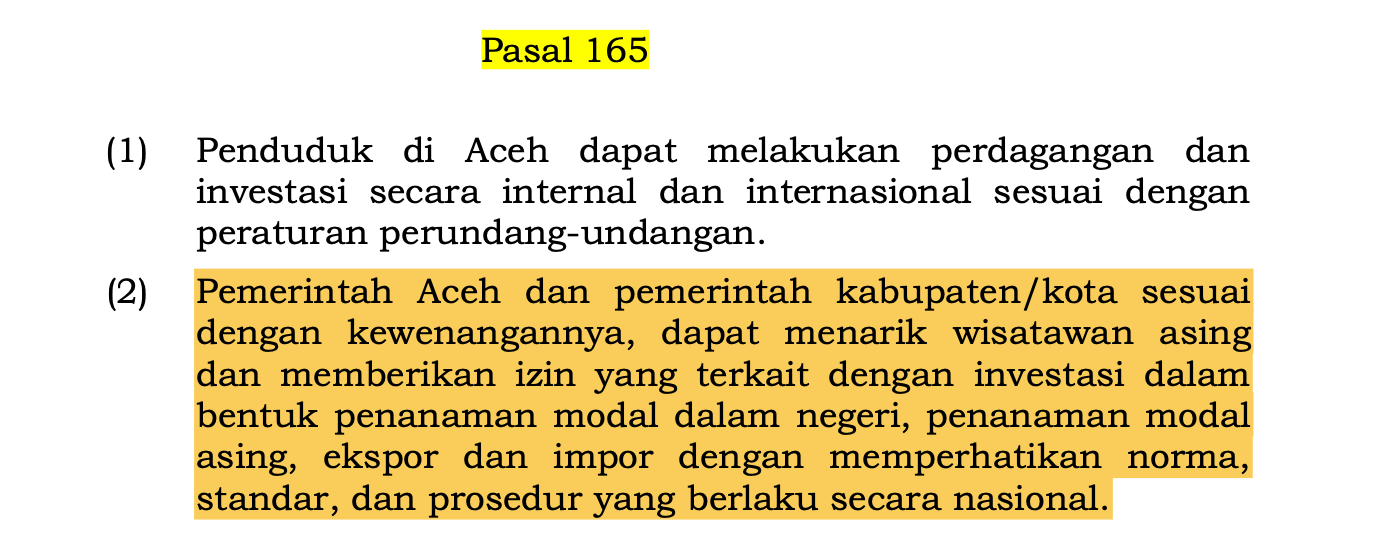
Under Article 165(2) of Law No.11/2006 on Aceh, the provincial Aceh government is legally allowed to “attract foreign tourists, and issue permits related to investment in the form of domestic investment, foreign investment, exports, and imports, while observing nationally applicable norms, standards, and procedures.”
We will reserve our analysis of Aceh for now. Stay tuned for our next volume, where we will be covering Aceh’s special autonomous status, 20 years on. Be sure to subscribe!
Indonesia’s local governments do control a wide range of commercial-based levies. which contrasts with China’s far greater emphasis on industrial-based taxation. Through its 1994 tax reform policy, China’s local governments were introduced to new levies like the urban real estate taxes, housing taxes, state-owned land-use taxes, cultivated land occupation taxes, and deed taxes.
They also benefit from a business tax, individual income tax, income tax from locally based enterprises, and profits from local state-owned enterprises, further strengthening the link between industrial activity and local revenue.
China also has a unique tax-sharing scheme, splitting VAT revenues evenly between the central and local governments. When taking into account that VAT contributes the most to China’s total tax revenue at 38 percent, it is clear that fiscal design is shaped with local governments in mind. These administrations benefit directly from expanding their economic base, creating strong incentives to industrialize.
It’s time we take decentralization seriously
Indonesia should aspire for a reality in which a regent in Nusa Tenggara Timur or a mayor in Sulawesi has the fiscal capacity to plan, invest, and innovate without depending on annual transfers from the central government. China’s model is by no means without flaws, especially noting the ongoing local debt stress, but it at least gives local administrations fiscal autonomy.
Indonesia’s opportunity is not to replicate China’s approach altogether, but to borrow its incentive scheme, so that localities could drive up local tax revenue, while carefully mitigating the debt trap. This means giving local governments both the opportunity to benefit from local economic growth and the responsibility to bear the consequences otherwise.
Without genuine decentralization, local governments will continue to operate at a deficit: accountable for service delivery without the fiscal capacity to drive outcomes. Prabowo’s growing centralization efforts certainly don’t help address this systemic hurdle.
If the President and his administration are serious about uplifting the welfare of local communities across the country, updating the decentralization model—instead of ransacking it completely—may prove far more effective in realizing Prabowo’s ambitious economic goals.
I think a big part of the problem also lies with local leaders themselves (governors, mayors, and regents). There’s a clear pattern of treating local office less as a mandate to govern and more as a career step. For some, it’s a pre-retirement “sunset career” option (which helps explain why so many candidates are already of retirement age). For others, it’s a ladder upward: serve one or two terms at the kabupaten/kota level, then run at the provincial level, and then (once they have enough clout) run for a national office, which has no term limits.
When a leader’s political horizon is framed this way (“in five or ten years I’ll need Jakarta”) then it actually becomes rational not to challenge Jakarta today even if you’re serving as mayor or governor or regent now (short-term investment for long-term gains). Taking a principled stand against central decision-makers risks alienating the very networks they’ll later need to enter the national ‘clique’. I have no solutions, but thanks for addressing the elephant in the room!
From Papua, and i thing its important to push this