

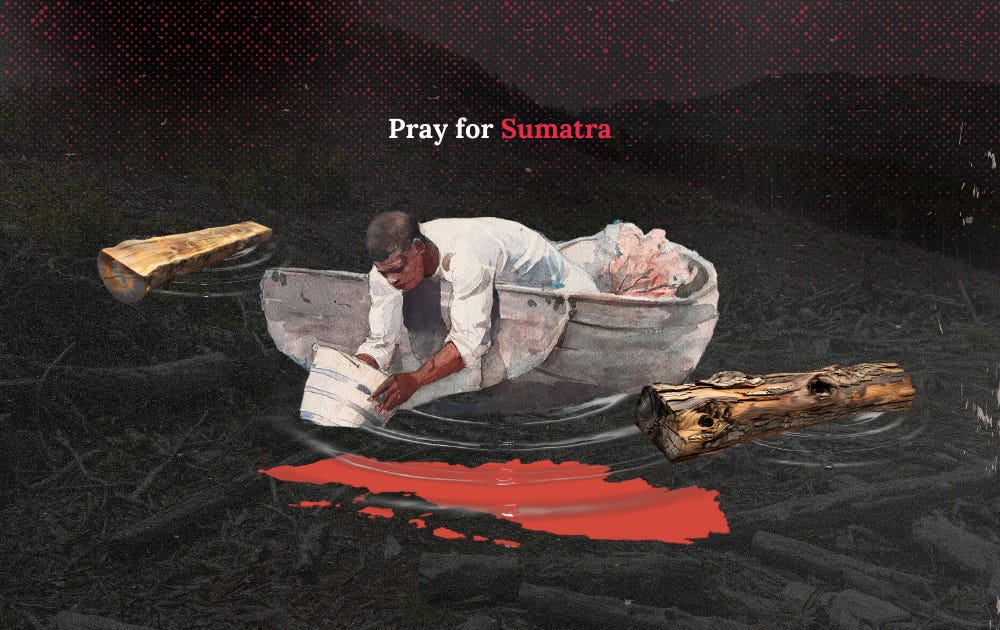
Cyclones don’t usually form near the equator, but an anomaly birthed tropical cyclone ‘Senyar’ that has triggered a series of deadly floods across Southeast Asia. The human death toll is staggering: as of 2 December 2025, nearly 1,000 deaths have been reported—708 in Indonesia, 181 in Thailand, 98 in Vietnam, and three in Malaysia; while hundreds remain missing and over one million displaced.
Based on the death toll alone, Senyar seems to have hit Indonesia the hardest, wreaking havoc on three major provinces: Aceh, North Sumatra, and West Sumatra. Sustained heavy rains, flash floods, and landslides wiped out entire villages, destroyed homes, and crippled infrastructure. The severe damage was intensified by widespread deforestation, which has removed the natural barriers that might have absorbed the rainfall before reaching populated areas.
The scale of devastation raises urgent questions about preparedness, response capacity, and ecological health. More could—and should—have been done to reduce risks, strengthen resilience, and prevent the loss of so many lives.
Today, 3 December 2025, at 13:00 Western Indonesia Time, President Prabowo will hold a press conference at the presidential palace to address the nation on this tragedy. In this edition of The Reformist, we list five key reforms that the government can and must do, from emergency relief to fundamental reforms:
1. Declare a state of national emergency
The very first order of business should be for the President to declare a state of national emergency.
Unlike Thailand’s swift response in declaring a state of emergency, Indonesia has been painfully slow at addressing the crisis. Prime Minister Anutin Charnvirakul was visibly remorseful for his government’s failure in preventing casualties and underscoring the urgency of the crisis.
Although the floods began on 25 November, it was not until 30 November that the central government initiated a coordinated response. The Head of National Disaster Management Agency (BNPB) Suharyanto admitted that he was “surprised” to see the scale of the disaster, having previously said it was not “as bad as social media made it seem.”
Some local governments have also raised white flags, declaring themselves overwhelmed amid limited capacity, budget, and their own families having been impacted by the flooding. This should have been enough to compel the central government to step in.
Yet, President Prabowo Subianto publicly stated that conditions on the ground were already improving and there wasn’t an urgent need to declare a state of emergency. After all, this disaster has already met the threshold of a “national disaster” per Law No. 24/2007: massive casualties, areas of impact, destruction of infrastructure, and economic losses across multiple provinces.
But it’s not too late: the central government can still right the wrongs of their slow early response by allocating the full capacity of the state to ensure no further casualties and provide urgent shelter, food, and relief.
2. Plan promptly to recover and reconstruct impacted areas
As relief efforts continue, the government must immediately begin planning for what comes after the waters recede. In an emotional presser, Aceh Governor Muzakir Manaf held back tears after noting that four entire villages were obliterated by the floods. In places where homes, schools, health centers, markets, and basic infrastructure used to stand, there are now only trails of thick mud. In total, more than 3.2 million people were affected, with 2,600 injured and at least 507 remaining missing.
If the political will is there, a lot can be done to recover from such devastation. There are past instances to learn from:
Following the 2018 Central Sulawesi tsunami, then-president Joko Widodo issued Presidential Instruction No. 10 of 2018 within two months. The instruction laid out a coordinated rehabilitation and reconstruction roadmap involving multiple ministries and local governments. The swift decision helped reconstruct 2,952 houses in Palu, 1,238 in Sigi, and 1,396 in Donggala; rebuild the Pantoloan and Wani international ports; and reopen hospitals, universities, roads, and bridges.
After the 2004 Aceh tsunami, the SBY administration established the Aceh-Nias Rehabilitation and Reconstruction Agency (BRR) with special authority, budget, and coordination power to rebuild from the ground up within three months, led by seasoned technocrat Kuntoro Mangkusobroto. BRR mapped the full extent of the damages and rebuilt over 140,000 houses, 3,700 kilometers of roads, 1,700 schools, 1,000 government buildings, and 36 airports and seaports in collaboration with international donors and aid projects. (Watch our conversation with then-Head of BRR Nias William Sabandar)
The government must ensure the rapid plan also encompasses not only physical reconstruction, but also comprehensive social and human recovery, including: psychosocial support (trauma healing), livelihood restoration, and guaranteed access to education for all victims.
3. Invest more in disaster prevention, mitigation, and resilience
If this disaster does not give the government a wake-up call to invest and allocate more budget to managing disasters, nothing will.
Earlier this year, President Prabowo’s austerity measures hit Indonesia’s disaster response and early warning capacities hard. Funding had been slashed for BNPB, the National Search and Rescue Agency (Basarnas), and the Meteorology, Climatology, and Geophysics Agency (BMKG), even as disaster risks escalated.
According to 2026 budget data, BNPB’s allocation will drop from this year’s Rp 1.43 trillion to just Rp 491 billion (-65%). Previously, Basarnas already saw a sharp fall in its emergency response budget from Rp 995.5 billion in 2024 to Rp 410.7 billion in 2025 (-59%). Similarly, BMKG’s budget was cut from Rp 3.114 trillion in 2024 to Rp 2.5 trillion in 2025 (-20%).
One researcher from the National Research and Innovation Agency (BRIN) has also questioned the government’s seriousness in natural disaster prevention, noting that the agency had already developed the early mid-term seasonal study of the Indonesian region (Kamajaya), a forecast system used to anticipate shifts in rainfall and extreme weather patterns to detect tropical cyclones months before their emergence.
In contrast to Indonesia’s budget cuts, neighboring Malaysia has instead pledged to increase its natural disaster prevention system by allocating RM 2.2 billion (approximately Rp 7.1 trillion) in 2026. The funds will be used to finance 43 flood mitigation projects, with 12 of them being new initiatives.
Reassessing the funding for Indonesia’s agencies shouldn’t involve comparing with neighboring countries. Indonesia is a tropical, archipelagic nation sitting dead center in the ring of fire, making the occurrence of environmental disasters inevitable, especially with the worsening climate crisis.
4. Halt new forest concessions and undo deforestation
Indonesia, including the island of Sumatra, has lost so much of its natural buffers and forest cover to rampant deforestation. President Prabowo must take urgent steps to end this and restore the much-needed natural defense system across Indonesia’s disaster-prone regions.
According to Greenpeace Indonesia, river basins across Aceh, North Sumatra, and West Sumatra are naturally narrow, steep, and deep, which give them little capacity to absorb overflow. Under these conditions, forest cover becomes the only buffer that can slow the movement of water. When rain hammers a healthy forest, the canopy breaks the fall, and the roots hold the earth. Conversely, without such canopies or roots, landslides and floods are almost a certainty.
This was evident as we watched the devastating videos of villages in North Sumatra being swallowed alive as stripped hillsides crumbled under heavy rainfall.
Decades of unfiltered extractive activities have depleted our forest cover, practically removing our natural ‘brakes’. The landslides and collapses we witnessed are not freak accidents of nature; they are the outcomes of policies that have allowed destructive industries to operate unchecked. Greenpeace estimates that less than 25 percent of forest cover remains in the three affected regions.
To this end, the government must immediately impose a moratorium on licensing in ecologically threatened areas and disaster-prone zones, reassess existing environmental and social impact assessments, and firmly revoke permits of companies that fail to comply with environmental sustainability requirements.
On the heels of Presidential Regulation No. 110/2025, which officially established the foundations of Indonesia’s carbon market, Indonesia’s delegation secured over Rp 7 trillion in carbon credits during the COP30 climate summit. The funds received from these credits must be earmarked for the protection and betterment of the country’s environment. It should not, by any means, be redirected to “greenwashing” projects that set us on a path of more tragedies.
5. Rethink how the environment and natural resources are managed
The government has to review and ensure adequate regulatory measures against land conversions for purposes of logging, oil palm plantations, mining, and other extractive industries.
Beyond issuing a moratorium, the government must rethink the existing legal and regulatory frameworks that govern land conversion, extractive industries, forest management, and spatial planning.
These include, but are not limited to:
Government Regulation (PP) No. 23/2021 concerning Forest Areas (a derivative of the Job Creation Omnibus Law), which often facilitates large-scale land clearing through mechanisms such as “forest area release” and “forest area use approval” that disproportionately favor investment over conservation.
Spatial Planning (RTRW) regulations under the Ministry of Agrarian Affairs (ATR/BPN) that govern “areas for other purposes” (APL) or natural forests that are not classified as forest estates. These regulations only loosely govern APL, leaving them vulnerable to conversion without the strict protections afforded to conservation areas.
Environmental Impact Assessment (Amdal) processes, which are a pre-requisite for all extractive activities, must be rigorously and transparently enforced. What we have witnessed in Sumatra this past week is the consequence of weak environmental impact assessment—a failure that has left many more vulnerable to disasters that could have been better mitigated.
Protecting the environment means saving lives now
This is not the first time that we have found ourselves in this situation. We have mourned preventable deaths before. We have rebuilt cities from rubble before. And we have shown the world that when leadership responds appropriately to crises, Indonesia can rise stronger than before.
We cannot afford treating the environment and climate change as afterthoughts anymore. Evidently, the choice is no longer between development today versus saving the planet tomorrow. Environmental degradation and climate change are already affecting our lives today, and the cost of ignoring it is too high of a price to pay. For that, we must act now.
Whether through reforestation programs, stringent environmental requirements for extractive companies, or restricting land use permits, our government bears the responsibility to lead Indonesia with the climate problem in mind at all times. Not out of external pressure or international standing, but for the protection, safety, and livelihoods of all Indonesians.
The victims in this disastrous episode deserve more than just our sympathy: they—we—deserve change.
Consider making your donation to s.id/pedulisumatera (via Kitabisa)
Protecting the environment means saving lives now....and tomorrow!