

The author is a Junior Planner at the West Nusa Tenggara’s Development Planning Board (Bappeda). This article is a winning submission to The Reformist Insiders Writing Competition 2026. It reflects the author’s own analysis and views and does not necessarily represent those of The Reformist.

This article is also available in Indonesian here.
Recently, the Governor of West Nusa Tenggara (NTB), Muhammad Iqbal, has frequently used the word “orchestration” in his speeches. He uses it to describe the role of the provincial government: to be an “orchestrator” that does not merely function as a representative of the central government, but also takes on a strategic role in uniting various development resources, ranging from the central and provincial governments, regencies and cities, villages, universities, the business sector, and development partners such as non-governmental organizations (NGOs) and civil society organizations (CSOs).
I think this is important for achieving effective development and well-targeted policy.
But this idea is not new to NTB. Several years ago, a similar idea was already being cooked up inside NTB’s Regional Development Planning Agency (Bappeda). At the time, Bappeda NTB was still under the command of Pak Is, a senior bureaucrat who had served across a wide range of regional agencies in West Nusa Tenggara. He initiated various programs that I later came to recognize as quite progressive, one of which was the establishment of the Partnership Program Management Unit, known by its Indonesian acronym UMPK.
When it was first formed, I thought the unit was genuinely exciting. I held high hopes that UMPK could uncover many opportunities for collaboration between the government and non-governmental organizations. Unfortunately, a classic situation that is hard to avoid in bureaucracy came to pass. After getting off to a good start, UMPK’s presence somewhat faded following a change in coordination structure.
But life has a funny way of coming full circle. For nearly two years, I watched UMPK from the outside, still holding onto high hopes for it. Then, out of nowhere, Pak Is appointed me as UMPK coordinator as he headed toward retirement.
It felt like swallowing my own words. Now I was the one carrying all the expectations I had once placed on UMPK: that the unit should be able to serve as a bridge connecting the limited capacity and resources of the government, particularly at the regional level, with the high expectations and substantial resources that our non-governmental colleagues bring, now referred to as “development partners.”
The good news is that the trend is moving in what I consider a positive direction. Development programs are now increasingly implemented by organizations outside the government. Our development partners no longer just come to criticize the government. They arrive with concrete, solution-oriented programs and significant funding they have secured from various foreign donors and domestic grant schemes.
This is precisely why Pak Is’s idea of forming UMPK as a bridge for collaboration between the government and development partners was the right breakthrough, especially given that NTB’s regional budget remains heavily dependent on fiscal transfers from the central government.
UMPK was established with five core tasks: 1) to register development partners; 2) to facilitate and support development partner programs and activities together with relevant technical units; 3) to monitor the progress of development partner activities; 4) to expand partnership networks in support of increased regional development funding; and 5) to prepare annual reports on development partner activities.
Along the way, it turned out that these tasks also supported the needs of several secretariats within Bappeda, including the Sustainable Development Goals (SDGs) secretariat and the Regional Poverty Reduction Study Team (TKPKD).
When Pak Is retired at the end of 2025, his initiative to manage collaboration between government programs and various development partner programs proved to be well aligned with the vision of the then-newly elected Governor Muhammad Iqbal.
So my hopes for UMPK’s role in NTB’s development remain alive. Now, under the leadership of a new head in NTB Bappeda, an intelligent female bureaucrat we affectionately call Bu Nelly, those hopes have not faded. If anything, they have grown stronger.
Although the unit has been renamed the Regional Cooperation and Development Partners Working Team (TKDMP), the collaborative spirit embedded in UMPK’s DNA has become a core value and a new direction for NTB. Because the new Governor carries the vision of an NTB that is “prosperous and globally recognized,” TKDMP is now involved in flagship programs with three primary goals: eradicating extreme poverty, achieving food security through agro-maritime downstream development, and building world-class tourism.
I want to share one of the flagship programs that has resonated most strongly across NTB, called “Desa Berdaya,” or Empowered Villages.
This program aims to build village self-reliance by strengthening its socioeconomic foundations through two approaches: solving existing problems and unlocking village potential. With full support from the NTB Governor, it challenges the assumption that provincial governments are rarely involved in addressing problems at the village level.
A few months ago, the NTB government held a development partner gathering forum for the Empowered Villages program. In his address, the Governor discussed why NTB remains among the 12 poorest regions in Indonesia, despite the many development partner programs that have been operating in the province for years. He argued that this is the result of a lack of orchestration, the absence of a coordinating force that enables government and non-government programs to reinforce each other and produce a comprehensive rather than piecemeal impact.
At this forum, data was collected on 52 development partners also working at the village level. So what came next? Didik S. Mulyono, a planning consultant from Yogyakarta, offered us very useful input. He suggested forming a logic model, a logical framework serving as a roadmap that explains the relationships between processes, outputs, and development impact. This framework can guide all parties in understanding how their contributions connect to the success of Empowered Villages.
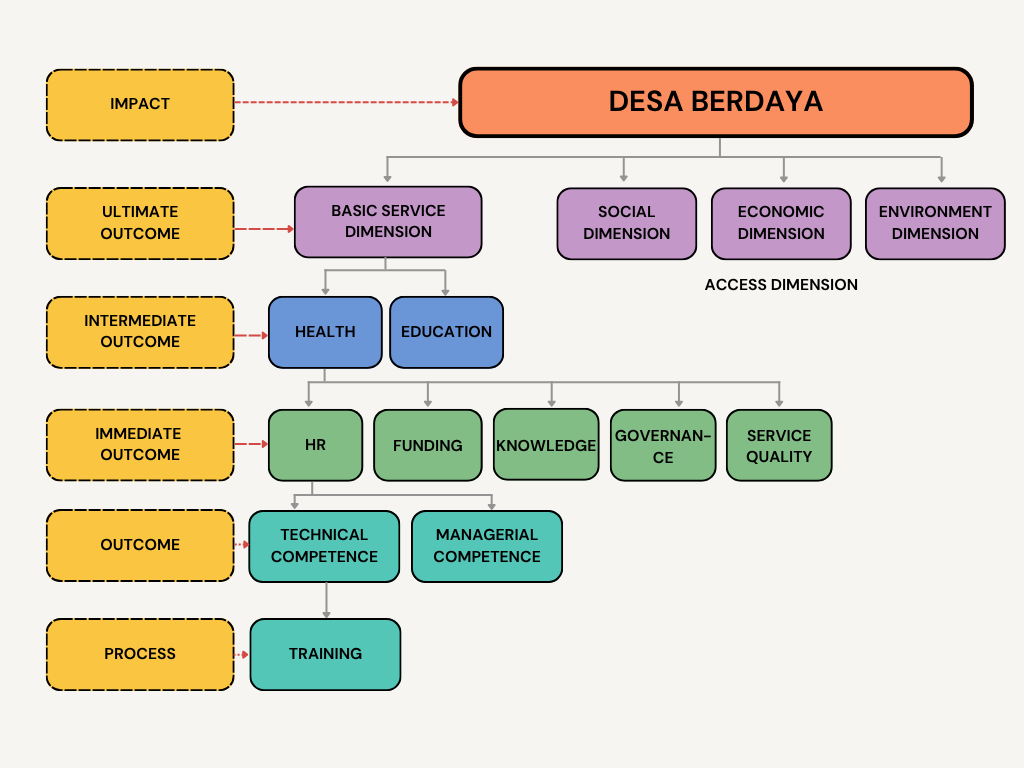
The structure looks roughly like this: with this framework, all parties involved, whether government, development partners, or communities, share a common understanding of the development direction and where their respective contributions fit within it.
Identifying the gaps, setting realistic targets
One of the strengths of this model is its ability to identify gaps. At the level of human resources, for instance, interventions often stop at improving knowledge without progressing to changes in attitude and practice.
Unfortunately, many development partner programs today only address technical aspects. Without a logical framework, these imbalances often go unnoticed. It is also important to understand that interventions operating at the process level can realistically expect change only up to the output level, not directly at the impact level. This awareness helps all parties set reasonable expectations and avoid overclaiming results.
And that is the interesting dynamic unfolding at NTB Bappeda. I find it quite reformist, especially amid the growing strain on regional budgets caused by significant cuts to central government fiscal transfers to local administrations. Now, provincial governments must remain proactive and creative in finding diverse resources to keep meeting their development targets, all in service of addressing the real and contextual problems facing the region and its people.