

The author is the writer of Notes on Nusantara. An earlier Indonesian version of this article appeared in that publication on 17 September 2026, before the budget was passed. This article reflects the author’s own analysis and views and does not necessarily represent those of The Reformist.
On 29 September, the House of Representatives passed the 2027 State Budget (APBN) into law. Finance Minister Suahasil Nazara delivered the government’s statement in plenary after only 15 days in the job.
President Prabowo Subianto swore him in on 14 September, replacing Purbaya Yudhi Sadewa. At his inauguration, the newly appointed Minister relayed the President’s specific instruction to safeguard state finances, keep the budget healthy and credible, and ensure it delivers the government’s priority programs.
“The APBN, as part of state finances, must be able to run the government’s priority programs,” said Suahasil, after being sworn in by President Prabowo, 14 September 2026.
This is the second year in a row the Finance Minister was replaced while the House deliberated the next year’s draft budget (RAPBN). But, compared to the last cycle, the President has been much more (publicly) directly involved in the planning process. On 20 May, the President went to the House himself to deliver the Macroeconomic Framework and Principles of Fiscal Policy (‘KEM PPKF’), the document that kickstarts each year’s budget talks with the legislature, making him the first Indonesian president to do so.
Two weeks earlier, at the National Development Planning Agency’s (Bappenas) Central Development Planning Coordination Meeting on 7 May, the central government introduced the National Priority Work Programs (‘PKPN’): 60 programs across eight clusters and one enabler program, described as the programs carrying the President’s direct directives.
One might expect little change to the budget (if at all) even with the change in Finance Minister.
That said, this piece examines how the government set and funded its priorities in the 2027 budget through allocations to different ministries and agencies (‘K/L’ or just ‘ministries’ hereafter).
This analysis draws on information from the 2027 draft state budget (‘RAPBN’), its financial note, and publicly available meetings between ministers and each House commission. These sources provided the only complete and consistent set of figures for reviewing the detailed budgetary changes.
What does RAPBN 2027 propose?
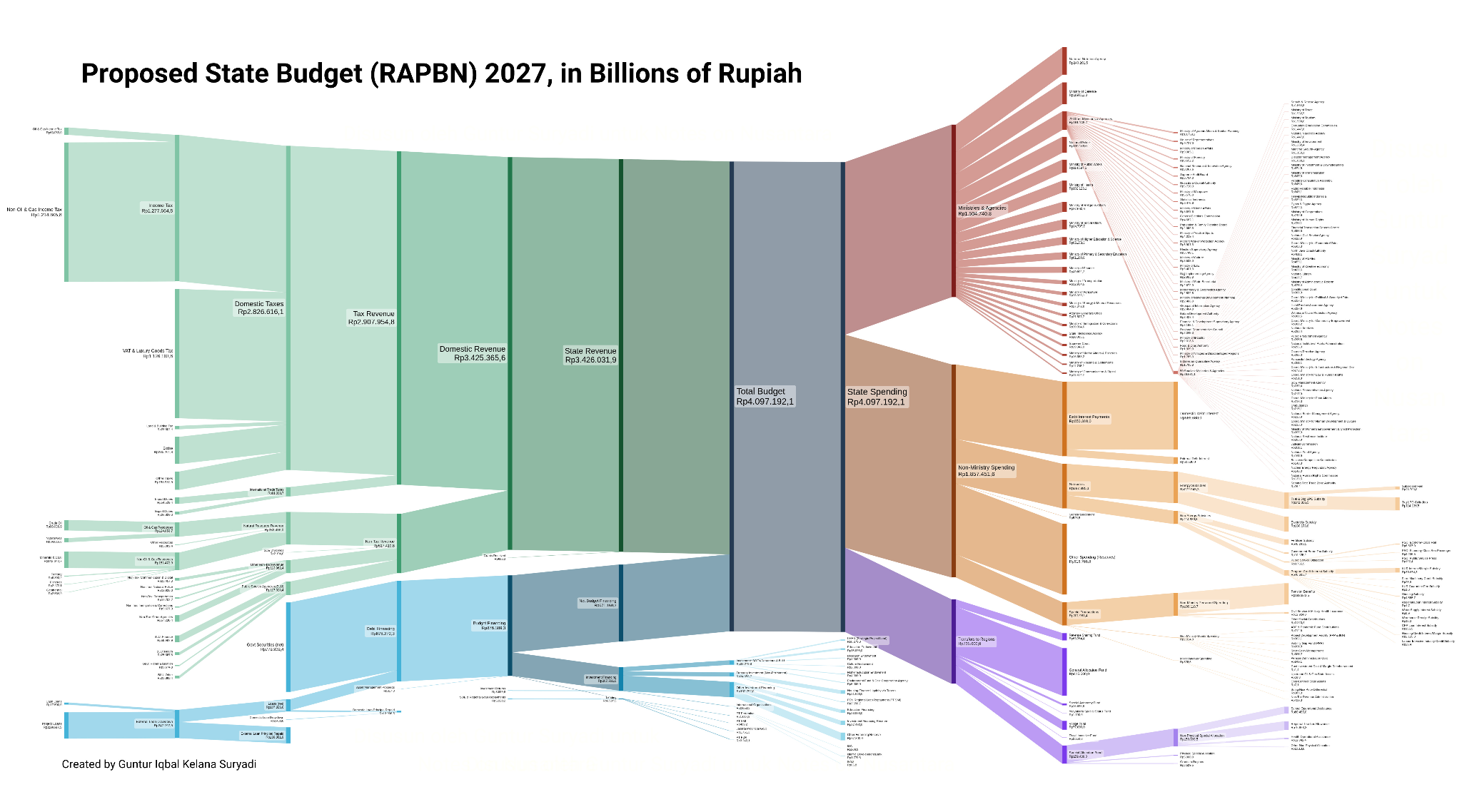
RAPBN 2027 planned state spending at Rp 4,097.2 trillion, the first time the budget crossed Rp 4,000 trillion, up 3.93 percent from the 2026 outlook of Rp 3,942.4 trillion. With GDP growth assumed at 6 percent, state spending is planned to grow more slowly than the economy.
Introducing: the National Priority Work Programs (‘PKPN’)
Ministries’ budgets for 2027 are focused on the 60 PKPN, the list of specific programs directed by the President. This is the first budget to apply the PKPN approach, though similar approaches may have existed before, such as the “money follows program” principle.
There is no information on the share of PKPN-forming programs in APBN 2026.
At the May meeting for the 2027 Government Work Plan, Bappenas presented its share in the 2026 budget after the efficiency cuts made early in the year. PKPN in 2027 is therefore compared with the 2026 post-efficiency budget allocation (DIPA).
In RAPBN 2027, PKPN took a larger share of the ministries’ spending budget (Rp 653.4 trillion, 43.42 percent) than the same set of programs in the 2026 post-efficiency DIPA (Rp 531.3 trillion, 36.30 percent). The share was slightly lower than what was presented at the indicative ceiling stage (Rp 626.5 trillion, 45.71 percent), even though the PKPN total in RAPBN 2027 was larger.
This supports the observation that, when setting the indicative ceiling, the government budgeted for PKPN programs first. Only when preparing RAPBN 2027 was the ceiling loosened, and the additional room went to non-PKPN programs that had not yet been funded.
By cluster, RAPBN 2027 changed every cluster significantly in both value and share. The Poverty Reduction cluster declined, in line with the 2027 poverty targets compared with 2026. The 2027 target is a poverty rate of 6 to 6.5 percent (the 2026 target was 6.5 to 7.5 percent), and extreme poverty close to 0 percent.
The Downstreaming and Industrialization cluster also declined by 1.25 percent, to Rp 1.38 trillion. PKPN covers ministries’ budgets only. A full picture of this cluster needs information on other channels: from the state budget (investment financing, subsidies, regional transfers, and others), from Danantara, and from private investment. This holds for every cluster. It is just more visible here.
Ministry spending and programs
RAPBN 2027 set ministries and agencies (‘K/L’ in the charts) spending at Rp 1,504.74 trillion, slightly below the Rp 1,510.48 trillion of APBN 2026, down Rp 5.74 trillion (0.38 percent). The comparison uses APBN 2026 figures, not the post-efficiency DIPA.
While total ministry spending in RAPBN 2027 was roughly unchanged from last year, much changed across specific ministries and programs. Chiefly, several of the country’s largest ministries and programs were slated for cuts. Several others received sizable additions.
Of 99 ministries and agencies with their own budget section:
1. 46 will receive more
2. 52 will receive less
3. 1 newly formed
And of 106 programs, excluding the Management Support Program:
1. 48 programs will receive more
2. 57 programs will receive less
3. 1 program is newly formed
The Management Support Program itself rose 1.14 percent (Rp 5.34 trillion) to Rp 474.77 trillion. This suggests that either the fixed transition costs of setting up new institutions that were visible early in this government’s term are cooling, or that the civil service capacity is being held where it is and is not planned to grow for next year — or perhaps both.
Compared with the efficiency and reallocation of the 2025 and 2026 budgets, RAPBN 2027 slightly corrects the concentration of budget in large ministries. At the widest gap, the six largest ministries differ from the previous year by 3.08 percentage points. This may appear minuscule; however, in absolute value, that 3.08 percent difference amounts to Rp 45.14 trillion, reflecting close to the combined budget of the 58 smallest ministries.
At the program level, the 8 largest programs made up 65.77 percent of ministry budgets in APBN 2026 and 61.12 percent in RAPBN 2027. The 4.65-percentage-point difference is worth Rp 47.90 trillion. Deconcentration is slightly larger at the program level than at the ministry level.
The shape of the cuts and the additions can be explored too.
The 10 ministries with the largest cuts account for 89.15 percent of all cuts.
The 10 ministries with the largest additions account for 66.58 percent of all additions.
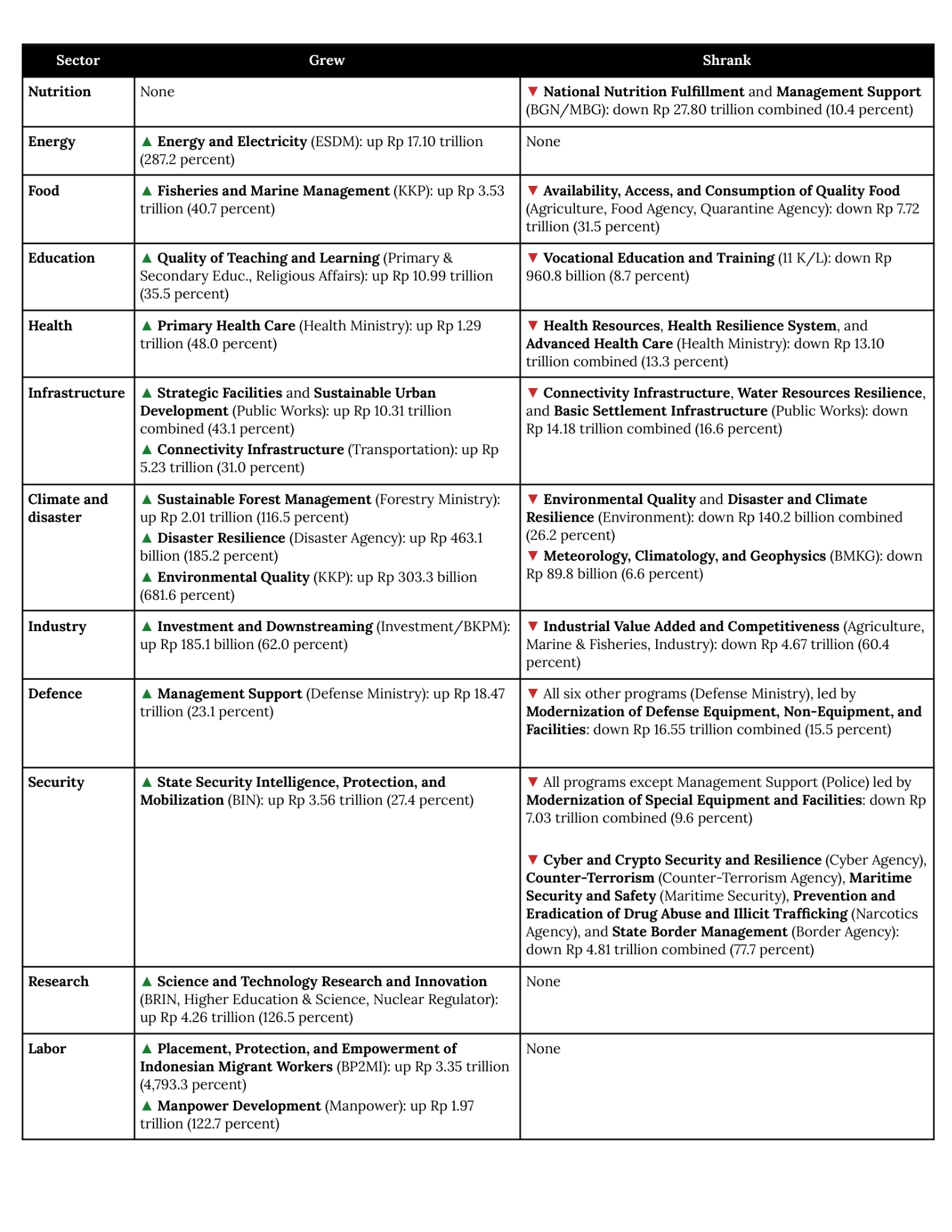
Meaning cuts were concentrated in a few large ministries, while additions were spread thinly across many. The exception is the Energy and Mineral Resources Ministry (ESDM), which alone makes up 22.93 percent of all additions.
The same pattern shows at the program level:
The 10 programs with the largest cuts account for 84.62 percent of total cuts.
The 10 with the largest additions account for 72.92 percent of total additions.
What moved?
Program budgets, change in RAPBN 2027 from the 2026 APBN Law (Ministry or agency in parentheses):
Is the movement due to PKPN?
The links between ministry budget movements and PKPN can only be guessed. For example, ESDM’s Energy and Electricity Program aligns with PKPN’s electrification of 10,000 villages and gas networks. The fisheries increase fits the government’s Fishing Villages program, fishing vessels, and salt industry centers.
But a PKPN program is not the same thing as a ministry program. PKPN programs are assembled from Detailed Outputs (‘RO’), three levels of detail below a ministry program, and the Financial Note does not go that far down. A ministry program’s ceiling can shrink while the PKPN outputs inside it grow, and vice versa.
The approved budget
On top of the approved RAPBN, the actual 2027 state budget added Rp 9.1 trillion to state spending, raising the final 2027 figure to Rp 4,106.26 trillion. The composition changed more than the total.
Ministry spending rose by Rp 52.16 trillion, and non-ministry spending fell by Rp 43.09 trillion. Rp 11.44 trillion of the non-ministry reduction came from cuts in energy subsidies. The rest is not itemized, but most likely came from “other spending”, a nondescript post in the State General Treasurer’s budget section that can be adjusted in the budget year.
The change came in two steps. On 7 September, with then-Minister Purbaya still in office, the tentative posture discussed with the House’s budget committee (Banggar) already raised ministry spending by Rp 9.1 trillion, to Rp 1,513.8 trillion. At the 24 September meeting, under Minister Suahasil, the government moved another Rp 43 trillion or so from non-ministry to ministry spending. Last year, under Minister Purbaya, Rp 43 trillion was added to central transfers to local governments. This year, a similar sum went to the ministries.
At that same 24 September meeting, the report of the working committee (Panja) on central government spending said the ministry spending addition was “among others, for additional allocations to” a list of ministries in an attachment, which was not read out, to support “the implementation of the 8 PKPN clusters.” At the plenary, the Government’s final opinion stated plainly that fiscal policy “must remain prudent, but not passive.” Banggar Chair Said Abdullah added a caution, “Every rupiah spent must be measurable, both in output and in outcome.”
Neither public document lists which ministries received the additional funds.
Where will the additional Rp 52.16 trillion go?
Part of the addition can be pieced together from the commission hearings that preceded the plenary; the rest cannot be pieced together due to limited public information.
The largest movement came from the decision that the central government will bear the salaries of government contract employees (P3K) working for regional governments, budgeted at Rp 23 trillion. It will do this through ministerial spending instead of increasing regional transfers. In the agreed figures, the Rp 23 trillion sits in the Primary and Secondary Education Ministry’s Quality of Teaching and Learning Program.
The remaining Rp 21.64 trillion sits among 22 ministries and agencies whose agreed figures are not in the public record.
What to monitor next?
PKPN widens the set of programs that are actually prioritized in budget terms, and slightly reduces the reliance on MBG. PKPN in RAPBN 2027 rose by Rp 122.1 trillion from the 2026 post-efficiency DIPA, while the National Nutrition Fulfillment Program was cut by Rp 22.80 trillion. The House’s addition did not change that. At the same time, Rp 52.16 trillion was added in the name of PKPN; Rp 21.64 trillion of it is not yet itemized in the public record, and none of it is described by output.
Two things can be monitored further:
1. Shifts between ministries, programs, and the State General Treasurer’s budget section (BA BUN) during the budget year.
2. PKPN details in the Government Work Plan, APBN Law 2027, and the Presidential Regulation on Budget Details, compared with the draft Work Plan at the indicative ceiling stage.
Both depend on the documents being public and on time. Last year they were neither. The 2026 APBN Law (No. 17/2025) was signed and promulgated on 22 October 2025, but the public could only read it in early January 2026, after Notes on Nusantara and The Reformist had written asking where it was. The 2026 Government Work Plan, which regulations require by June, was set by Presidential Regulation 117/2025 only on 20 November 2025. The Presidential Regulation on Budget Details, due by 30 November, was still not public in January.
For 2027, the President has until 29 October to sign the 2027 APBN Law, after which it takes effect without his signature. At the time of writing, neither the 2027 APBN Law nor the Presidential Regulation on the 2027 RKP has been published. Whether this year’s documents arrive on time and are made public still needs to be monitored.
