


In September, Jakarta Governor Pramono Anung met with New York City (NYC) Mayor Zohran Mamdani and exchanged remarks at the U20 Mayor’s Summit. Among the things they discussed were municipal bonds — debt securities issued by governmental entities to finance infrastructure projects — and how NYC historically used them to build the Big Apple into what it is today (the best city in the world, according to a new Oxford economics study).
Municipal bonds had already been on Pramono’s radar for some time. In a July meeting, he said Jakarta plans to issue Rp 3.5 trillion in 7-year bonds starting in June 2027. Since then, the planned amount has risen to Rp 5.2 trillion.
Decentralization optimists see the policy as a step toward real fiscal autonomy in Indonesia, with other localities watching closely to see how it plays out.
Before Purbaya Yudhi Sadewa was removed from the Finance Minister post, he questioned why Jakarta wanted to issue loans, since the city administration is by far the richest province in the country.
Pramono responded that the provincial government must find new ways to source income amid repeated budget cuts to central government transfers. “After all, the Jakarta government knows its own needs. Purbaya said Jakarta has a lot of money. But we are also being told to build a lot, and building takes money,” explained the governor.
Pramono has a point. Since the new millennium, a variety of new laws have reshaped the relationship between the central and regional governments after three decades of authoritarian rule under President Suharto. Among them was greater local fiscal autonomy.
Read our volume about decentralization and local fiscal autonomy:

22 years ago, Law No. 33/2004 on Financial Balance Between the Central Government and Regional Governments (HKPD) gave local governments a clear legal route to borrow from the public. Article 57 states that regions “may issue regional bonds in Rupiah on the domestic capital market,” and that the proceeds must go to “public sector investments that generate revenue and benefit the community.”
Yet, despite over two decades of legal breakthroughs and amendments, no regional government has ever dared to issue its own loans, or at least until Jakarta does so next year.
What does this really mean for Jakarta and the country’s other local governments? In this edition of The Reformist, we’ll cover why Jakarta is opting to borrow, lessons learned from NYC, and the paradoxical reality that this income source may be available only to a select few localities.
Why Jakarta wants to issue bonds
When you look at Jakarta’s total annual budget, especially compared with the other 37 provinces, Purbaya may have been right. Why must Jakarta, a local government with a regional budget (APBD) of Rp 81.32 trillion, take on loans when its budget is two and a half times larger than West Java’s, the second-largest economic budget in the country?
Pramono has cited at least two reasons: (1) narrowing fiscal space from budget cuts, and (2) public transport financing.
This year, the central government slashed Rp 14.5 trillion of annual cash transfers to Jakarta, depleting the province’s budget from Rp 95.3 trillion to Rp 81.32 trillion overnight. A couple of weeks back, Jakarta’s budget agency further decreased the budget to Rp 79.6 trillion after final accounting measures.
These austerity measures follow a pattern set by the current administration since President Prabowo Subianto first came to power. In 2025, President Prabowo issued his first presidential decree, slashing central government transfers by 5.5 percent from Rp 919 trillion to 849 trillion. This year, the central government has since cut the transfers again by Rp 716 trillion.
Pramono and Jakarta saw this as the final straw, prompting the idea of issuing municipal bonds to exercise fiscal independence.
The second, more forward-looking reason is financing public transit. This raises questions, since public transportation is almost always a loss-making business venture. It barely makes any profit, is hard to establish, and is difficult to maintain. How would the province then pay back the loan?
Jakarta’s bus network, TransJakarta, for example, depends heavily on the provincial government to subsidize its operations. This year, TransJakarta received Rp 3.75 trillion to cover the difference between its subsidized user fare and its actual price.
Since 2005, TransJakarta has increased its fares only once, from Rp 2,000 to Rp 3,500, despite two decades of inflation. To put the numbers in perspective, Jakarta’s minimum wage has risen by over 600 percent since 2005, from Rp 819,000 to Rp 5,73 million. The actual cost of TransJakarta ridership is estimated at around Rp 13,200 per rider, meaning the Rp 9,700 difference is fully subsidized by TransJakarta and, by proxy, the provincial government.
Read our volume on TransJakarta:

Only recently, in late September, did a governor finally dare to rip the band-aid and announce that fares will be readjusted at the beginning of next year.
And this should be okay! Because despite public transport being a costly public good, it is highly beneficial for a city and its people. The more people use public transportation, the more agglomeration occurs, spurring up economic activity in urban areas. One Universitas Indonesia study estimates that every Rp 1 trillion endowed for TransJakarta generates Rp 3.2 trillion in national economic output. Ridership has also grown year after year.
Last year alone, public transportation ridership across all modes eclipsed 461 million passengers, even though over 70 percent of Jakarta citizens still primarily use private vehicles.
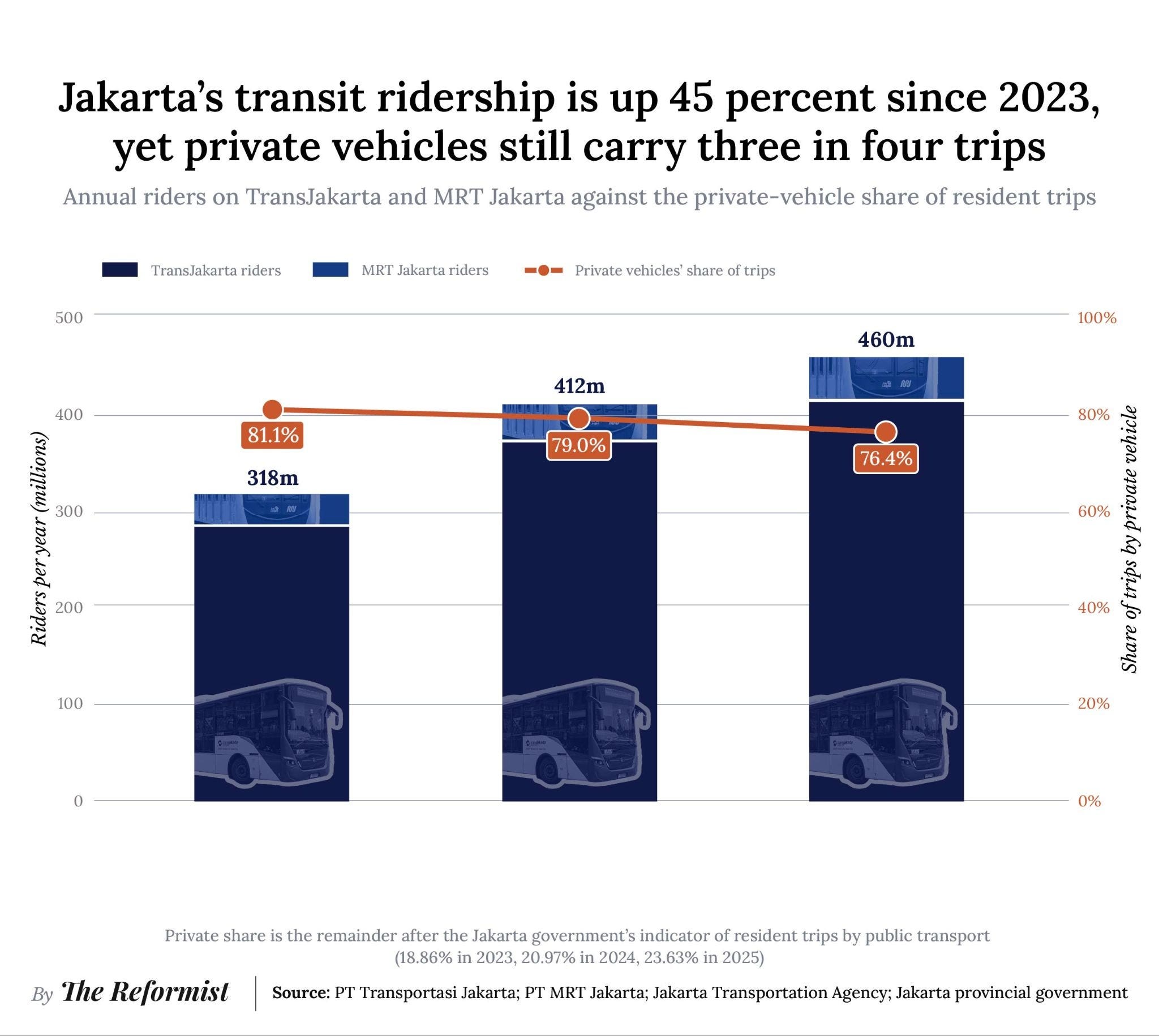
This means there is still plenty of potential. Yet operational costs are the smaller problem. Suppose fares and a healthy subsidy cover buses, drivers, and fuel. They still would not pay for a new LRT line or a new bus fleet. That is capital spending: huge sums up front for assets that serve riders for 30 to 50 years. No fare, however well set, can raise that money in the year it is needed.
Which is why the sector is heavily subsidized and requires some form of state intervention. Paying for a line out of one year’s revenue means that year’s taxpayers fund something generations will use, and the city can’t build it without starving other infrastructure needs.
For example, the existing 15.7-kilometer MRT line, which connects Central and South Jakarta, cost the provincial government Rp 16 trillion. It received initial capital from the Japan International Cooperation Agency (JICA) through a 40-year loan, with a burden-sharing scheme that involved a 49 percent grant from the State Budget (APBN) while the rest of the loan is paid off through Jakarta’s ABPD.
A generous gesture from the central government, but one that is dependent on its benevolence. A similar price tag appears in the recently inaugurated 12.2-kilometer Manggarai–Kelapa Gading LRT line, which needs around Rp 12.1 trillion in capital funding.
This is the problem municipal bonds help to solve. A bond lets a city borrow today and repay over decades, spreading the cost across the people who will actually use the asset.
Governor Pramono has revealed that Rp 2.7 trillion from the Jakarta bonds would be used to extend the Manggarai–Kelapa Gading LRT route to Dukuh Atas, further connecting the city. The remaining Rp 2.9 trillion would finance the Sumber Waras Hospital project, which has been delayed for over 14 years.
The public transit financing logic applies to many other capital-heavy infrastructure projects with minimal profit margins. Public goods like hospitals (as seen through Pramono’s pledge), schools, and social housing require upfront capital to kickstart construction; municipal bonds can help provide it.
How NYC used bonds to build a connected city
In the United States, over 50,000 local governments and institutions participate in the bond market. The US is also the country where municipal bonds finance almost two-thirds of cities’ infrastructure and urban development. Among their many uses, municipal bonds often fund new public transportation infrastructure.
Perhaps the most famous use case was the creation of the New York City subway system. In 1894, the New York State Legislature passed the Rapid Transit Act, allowing the city to borrow money and build a subway it would own. The first contract, signed in 1900, priced the project at US$ 35 million or roughly Rp 25 trillion in today’s money. An independent contractor then used this capital to build and operate the subway system under a franchise for 50 years.

By 1908, the subway and other public works had pushed New York close to its legal borrowing limit. Rather than stop building, New Yorkers voted for more. In 1909, the legislature and New York citizens approved a constitutional amendment by referendum. The amendment meant that debt used to fund self-paying projects, like the subway, no longer counted toward the limit, freeing up about US$ 120 million for new lines.
But, as you can see today, everything worked out in the end. When the subway first opened, the New York Subway had a single 14.6-kilometer line — shorter than Jakarta’s MRT today — and carried 150,000 passengers on opening day. Today, the network spans 399 kilometers across 28 train services and 472 stations, carrying nearly 1.3 billion trips a year and reshaping the city.
To Mamdani, Pramono explained Jakarta’s plan to issue municipal bonds to finance the capital city’s public transportation projects, prompting the NYC Mayor to commend the initiative and note that New York has historically used municipal bonds to fund similar projects, including the New York Subway.
Jakarta has clearly taken inspiration from New York, given Pramono’s candor to Mamdani. If Jakarta aims to become a city like the world’s number one, it must build its public infrastructure, with municipal bonds as a driving force.
A systemic barrier for Indonesia’s (other) local governments
Among the other responses, Mamdani told Pramono that New York would be more than happy to offer technical assistance to help Jakarta kickstart its loans. But despite optimism from both sides, if the New York team dug further into the details, it would quickly realize that the Indonesian system makes regional borrowing even harder than it looks.
For one, the US federal system does not require localities to seek federal approval to issue municipal bonds. By contrast, Indonesian localities must seek approval from both the Finance and Home Affairs Ministry to issue regional bonds. This is a hurdle Jakarta is currently facing.
In terms of taxation, the US federal government allows local states and cities to apply a variety of taxes as they see fit. NYC, for example, collects its own personal and corporate income, sales, and property taxes — to name a few. In fiscal 2025, the city documented over US$ 111.6 billion in total revenue, with 68.6 percent coming from city taxes.
On paper, Jakarta looks similar. About 66 percent of its 2025 revenue came from its own sources. But other provinces don’t share that luxury. For the median Indonesian province, that number drops to 41.2 percent, according to our calculation based on Finance Ministry data. Another major difference is that New York City gets to choose its own taxes, including a city income tax.
Jakarta’s taxes, like those of every other Indonesian locality, are predetermined under Law No. 1/2022 on Financial Relations between the Central Government and Regional Governments (HKPD) — the most recent amendment to the original 2004 Law.
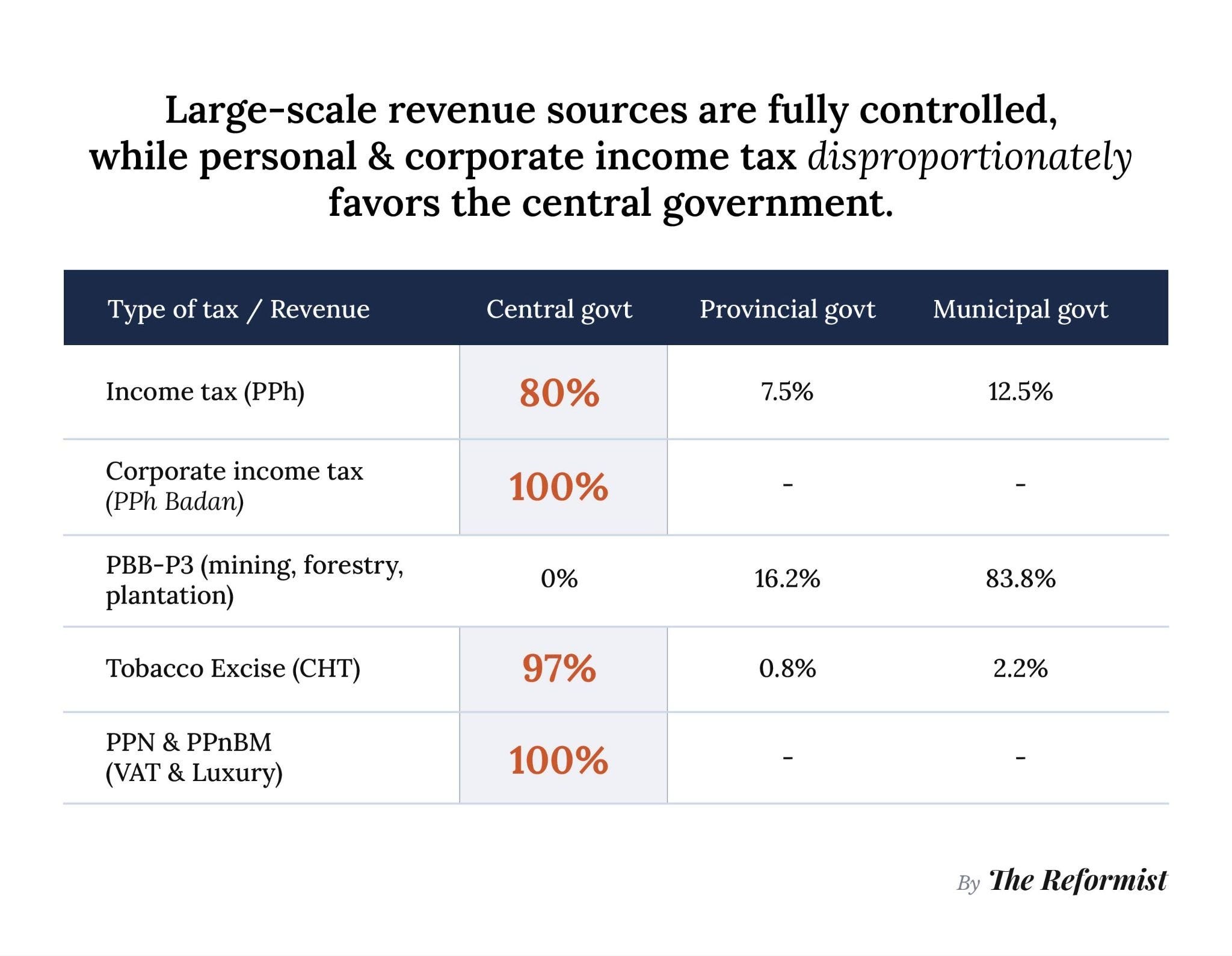
Under this Law, local governments (both provincial and municipal) are entitled to only a few types of taxes, most of which are land- and asset-driven. Large-scale revenue sources like the Value Added Tax (VAT) are fully controlled, while personal and corporate income tax disproportionately favors the central government. See the graph below for the breakdown.
This has left local administrations reliant on annual cash transfers from the central government. Essential infrastructure projects, public transit, school renovations, and teachers’ salaries are only financially feasible if the central government’s budget allows.
As we’ve cited before in a previous volume:
“As of 2024, 298 out of 552 local (provincial, regencies, and municipal) administrations rely on central government transfers for more than 80 percent of their total revenues.”
This makes borrowing risky. Repaying loans from an unstable revenue source becomes a gamble, especially when the central government has shown it is willing to cut transfers without deliberation to prioritize its own national agenda.
Worse, the central government returns less than the Law’s tax-arrangement formula. Taxes meant to be redistributed to localities must first be collected by the central government through a revenue-sharing fund (‘DBH’). In 2025, the country collected over Rp 593.9 trillion in non-corporate income tax, covering all income tax except what companies pay on their profits.
At the 20 percent regional share, around Rp 118.78 trillion should have gone back to regional governments. But this wasn’t the case. Under Presidential Regulation No. 118/2025, the personal income tax DBH was set at just Rp 15.2 trillion, or 2.6 percent of the entire DBH pot for the 2026 fiscal year. According to Regional Autonomy Watch (KPPOD) Executive Director Herman Suparman, this goes against the HKPD Law.
For Jakarta, its income tax DBH was slashed by 66.3 percent, from about Rp 21 trillion to Rp 7 trillion, despite being the country’s largest economic contributor.
But while Jakarta has chosen to explore the municipal bond route to ease fiscal pressure, the provincial government can also source 66 percent of its income independently. The Jakarta government has also planned ahead, currently preparing a rainy-day fund to cover future debt repayments.
If the rest of the country follows suit, it will need to plan carefully and tread lightly to avoid borrowing beyond its means.
Jakarta should be safe to proceed with its plan
While loans offer fast and easy capital, they must be managed intentionally so they do not bankrupt a city. This issue matters especially in the Indonesian context, where tax arrangements heavily favor the central government.
Thankfully, the HKPD Law’s implementing regulation (Finance Minister Regulation No. 87/2024) sets a ceiling on how much local governments can issue in municipal bonds. Regional debt of all kinds, existing plus new, cannot exceed 75 percent of the previous year’s revenue that the region is free to spend. This means net income excludes money such as earmarked transfers from the central government, a portion of vehicle and cigarette taxes, hospital revenue, and more.
Municipal bonds also have a minimum Debt Service Coverage Ratio (DSCR) of 2.5. In plain terms, this means a region’s annual income must be 2.5 times its annual debt payments to avoid bankruptcy risk.
The proposed Rp 5.2 trillion Jakarta bonds show how far the province is from the limit. Compared with the province’s Rp 79.6 trillion budget, the total loan would make up only about 6 percent of the city’s total budget.
Add to that no other local government has ever issued its own loans, and any limits provision will have no significance for now. Perhaps in a few years, The Reformist can return to this topic with a richer discussion of regional debt management.
Is borrowing always bad?
It has been 22 years since the 2004 Law laid the foundation for local governments to source their income independently through new means. This isn’t because they haven’t tried. Before Pramono’s Jakarta bonds plan, then-West Java Governor Ridwan Kamil floated the idea of municipal bonds in both 2020 and 2023, but to no avail. In 2024, West Sumatra similarly tried to issue loans, and things never went beyond the planning stage.
Jakarta has also tried to issue loans before: in 2011, then-Governor Fauzi Bowo planned to issue Rp 1.7 trillion in municipal bonds, but his successor, Joko “Jokowi” Widodo, scrapped the idea. In what is now a viral clip of the former governor turned president, he asked, “Why use bonds? What are bonds? They’re debt. Why are you so fond of borrowing when we have plenty of money ourselves?
But as seen in the US and NYC, borrowing doesn’t automatically equate to bad governance. In fact, it is quite the opposite, especially when done correctly and used for infrastructure the masses use and enjoy.
Thank you for continuing the discussion on decentralisation. I’d like to add a few thoughts, if I may 🙏🏻🙏🏻🙏🏻
first, can we really treat municipal bonds as a step towards fiscal autonomy? I’m not sure that the ability to borrow necessarily translates into the ability to determine one’s own revenue sources. Bonds certainly expand the financing options available to local governments, but they also create future repayment obligations. If local revenue-raising powers remain largely constrained by the central government (UU HKPD), issuing bonds could actually place additional pressure on local governments whose fiscal capacity is already limited.
on the paper fiscal autonomy has at least three key dimensions: the authority to raise revenue, the discretion to allocate expenditure, and the capacity to access financing. Municipal bonds address the third, but the first two remain constrained within a relatively rigid framework. This raises a more fundamental question about whether access to debt, on its own, meaningfully advances fiscal autonomy.
second, as a financing instrument, municipal bonds may be accessible to only a handful of local governments. Jakarta, for instance, has a significantly larger own-source revenue base than most other local governments in Indonesia. While I understand that the article is about decentralisation rather than the mechanics of infrastructure financing, I think this is an important analytical lens through which to examine the issue. Local governments with weaker fiscal capacity may find it much harder to issue bonds, even though they may face the greatest unmet infrastructure investment needs. This brings us back to the first point: a narrow revenue base may simply be insufficient to support debt repayment.
when access to bond markets depends on fiscal capacity that local governments already possess, the instrument risks reinforcing, rather than reducing, existing disparities in their capacity to finance development. In other words, those that are already better positioned to invest may be the ones best able to access additional financing, while those most in need of investment remain excluded.
this leads me to a broader question: should local governments generally be encouraged to access debt markets, or should financing instruments instead be differentiated according to local characteristics, fiscal capacity, and the types of public services they are responsible for delivering? For local governments without an adequate revenue base, various scheme of dana transfers ( or grants) may be more appropriate than debt financing.
finally, IMHO, municipal bonds should be evaluated as part of a broader infrastructure-financing strategy rather than as a substitute for fiscal reform. How do their costs, risks, and distributional implications compare with those of land value capture, intergovernmental co-financing, development lending, and other instruments? More fundamentally, can borrowing resolve a structural mismatch between local expenditure responsibilities and the revenues available to finance them? Wallahualam.
anw, thank you for the article. I really enjoyed reading your reflections on decentralisation, and hope you will continue exploring this theme. Looking forward to more!