


Some years ago, reproductive rights advocate Nur “Nana” Jannah got a call from a 17-year-old girl who found her number online, asking her about her unusual vaginal discharge. She wasn’t sure what to do. Nana suggested that she seek medical help, but the girl told her she feared judgment or shame from her community for needing medical advice on such a “taboo” part of the body as reproductive organs, leading her to seek help online and call Nana instead.
“I tried to convince her that you need to go to the Puskesmas [community health center] and try to get it treated, but she said, ‘I’m scared that I will get questioned about my sexual behavior if I do it in my hometown,’” recounted Nana, who spoke to The Reformist about barriers women face to healthcare service access in Indonesia.
This is not an uncommon experience. Across the country, seeking reproductive healthcare as a single woman is still heavily stigmatized, sometimes by the very healthcare workers who are meant to offer such services. Women, especially those who are unmarried, are often hesitant to conduct regular checks with an obstetrician-gynecologist for fear of being perceived as “dirty” or having made poor decisions, Nana tells The Reformist.
One study even confirmed that a major stigma from healthcare providers towards unmarried women seeking cervical cancer screening was “perceived sexual immorality.”
It may come as no surprise, then, that despite the Health Ministry’s efforts to increase early breast and cervical cancer screenings through free programs, test uptake among women also remains low.
Less than 30 percent of women in Indonesia undergo breast cancer screenings, even though it is the most common cancer for Indonesian women. Meanwhile, nearly 70 percent of cervical cancer detections in Indonesia happen in later stages, increasing the risk of mortality for a disease that is noncommunicable, preventable, and curable. Cervical cancer kills more than 20,000 women in the country per year.
Reproductive health is a guaranteed right to all people under Law No. 17/2023 on Health. However, convoluted regulations regarding which areas of reproductive health are deemed a critical public health issue, ongoing stigmatization around seeking services, and systematic underfunding and lack of resources have discouraged many vulnerable groups — such as young girls, unmarried individuals, and those with disabilities — from seeking reproductive health services and support.
In an earlier volume, we wrote about a historically successful yet controversial aspect of Indonesia’s reproductive policy: the New Order-era Family Planning program, which tackled the country’s high infant and maternal mortality rates and significantly controlled its population growth.
Read here:

But in this edition of The Reformist, we look beyond technocratic population control to examine Indonesia’s broader reproductive health policy landscape; how the stigmatization of reproductive health poses public health concerns for vulnerable groups, and what the government could do to more precisely target underlying implementation concerns in this critical facet of public health.
The good news: Legal protections for reproductive health have progressed
Broadly speaking, reproductive health encapsulates a variety of intersecting health areas for both men and women, including family planning and contraception; maternal and infant care; sexual health, rights, and education; and reproductive organ health.
Under Suharto’s New Order, Indonesia’s reproductive health policies focused heavily on family planning and population control. In recent decades, the laws have evolved to address public health concerns on a rights-based, norms-based basis, such as lowering maternal and infant mortality rates, decreasing childhood stunting, and combating gender-based sexual violence.
In 2022, in response to the COVID-19 pandemic, the Health Ministry sought to boost the country’s national health policy and created the Health System Transformation Agenda (HSTA) to strengthen local and community engagement in public health. The agenda focused on six main pillars: primary health care, referral care, health resilience, human resources, health financing, and technology.
The new health agenda also prompted the development of Indonesia’s most recent comprehensive legal framework on health policy, Law No. 17/2023 on Health. It replaced Law No. 36/2009 on Health, which advocacy group Amnesty International argued was discriminatory as it limited access to reproductive health to only “legal partners,” or married couples.
Some legal professionals have praised the 2023 law for pursuing the lofty goal of modernizing Indonesia’s health care system and consolidating several laws into a single statute. Among other provisions, the 2023 law shifted the national health focus to preventive, rather than post-illness, measures; permitted foreign medical professionals educated overseas to practice in Indonesia to address domestic workforce gaps; and strengthened legal provisions for disease outbreak management and local health financing.
It should be noted that the 2023 law received major public backlash for getting rid of a mandatory health spending provision previously set at 5 percent of the national budget and 10 percent of municipal budgets. On this, we will cover later in the article.
Nonetheless, the 2023 health law also provides what scholars have noted is a more progressive legal framework that recognizes reproductive rights and maternal health not merely as medical issues but as part of human rights protection by expanding maternal healthcare services, protecting against discrimination and violence, and recognizing women’s reproductive autonomy.
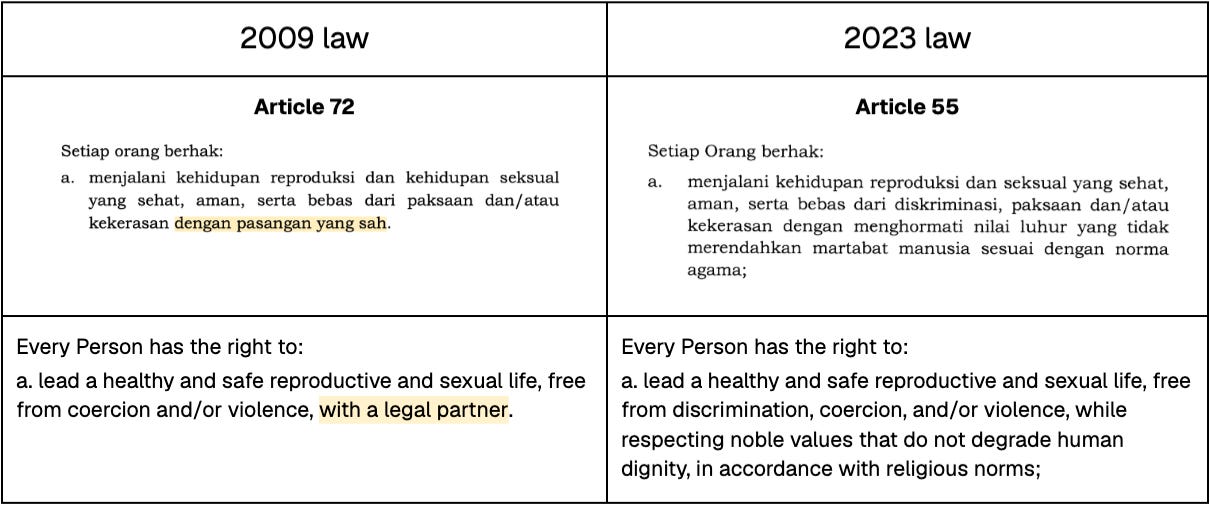
For instance, Article 55 of the 2023 law removes the constraint of “with a legal partner” from its section on reproductive health, suggesting that a safe and healthy sexual life is a human right, not only within the confines of a marriage. It also includes a provision to receive health and recovery services due to sexual violence.
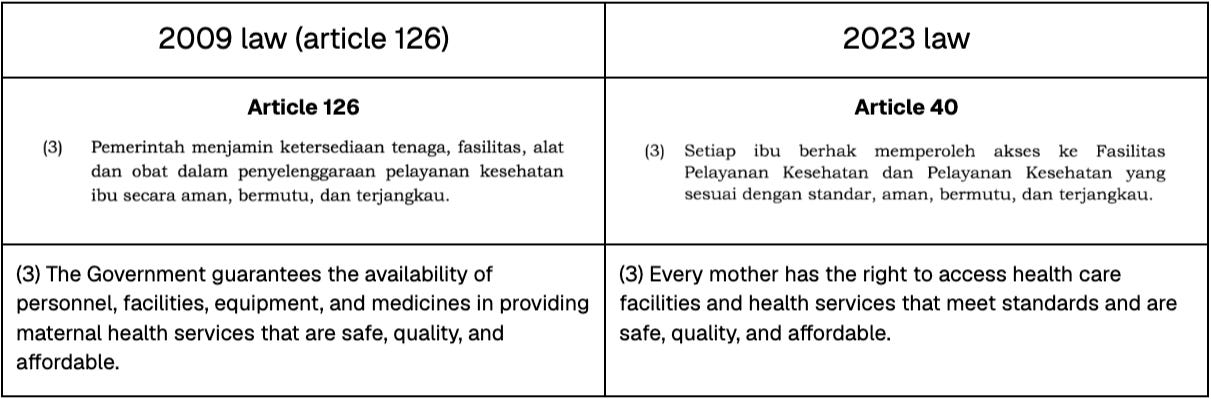
Moreover, Article 40(3) of the 2023 law explicitly grants every woman seeking maternal care the right to obtain healthcare facilities and services that meet standards of safety, quality, and affordability for all stages of pregnancy and post-childbirth, which offers a broader period of service coverage than the 2009 version of the law.
Since the law’s passage, the government has made some progress on certain health indexes. In 2023, following a school-wide mandatory HPV (Human Papillomavirus, which can increase the risk of cervical cancer) vaccination campaign for girls aged 11 and 12, HPV immunizations were administered to more than 89 percent of targeted girls for their first dose that year. The government plans to conduct HPV vaccination for boys in 2028. That the Indonesian government was confident enough to apply a nationwide mandate reflects how far the country has come in terms of reshaping social norms to advance public health initiatives.
But other factors of reproductive health indicators have seen less than satisfactory improvements or remain stagnant.
Maternal mortality, for example, has declined in recent decades — from 298.6 per 100,000 live births in 2000 to 172.9 in 2020 — but remains well above the Sustainable Development Goal of 70 per 100,000 live births.
Awareness of reproductive health for adolescents also remains an issue yet to be fully addressed. Some 35 percent of men and 31 percent of girls aged 15 to 19 in 2022 have limited or no awareness of reproductive health, which might contribute to unplanned pregnancies (the adolescent birth rate is now 26.6 per 1000 in girls aged 15 to 19) and increase the risk of HIV and other sexually transmitted diseases.
Modern contraceptive use, even for married women in Indonesia seeking to delay pregnancy, has stagnated at around 59 percent since 2012. This number is significantly lower for unmarried women, with one estimate putting that number as low as 1.5 percent.
More egregiously, a United Nations Population Fund (UNFPA) report in 2024 revealed that almost half of all women aged 15–49 years in Indonesia have undergone female genital mutilation/cutting (FGM/C), attributing its cause to social and religious norms. The practice was recently banned under Government Regulation No. 28/2024 for babies, children under 5, and preschoolers. It remains to be seen just how effective this ban will be in curbing this socially endemic issue.
So, what gives?
There’s an interesting dichotomy with reproductive rights, noted Nana, who has spent most of her professional life in reproductive health advocacy with Rutgers WPF Indonesia, Ipas Indonesia, and now NLR Indonesia. “It is actually quite promising at the level of the Law,” she explained, “but when we talk about the lower-level regulation, or the more technical regulation regarding the provision of reproductive health and rights, … [it] is very much limiting because of the pushback from the public,” she noted.
The reality, Nana observed, is that oftentimes when unmarried individuals seek contraceptive access through private channels — the only legal option available to them, which already introduces a high cost barrier — healthcare providers are still restrictive with their contraception distribution, often refusing to prescribe contraceptive treatment to young girls or single women.
One of the main reasons for this hesitancy is the “rooted” belief from healthcare providers that they “will bear the burden of the sin” for condoning premarital sex or intervening with the natural process of creating life. This is especially true for offering abortion services, Nana told The Reformist.
These strong moral and religious beliefs have also made their way into every iteration of the law, including the 2023 law :
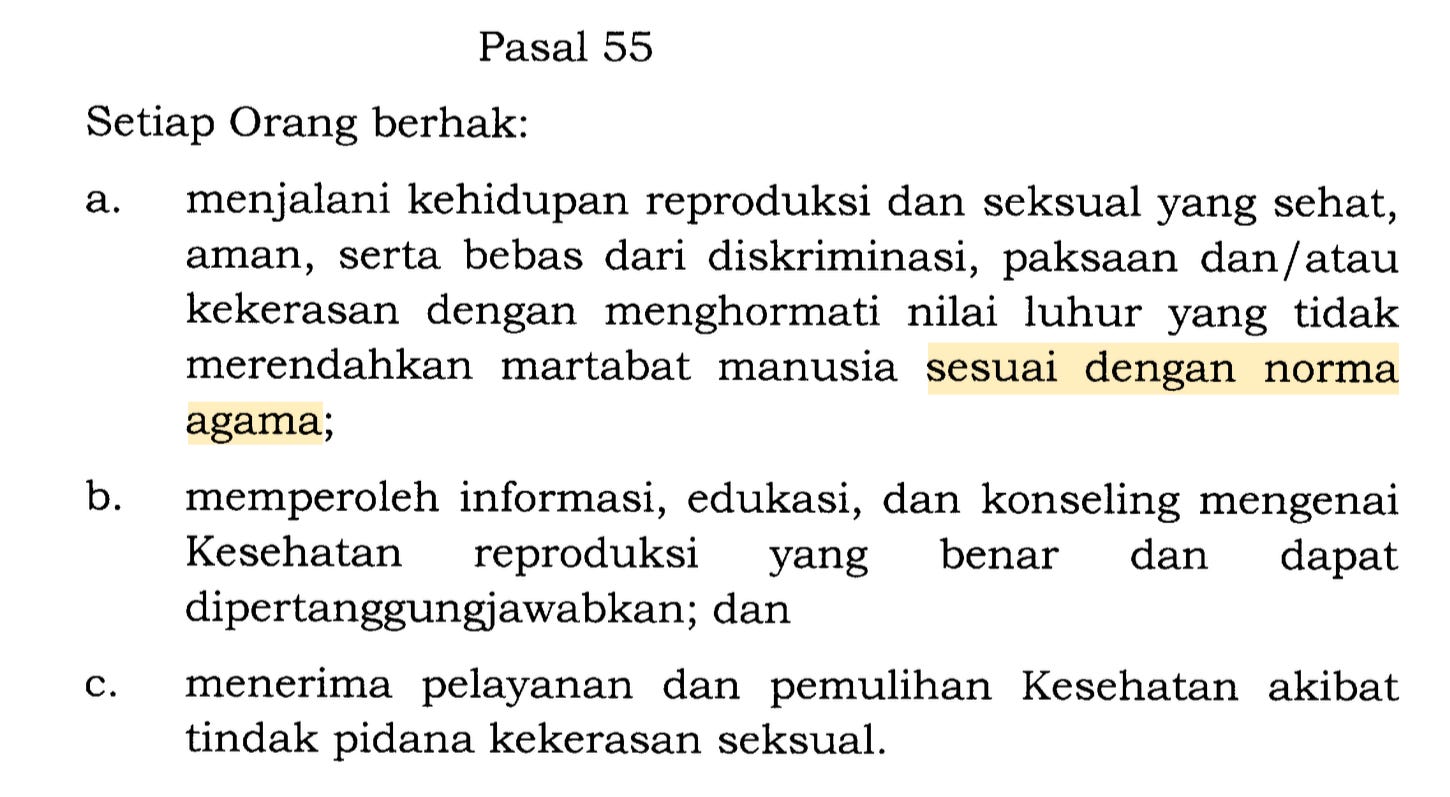
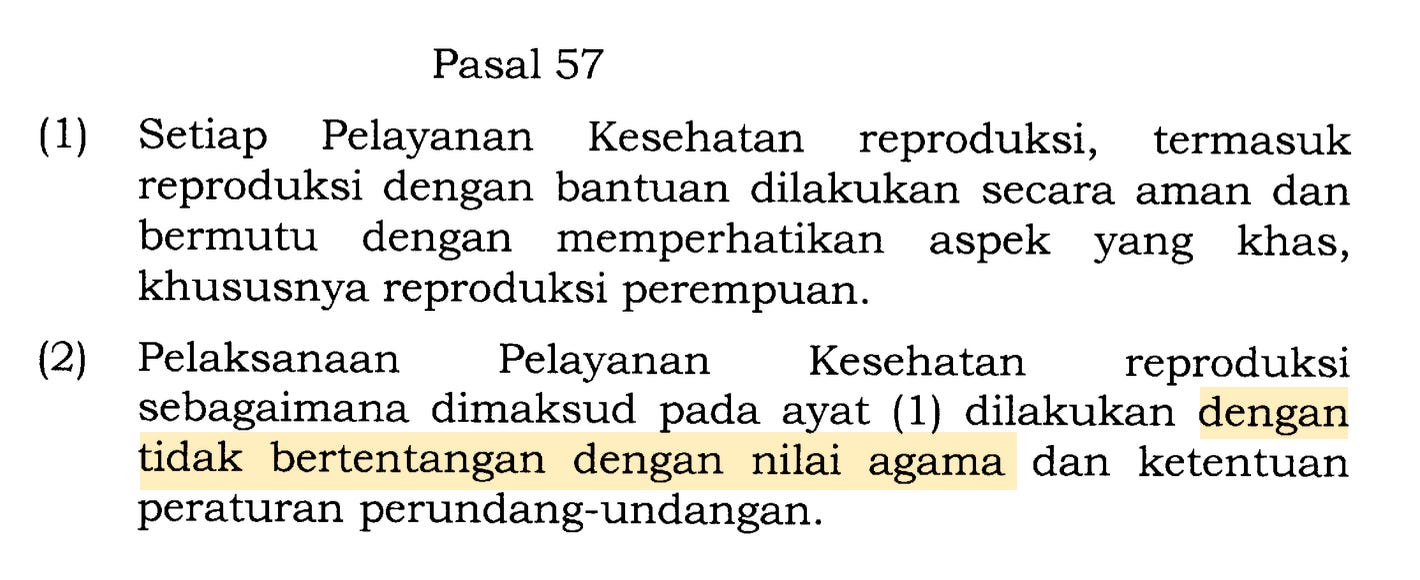
The inclusion of supposed religious “norms” and “values” creates a legal grey zone that can hamper on-the-ground efforts to offer reproductive health services to “every person,” as the legal provision states.
Religious pushback has also limited the scope of reproductive services supported by the government, leaving out protections for more “sensitive” issue areas, such as offering sexual education and contraception. Article 26 in Law No. 52/2009 on Growth and Family Development restricts the government’s obligation to provide “contraceptive service assistance for a husband and wife.” This leads to most public doctors refusing to prescribe contraceptives without proof of marriage certification.
Originally, the implementing regulation for the 2023 health law, Government Regulation No. 28/2024, specified that contraception and reproductive health services would target “fertile age couples” and married couples seeking to delay pregnancy. The regulation swiftly received criticism from religious groups and conservative civil society organizations who argued that the regulation was promoting pre-marital sex. This prompted the Health Ministry to publicly clarify that contraceptives for adolescents are reserved strictly for those who are legally married.
Indonesia’s criminal code also creates parameters around who is permitted access to contraception. Article 408 limits even the discussion or display of contraceptive tools to those under 18, with a maximum fine of up to Rp 1 million. The law excludes “authorized officials” implementing family planning or health education and counseling, without specifying who is considered “authorized officials.”
Abortion is punishable by law, both for the women seeking it and those performing it. An exception is granted for victims of rape or other acts of sexual violence as long as the pregnancy does not exceed 14 weeks of gestational age, or in the case of a medical emergency. But activists note that the documentation and burden of proof for building a rape or sexual violence case can take so long that victims end up not being able to access abortion due to missing the allowed window.
The same stigmatization about women’s health issues can also be internalized by women themselves seeking reproductive health services broadly, such as early-stage cancer screenings. One 2023 study by researchers at Universitas Gadjah Mada found that women in Yogyakarta were apprehensive about preventative breast cancer screening services, as they considered it shameful to talk about breast conditions with other people. Similarly, a 2021 review by researchers at the University of Melbourne found that across Indonesia, approval from a woman’s husband, family, and social support were major factors in whether they sought cervical cancer screenings.
Public education on reproductive and sexual health in Indonesia is still limited, which contributes to the stigmatization of seeking reproductive care. This prompted the push for adding sexual and reproductive health education into the school curriculum. In 2016, advocacy groups brought this concern to the attention of the Education and Culture Ministry. Then-Education Minister Anies Baswedan welcomed the groups’ recommendation and said the ministry was preparing a regulation for a comprehensive reproductive health curriculum. Today, reproductive health education modules are part of the school curriculum at the elementary, junior high, and high school levels. However, the effectiveness of the subject remains to be seen.
Funding limitations haven’t helped
Underlying this social issue is, as often happens, economic inequality. Healthcare infrastructure in Indonesia is unevenly distributed across the country. Indonesia has an average of 50 to 60 doctors and 2 OBGYNs per 100,000 people, which actually exceeds the Health Ministry’s national need. But despite this, only 180 out of 514 regencies/cities have enough doctors to meet the demand, as most healthcare providers opt to work in urban centers.
Villages rely on midwives (bidan) and community health volunteers (kader) in integrated health services posts (Posyandu) for basic services. Community-based health service delivery is prominent in Indonesia and has proven effective, as shown by the success of the Family Planning program’s community-based model. But this approach is not without flaws, especially because it relies on unpaid volunteer work, which we will examine in our next volume on Posyandu.
The 2023 health law also eliminated a 5 percent mandatory national budget allocation and a 10 percent subnational budget for health programs, instead requiring ministries to rely on key performance indicators to fund their programs. Policymakers argued that the mandatory allocation was inefficient because it did not match actual funding needs, while critics worried that without a budget floor, regional disparities would widen, with some provinces already severely underfunded and lacking planning capacity.
To the government’s credit, since the 2023 law was enacted, the National Health Budget has been growing year on year, with a 13 percent increase in the allocated state budget in 2026 to Rp 247.3 trillion. But although the national family planning department (BKKBN) receives the largest portion of this budget — roughly 36 percent — BKKBN has seen some budget efficiency cuts in past cycles. In 2026, BKKBN saw its budget slashed by 5.8 percent to Rp 3.63 trillion, partly to make fiscal room for President Prabowo Subianto’s free nutritious meals program (MBG). Under tighter funding scrutiny, BKKBN announced last year that it had allocated a limited budget to contraceptives.
At the regional level, budget cuts appear to be a common theme. In Bandung, West Java, where infant mortality rates have almost tripled in the past five years, advocates have been pushing for an increase in state budgets for reproductive health. Despite this, allocation for reproductive health has dropped year over year, from 4.1 percent of the total Puskesmas budget in 2024 to just 1.9 percent in 2026.
Neither has the changing international order
Amid declining public health investment, civil society has tried to fill the gap at the grassroots level. Faith-based organizations, disability rights organizations, and the UN bodies have all contributed to offering services for so-called “politically sensitive work,” Nana told The Reformist. This includes: “comprehensive sexual education for young people, reproductive help for people with disabilities, or the assistance for victims of sexual violence who need to access safe abortions,” she added.
The problem is that these areas still rely heavily on foreign aid. “But the funding is not stable,” Nana said. “The situation with the U.S. pulling out the funding from UNFPA [UN Population Fund] is definitely changing the landscape of how civil society and also the non-governmental actors try to fill the [funding] gap.” The United States withdrew about US$ 337 million worth of contracts from UNFPA in early 2025, which amounts to close to 26 percent of the total contributions that year.
It’s not just the United States that is cutting its aid. In 2024, the Netherlands cut 70 percent of its funding to global civil society organizations running reproductive health programs globally. The cut, according to implementing partners, could “jeopardize access to reproductive health services for women and girls,” reflecting the foreign aid dependency to deliver these services.
The decline in global aid funding and a lack of political will for public funding have left the more sensitive public health issue areas, such as reproductive health, hanging out to dry.
Looking ahead
Eventually, Nana told The Reformist, she traveled to meet the girl halfway between their cities to accompany her to seek medical advice at a Puskesmas.
“I was holding her hand the whole time because she was so scared of all the questions, even the simple questions and gestures coming from the healthcare professional there,” Nana said.
Afraid to accept the potential outcomes, or worried about judgment from one’s community, the reality for many Indonesian women is that reproductive care feels intimidatingly out of reach, even when it is guaranteed by the law.
Given the systemic threat that a lack of reproductive healthcare resources and education creates for women in Indonesia — from high maternal mortality rates, low early detection of breast and cervical cancer, and unsafe childbearing practices — the government should take reproductive issues seriously.
Beyond increasing funding — which will always come at the mercy of political winds — one way to mitigate these challenges is to reframe public messaging on reproductive rights as a fundamental facet of public health.
Addressing the religious sensitivities around reproductive health would require buy-in from religious groups on how offering reproductive health services and education would benefit the well-being of women and a healthy society.
And there is proof of concept that this method works. The Suharto-era family planning campaign, “Two Kids Are Enough,” reached out to the two major Islamic mass organizations — the Nahdlatul Ulama (NU) and Muhammadiyah — to scope contraception tools that would be viewed as religiously permissible. This cleared a pathway for family planning fieldworkers to involve local religious figures — the kyai, or Muslim clerics — in their outreach activities that effectively introduced contraception to rural parts of the country.
Access to sufficient knowledge and information about reproductive health can prevent cascading symptoms and diseases, while accessing care early can often be life or death for vulnerable groups. Unpacking the stigma around reproductive health, from both patients and healthcare professionals, is a necessary next step for Indonesia.
What do you think should be done to improve Indonesia’s reproductive health ecosystem? Leave your thoughts in the comments!
PSA! The Reformist is growing, and we’d like to get to know you better. What keeps you coming back to The Reformist, and what can we offer more to serve you better?
Take this 5-minute survey!
Credits:
Writers, researchers: Clara M. Fong, Nea Ningtyas
Editors: Nathaniel Rayestu, Rayhan Kalevi