


What does an ideal family look like to you? Is having a life partner with two or three children just the right amount? Or are kids not at all in the picture? If your answer happened to be a family of four with two children, this preference may not entirely be authentic. Instead, it may have come from decades of social engineering.
Sixty years ago, Indonesian women were having nearly six children on average, doubling the population every generation. But what followed was one of the most successful family planning programs of the 20th century, dubbed Keluarga Berencana (KB).
Politically neglected by Indonesia’s first president, Sukarno, family planning became a flagship program under Suharto’s authoritarian New Order regime—perhaps not out of goodwill but of necessity. Despite being top-down in nature, the program employed innovative social campaigns and bottom-up approaches, which contributed significantly to its overall success: reducing the country’s total fertility rate (TFR) from 5.8 children per woman in the 1950s to 2.1 by 2025, reaching the global standard.
In this edition of The Reformist, we look back six decades to understand what made Indonesia’s family planning program work as a reform.
But first, let’s talk about why it didn’t happen during Sukarno’s Old Order.
Dissecting Sukarno’s pro-natalist Old Order
After gaining independence in 1945, Indonesia’s population was growing at a rate that would cost the government significantly in the long run. By the mid-20th century, the country’s population was expanding at roughly 2.8 percent per year, with an infant mortality rate of 145 deaths per 1,000 births, contraceptive prevalence among women below 5 percent, and a Total Fertility Rate (TFR) of 5.8 children per woman.
As an infant nation with a fragile economy, development would have been difficult if no action were taken. Something had to give, and founding father Sukarno was not budging.
Sukarno was known for his pro-natalist stance, often flaunting Indonesia’s power by highlighting its large population. He once boasted that “Indonesian people breed like rabbits. Ten, twelve, fourteen children. This is normal, and we have a large country.”
Instead, family planning initiatives under the Old Order were mostly driven by private actors. Doctors, academics, physicians, and progressive elites quietly promoted birth control from the early 1950s despite the unfavorable political climate. In 1952, a group of prominent women in Yogyakarta established a Family Welfare Foundation that included contraception among its services, carefully avoiding the phrase “birth control” for fear of its social implications. By 1957, the Indonesian Family Planning Association (PKBI) was formally established, notably with Sukarno’s own personal physician as its head.
Things changed rapidly once Sukarno fell and Suharto came into power.
Here are three takeaways on how Indonesia launched a relatively successful family planning program in the new era:
I. Technocratic approach supported by strong political will
Foundations of state-sponsored family planning
The zeitgeist of the mid-20th century was the perceived existential threat that Earth’s available natural resources would not sustain the rapidly growing human population. This phenomenon was coined Neo-Malthusian, after the English economist Thomas Malthus, whose theory stated that food supply would never be able to keep pace with unregulated population growth, inevitably causing widespread poverty, famine, and war.
This craze spread across Western governments and international institutions alike, driving a wave of donor-funded population control programs across the developing world.
In addition to international pressure, local technocrats from the National Development Planning Agency (Bappenas) also warned President Suharto that Indonesia’s population growth rate had to be controlled for sustained economic development to happen.
Having just seized power under an economic development platform, Suharto gave the family planning initiative high priority, showcasing that ‘political will’ does factor into whether a policy can or cannot work.
Political and economic structure behind family planning
After signing the United Nations (UN) declaration on the World Population in 1967, Suharto kick-started his family planning program through Presidential Instruction No. 26/1968, creating the National Family Planning Institute (LKBN). The National Family Planning Coordinating Board (BKKBN) was then established under Presidential Regulation No. 8/1970 and listed among the priorities in the New Order’s first five-year development plan (Repelita).
Financial endowments from both the state budget and international donors were crucial to the longevity of this program. In the BKKBN’s infancy, the government provided US$ 1.3 million to the program, with an additional US$3 million from international donors. This figure rose steadily year after year. In 1977, US$28.5 million from the state budget was used, rising further to US$34.3 million the following year.
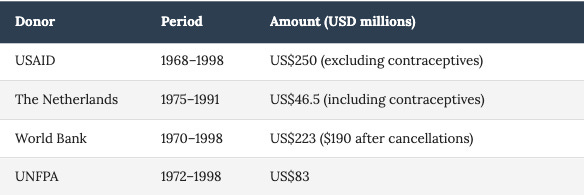
The large bulk of the program’s funding, however, came from different international donor sources. Countries like the United States, through USAID, the Netherlands, and institutions like the World Bank and the United Nations Population Fund (UNFPA), have all endowed the Indonesian government and BKKBN since the program’s founding. From 1968 to 1998, these four donors contributed more than half a billion US dollars for the family planning program.
II. Top-down objective, bottom-up implementation
The program had two official objectives from the outset. The first was improving the health and welfare of mothers, children, and the family at large. The second was raising the standard of living by reducing the birth rate, ensuring that population growth would not outpace economic production. In practice, the program pursued these goals through two main channels: contraceptive service delivery and information, education, and communication—known within the program as KIE.
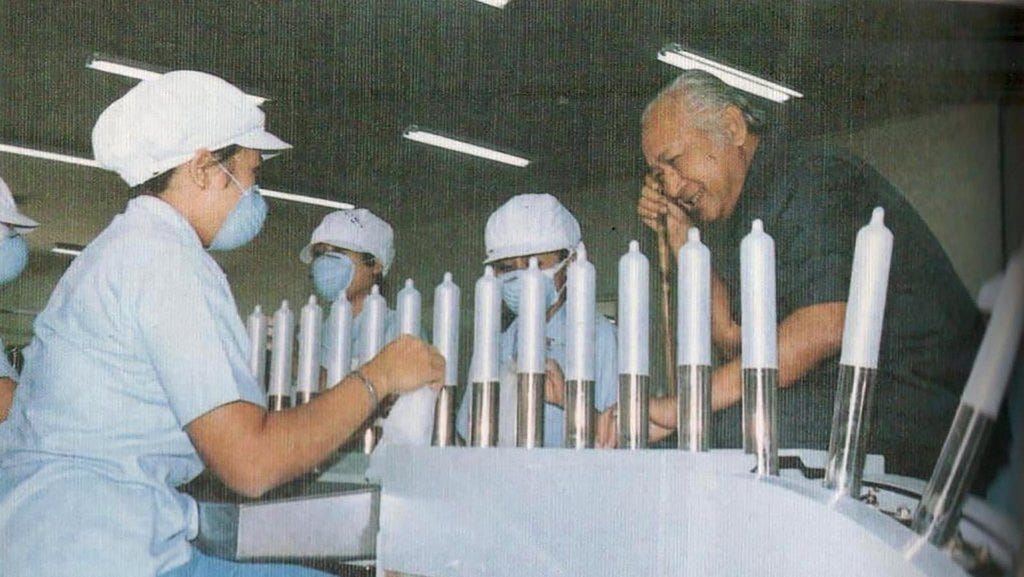
On the services side, the program began as a clinic-based operation concentrated in Java and Bali. Clinics provided contraceptives—primarily IUDs and birth control pills—through the Health Ministry’s network of community health centers (‘Puskesmas’). But officials quickly realized that clinics alone could not reach the tens of millions of eligible couples spread across 22,000 villages.
By the second Repelita in 1974, the BKKBN had pivoted to a community-based model. Trained fieldworkers were deployed to live and work in the communities they served. Village-level contraceptive distribution centers were established, stocking pills and condoms so that women could access them locally rather than traveling to distant clinics. Village volunteers—often recipients themselves—ran monthly meetings where supplies were distributed, motivation was reinforced, and community activities like nutrition courses and savings lotteries were held alongside family planning discussions.
The KIE effort was equally ambitious. The BKKBN went out of its way to change the way Indonesians thought about family size altogether. Fieldworkers went door to door. Community and religious leaders were enlisted to carry the message. The program made use of traditional local institutions. In Bali, for example, the banjar (a hamlet-level cooperative unit) was recruited to normalize family planning as a community matter, with household heads required to publicly report the contraceptive status of every married woman of reproductive age under their roof.
The BKKBN’s role within all this was formally that of a coordinator rather than a direct implementer. Its major functions were to set policy guidelines, channel funds, and monitor the work of implementing units.
III. Amassing public support: Grounded campaigns and threading religious sensitivities
Even with Suharto’s nod of approval, extensive social engineering had to be done to normalize the program among the masses. Given Indonesia’s large rural and religious population, acceptance of the program meant having to shift national social norms that had been centuries in the making.
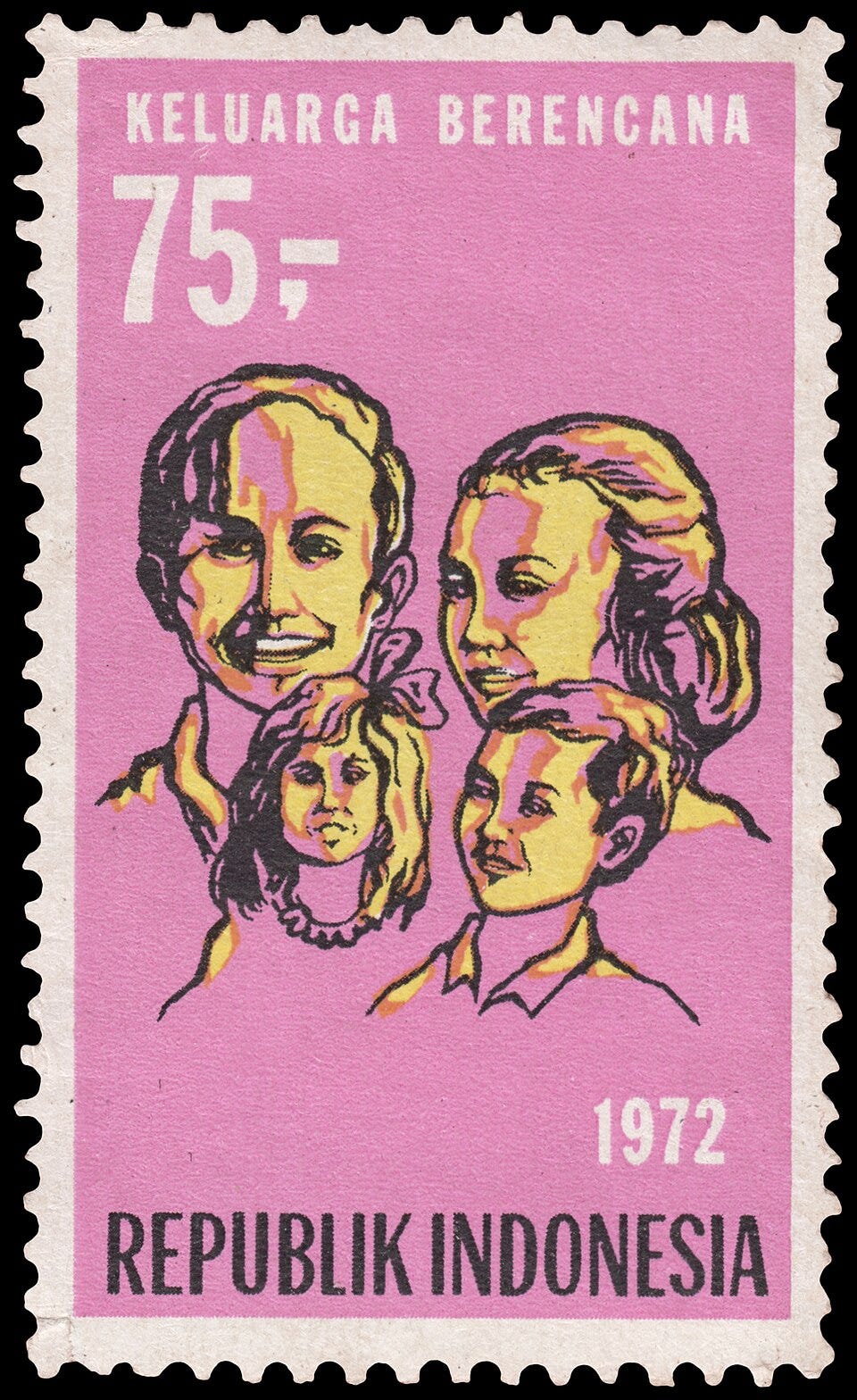

Before family planning was initiated, the phrase “banyak anak banyak rezeki” (many children equal many blessings) was the dominant belief. Children were seen as gifts from God and a telltale sign of future prosperity. Under Suharto, this framework was systematically reframed. The new slogan of “dua anak cukup” (two children are enough) was plastered, directly and indirectly, across state-sponsored advertisements, postcards, stamps, national speeches, and every other available medium.

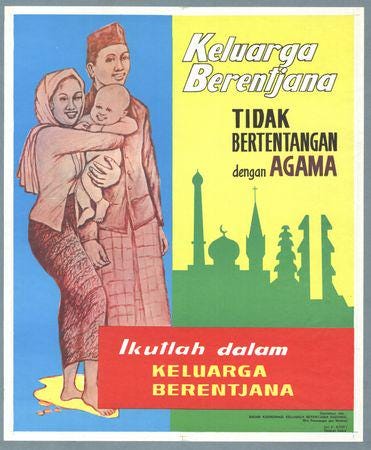
PSA campaigns aside, the regime also understood that the program could not succeed through government messaging alone. With Muslims making up nearly 90 percent of Indonesia’s population, the moral authority of Islamic leaders was not something the BKKBN could afford to work against.
As early as 1968, before the BKKBN was even formally established, Suharto’s government held closed-door discussions with national religious leaders to reach a consensus on which contraceptive methods could be religiously sanctioned. Abortion and sterilization were ruled out and kept off the official program. The IUD raised extensive debate, but was gradually accepted by religious authorities, provided insertion was performed by a female doctor or, in emergencies, a male doctor in the presence of the woman’s husband. By the end of the New Order, birth control pills and injections were the main contraceptives used in the program
The two major Islamic mass organizations—the Nahdlatul Ulama (NU) and Muhammadiyah—were the primary targets of this outreach. NU, the organization with a larger rural base, issued a declaration in 1969 framing family planning “not as limiting family size but as spacing pregnancies for the welfare of mothers and children.” Muhammadiyah followed a similar path, ruling in 1971 that family planning was permissible provided it served the well-being of families and society.
Once national religious leaders were on board, the BKKBN worked downward. Family planning fieldworkers were instructed to actively involve local religious figures—the kyai, or Muslim clerics—in their outreach activities. In known strongholds of orthodox Islam, such as East Java, Madura, and Aceh, the legitimizing power of these local leaders was especially critical. For ordinary villagers, whether modern contraception was morally permissible depended in large part on what their local kyais said.
While largely effective in securing local support, the approach was not without friction. Religious opposition never fully disappeared, and family planning would often become a proxy for broader resistance to the New Order regime.
The result speaks for itself
Indonesia’s total fertility rate dropped from 5.6 children per woman in the mid-1960s to 2.1 in 2025. Accompanying this was a parallel drop in infant mortality, from 146 deaths per 1,000 live births in 1960 to around 17 per 1,000 in the present day. In achieving its stated goal of controlling population growth, the program was, by conventional measures, a success.
The program’s emphasis on reaching rural areas has also left lingering effects in the present day. In a 2018 survey conducted by BKKBN, the agency found that contraception use in rural areas stood at 64.2 percent, slightly higher than the 63 percent in urban areas, making villagers more “woke” than their metropolitan counterparts.
Beyond fertility rates, the program reshaped Indonesia’s population growth to a much more sustainable rate. The population growth rate, which stood at 2.8 percent in the mid-1960s, fell to 1.49 percent by the 1990s and 2000s, and has since declined further to around 1.1 percent between 2020 and 2025. The contraceptive prevalence rate, which had been below 5 percent when the program launched, reached 57 percent among married women by the end of the New Order, and around 61 percent by 2025.
Objectively, the family planning program was a major success in achieving its goal of meeting demographic targets. With a controlled fertility rate, Indonesia positions itself strategically as a country that is young enough to continue existing while not growing fast enough to significantly strain the nation’s budget and its limited natural resources.
But it came with a cost
It is unjust to laud the program’s success without mentioning its glaring social costs. Given Suharto’s top-down approach, methods of coercion were commonplace throughout the program’s implementation. This was most evident in the experiences of women—the overwhelming majority of program recipients—who were treated not as individuals with agency but as targets of a demographic goal.
The BKKBN’s conception of women was narrow: wives and mothers, not individuals with independent reproductive rights. It wasn’t uncommon to hear stories of women coerced, pressured, or manipulated into accepting contraception—particularly IUDs—without informed consent.
The military conducted annual “social service” visits called Safari, in which soldiers descended on villages to recruit family planning acceptors, often arriving with quotas to fill. Their presence alone was enough to intimidate; in areas where Safaris were announced, women would hide in their homes to avoid being pressured on the spot.
A lesson for the current administration
President Prabowo Subianto has ambitions arguably grander than family planning, like ensuring free meals for millions of students and developing Indonesia’s village-level economy through 80,000 cooperatives. These are programs that cost our taxpayers hundreds of trillions of Rupiah, whose implementation has been questionable at best and burdensome at worst.
We think the three lessons outlined in this piece could be useful for how these flagship programs should be implemented: careful planning and technocratic solutioning, balancing top-down and bottom-up approaches, and getting widespread public support through understanding local contexts.
Editor’s note: Most of the information gathered for this analysis came from the book Two Is Enough. Family Planning in Indonesia under the New Order 1968-1998, edited by Anke Niehof and Firman Lubis. We cannot recommend this book enough as a comprehensive deep dive into Indonesia’s family planning program.
Do any of our readers work within the public health and family planning sector? We would love to hear your take on this issue and any on-ground stories that could enrich this discourse with more context and nuance! Comment below or reply to this email.