

The author is a public policy researcher who has evaluated government transparency and public service delivery across Africa, Asia, and Europe. This article reflects the author’s own analysis and views and does not necessarily represent those of his employer or The Reformist.

Sixteen months in, President Prabowo Subianto’s first term has been eventful… to say the least. From announcing the 100 gigawatt solar power ambition to nominating himself for mediating geopolitical rows, you can say that his plate’s been full.
Yet one program continues to stand out from the rest: the “free” nutritious meal or Makan Bergizi Gratis (MBG). With a Rp335 trillion price tag—roughly 8.7 percent of the 2026 state budget—this is, in every way, shape, or form, Prabowo’s flagship program.
A year ago, I read The Reformist’s piece on MBG. I recommend reading this one first, as this builds on the strong case it already made.
Unfortunately, things have not improved much since then. MBG’s problems unraveled over time: from food poisoning to fictitious partner kitchens (Satuan Pelayanan Pemenuhan Gizi or SPPG).
Before you dig in…
A 2025 report by the Food and Agriculture Organization (FAO) estimates that 43.5 percent of Indonesians cannot afford healthy and nutritious food. That said, I think we can all agree that MBG is not an inherently bad policy in and of itself. In fact, school meals provision is common across the world. What is alarming from MBG is the “how.”
MBG is a signal that President Prabowo prioritizes electoral appeal over structural improvements. Of course, he is far from the only politician who think this way. However, the problem lies in the fact that MBG has evidently constrained Indonesia’s already-weak fiscal structure: a low tax-to-GDP ratio, heavy reliance on income and value-added taxes, and significant spending on social, infrastructure, and vanity initiatives.
One might argue that perhaps MBG’s current implementation is plagued with problems because we’re not giving it enough time to succeed. Perhaps things will fall into place as we learn more about how to do it properly. But the thing is, MBG is not the first program of its kind. We already had a version of it—way before—and it is a superior one, I would argue, as it didn’t trade off prudent decision-making for the sake of scaling up.
New Order-era school meal program that made sense, unlike MBG
Okay, I know that putting the “New Order” regime and “sense” don’t really, well, make sense, but hear me out.
In 1997, then-President Suharto issued Inpres No. 1 of 1997, formalizing the Supplemental School Feeding (Pemberian Makanan Tambahan Anak Sekolah, hereafter ‘PMT-AS’) project. Some forms of it had already existed since earlier in the decade, but this regulation established a structure and remit around the practice.
Here is how it differs from present-day MBG:
I. Clarity in intention
PMT-AS was specifically designed for students in underdeveloped areas first and foremost. Unlike MBG, it did not create a massive infrastructure and hierarchy that required trade-offs across other sectors to run.
It’s almost like PMT-AS was designed as a trigger: over the course of 9 months, elementary students get PMT-AS intake at least 3 days per week for a total of roughly 108 days. That means no food delivery while the students are on school break, also unlike MBG.
Moreover, PMT-AS was targeted and anchored in how nutritious meals are leveraged to improve education. Whereas MBG clearly lives by “the bigger, the better” principle.
See how PMT-AS is distinct from MBG on key aspects from this comparison table:
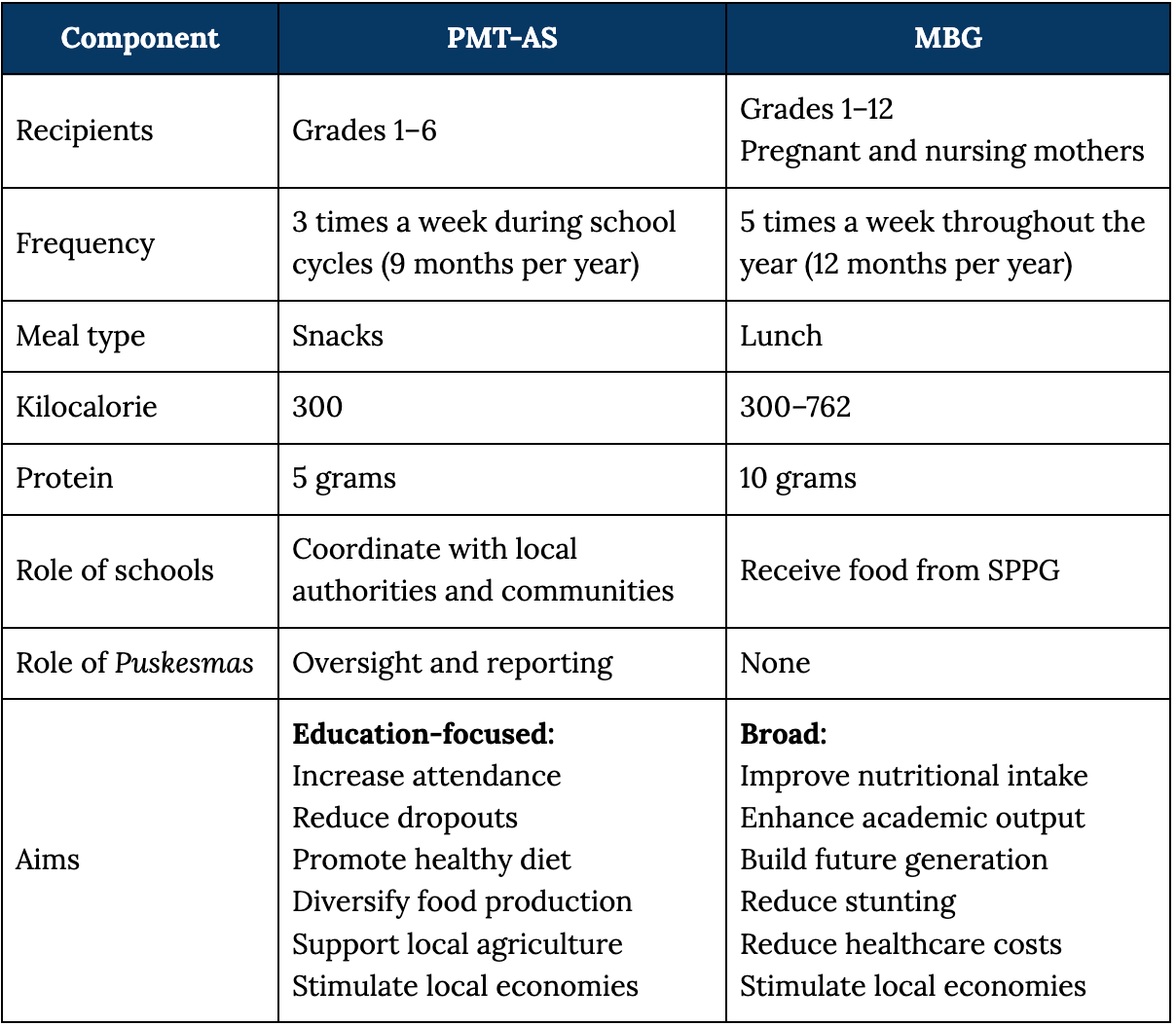
After reading the table above, it’s tempting to think that MBG is the superior project. After all, it feeds more people and the government centrally manages it—something that we often read as a signal of stronger political will.
Interestingly, the evidence suggests otherwise.
Consider this: The World Food Programme (WFP) advocates school feeding programs globally as they are widely recognized as an effective tool for very specific purposes: improving school attendance, increasing short-term concentration and learning, enhancing dietary diversity, and providing social protection buffers for students from low-income households.
But this is where MBG stops making sense. It sets out to do one thing and then claims to have accomplished something entirely different.
What MBG does is provide school lunches. What it purports to achieve is—let’s pick one from the many on the list—to reduce stunting. There is a logical acrobat here. To start with, science says that stunting prevention is concentrated in the first 1,000 days of life, roughly until a child reaches age 2. That is years before they begin receiving MBG in schools, which typically starts at age 6–7.
Alas, this “confusion” may not be surprising if we look at the governance of the institution mandated to implement MBG: the National Nutrition Agency (Badan Gizi Nasional, or BGN). Among its 10-person leadership structure, none has public health or education credentials, and six are retired police and military personnel. Infamously, Deputy Speaker of the House of Representatives, Cucun Ahmad Syamsurijal, claimed that MBG does not need nutrition experts to run effectively. Well, what gives?
Ultimately, there was one thing that PMT-AS was clearly superior in: intention.
It did not try to make the grandiose claim of providing lunches and magically eliminating stunting abruptly. It was honest about what it was aiming for: promoting local food with its “I love Indonesian Food” (Aku Cinta Makanan Indonesia, or ACMI) jargon, healthy diet, and the importance of breakfast for children who otherwise would have skipped it. Most importantly, PMT-AS was run by the aunties and uncles; the moms and pops of your communities, who wanted nothing more but to put great care into the food served on the table.
II. Procurement irregularity risks
Both PMT-AS and MBG require the government to deal large-scale, centralized contracts with many vendors. This process should be transparent, competitive, and accountable. In Indonesia, government procurement is overseen by the Government Procurement Policy Agency (LKPP), the Supreme Audit Board (BPK), and the Business Competition Supervisory Commission (KPPU).
But MBG operates within a hollow space where procurement rules do not seem to apply. Deploying such a budget size within a single fiscal year is a feat—sure, but it comes with major risks. It is particularly worrisome when you consider that, according to the Anti-Corruption Commission (KPK), procurement fraud is the second most common after gratification and bribery.
I am not saying that corruption risk is entirely absent from PMT-AS. But the decentralized model does mitigate risks better compared to MBG’s direct appointment model.
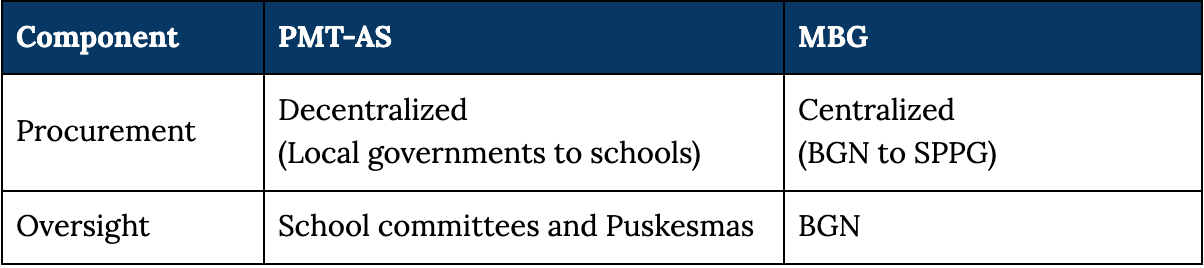
But if the government must initiate an open tender process for every MBG partner kitchen (SPPG), how long would that take?
Well, exactly. That’s my point.
There is a reason why procurement is designed in sequence. It is exactly to prevent hasty decision-making, conflicts of interest, and irregularities that cause the misuse of public funds. Building a programme with a daily turnover year-round like MBG requires a vast, complex supply chain that simply cannot—and should not—be rushed, as it has been made apparent.
Imagine if Borobudur were built on a swamp. That’s what President Prabowo is doing now. MBG drains so much of the state budget, but there is no structural integrity that protects it from crumbling down.
By all means, go big, but do it at scale, please.
III. The lost opportunity cost
So many others have made this point already—most especially this Project Multatuli’s masterpiece—so I’ll be brief.
For every rupiah spent on MBG, the government is sacrificing another priority. From healthcare provision, school expansion, early childhood support, climate adaptation, infrastructure maintenance, to so many other things that could create a bigger, more sustainable impact lasting beyond the day’s lunch break.
The main contrast between MBG and PMT-AS in this respect is that PMT-AS was financially “controlled” and geographically targeted. It didn’t claim to create impact beyond what it actually did. It had an effect on attendance, dietary habits, and dropout rate—nothing more. Because of that, it was able to actually achieve its goals.
MBG’s model of SPPG kitchens also defies FAO’s recommendations, which advocate home-grown school feeding models that link local agriculture to school meal procurement. And this goes beyond “local wisdom” or creating jobs. It supports smallholder farmers, stabilizes demand and supply at the local level (hence more resilient and independent communities), encourages economic diversification, reduces transport costs, and most importantly, instils community ownership of the feeding programme.
But PMT-AS was not without its flaws
In 2013, a thorough evaluation of PMT-AS underlined several structural problems: lack of funding, unclear guidelines, insufficient training for technical staff, inconsistent food quality, insignificant nutritional increase, poor hygiene, and weak integration with other social assistance initiatives.
MBG, as things stand now, seems to have “solved” the first of these problems—lack of funding—and glossed over the rest.
But there is a reason universal programmes like MBG are politically popular. After all, they are an effective tool to build broad constituencies of support—even if they do not materially and structurally make lives better for people in the longer term.
After all, how can anyone hate feeding children?
This debate is not about whether or not feeding children is a good policy. There is virtually no argument there. It is about whether Prabowo’s policy ambition comes at the expense of other key sectors or, even worse, a fiscal collapse.
MBG neither builds on nor improves the foundation established by its predecessors. It instead rolled back the objectively good aspects it had already been on track to achieve.
To fulfil the promise of MBG, President Prabowo must first begin at the most fundamental part: Reframe it as an education-linked social protection initiative, not a public health policy.
Only once that happens should he revisit scaling MBG nationwide—with a phased rollout plan that begins from the most disadvantaged regions and only expands into wider locations once operations mature at the top-priority spots.
In doing so, adopting an open, transparent procurement process through public tendering would be key to ensuring that MBG doesn’t haunt him in the future. Otherwise, I think it’d be remiss not to end with the cautionary tales of Hambalang in Susilo Bambang Yudhoyono’s otherwise net-positive legacy or KPK’s disarming which continues to define Joko Widodo’s administration and weakens government accountability today.
It’s just like when you climb a mountain too fast, and your body collapses from not having enough time to adjust to lower oxygen levels and reduced air pressure. MBG’s hasty redirection of trillions in public funds risks collapsing the country’s fiscal health and, when that happens, nobody benefits from saying, “I told you so.”


.jpg)
I wouldn’t have disliked MBG so much if the program's approach and implementation had been strategic and clear enough
Oh finally an Indonesian good writer who writes about Indonesia’s issues!