

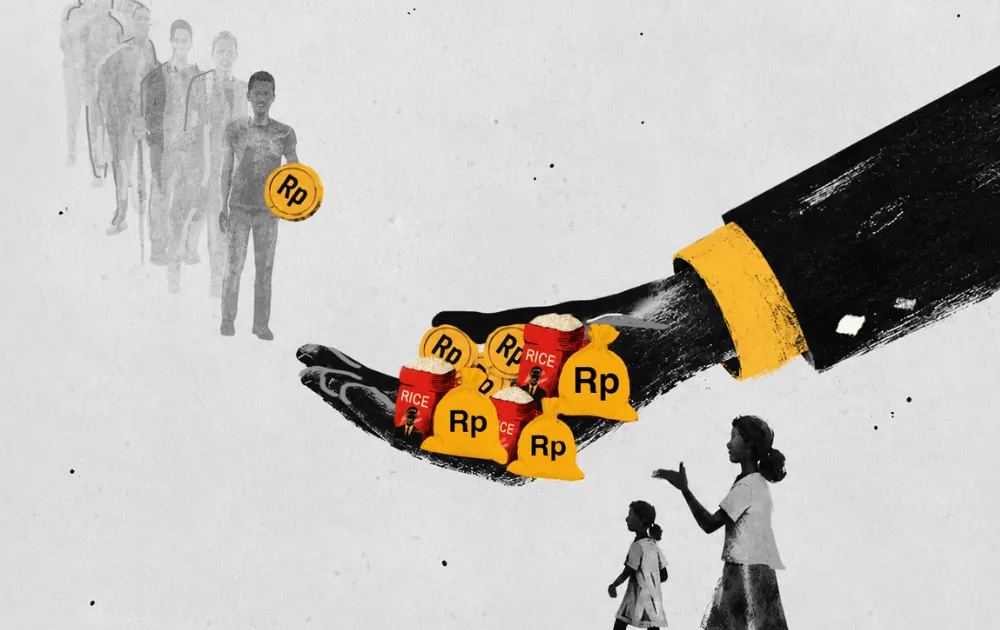
For most of you reading this article, government social aid or bantuan sosial (bansos) is perhaps something you’ve only seen in the news. Different versions of it can be traced back to at least three decades ago, right after the 1997 Asian Financial Crisis. It mostly came in the form of distributing essential goods to the lowest-income households, crafted and delivered by policymakers who decide what is best for a social class they don’t belong to.
That’s probably why we still see rice bags with the smiling face of a politician plastered on them and cash transfers handed out just before election day.
But for over 23 million people still living below the poverty line, bansos is not a political chip. It’s what makes life just a little bit more tolerable for the country’s neediest.
The evolution of bansos has attracted serious attention among researchers worldwide. Esther Duflo and Abhijit Banerjee, the 2019 Economic Nobel Prize winners and co-founders of the Abdul Lateef Jameel Poverty Action Lab (J-PAL), built their careers on conducting intensive studies to monitor and evaluate the 30-year lifespan of bansos programs.
In those three decades, Indonesia’s social aid system has reinvented itself many times over. This is the story that this edition of The Reformist invites you to explore across three key regimes: rice distribution, cash transfers, and digital reform. It is essential to acknowledge and learn the rigor and planning required to launch each of these initiatives, because good enough won’t cut it.
I. The rice subsidy era: A need for speed
Modern social aid programs in Indonesia began in response to the 1997 Asian Financial Crisis. The newly appointed B.J. Habibie administration initiated an urgent program called the Special Market Operation (Operasi Pasar Khusus, or OPK) to create a social safety net for low-income households to cushion the effects of the economic crisis.
Back then, the government decided that rice was the most essential to ordinary Indonesians’ everyday lives, so rice became the centerpiece of this program; distributed to the lowest-income households across the country.
OPK allowed every eligible household to purchase 10 kilograms of rice every month at Rp 1,000 per kilogram — 50 percent cheaper than the Rp 2,000 per kilogram market price at the time.
The program was launched on 1 July 1998, under the leadership of the State Logistics Agency (Bulog), using population datasets from the National Population and Family Planning Board (BKKBN), and employing local government officials across 27 provinces to distribute the rice en masse.
What is perhaps most striking about OPK was the variables the government used to decide who received the rice packages. Because it had used BKKBN’s data as its basis, the program also used the institution’s economic classification system.
The lowest tier in BKKBN’s system was the “pre-prosperous family” (KPS), households that fail to satisfy one of these five seemingly arbitrary variables:
Eating at least twice a day.
Living in a house with flooring (not dirt).
Wearing different sets of clothes for work and leisure.
Taking a sick child to a clinic rather than a shaman (dukun).
Performing basic religious observance according to each family’s faith.
However crude these requirements may look today, the BKKBN identified over 7.3 million households — 15 percent of the entire Indonesian population at the time — belonging to this social class. Due to the financial crisis, the list grew to 12.8 million after more families fell into the KPS category.
What worked: Working with what we had to achieve the goal
As hasty as the program was, OPK was successful in what the program was primarily designed to do: deliver rice quickly to as many people as possible, en masse.
An evaluation report by the SMERU Research Institute in 1998 found no evidence of people stealing and reselling rice, though it found several “leakage opportunities”, and that the delivery and purchase of rice in some provinces were done adequately.
We understand why the government chose the BKKBN data for OPK, as it had already mapped the then-three-decade-old family planning program. They used the best available datasets they had, but it was simply not built for the problem they were trying to solve.
Read The Reformist’s volume on Indonesia’s family planning program here.
Importantly, the overall supply of rice from Bulog also remained sufficient throughout the program, despite the high demand in such a short timeframe (though the quality of the subsidized rice was not the best). Much of that supply readiness can be attributed to how social aid was carried out during the New Order regime.
Before 1998, rice distribution programs were supply-focused. The government targeted farmers and crop producers to increase the country’s overall rice supply by providing easy credit and fertilizer subsidies to increase productivity. The goal was to keep rice prices low, ensuring that this essential good remains accessible for the majority of Indonesians.
This New Order-era state intervention sought to reduce poverty through a trickle-down effect via job creation and easy credit lending, instead of direct aid.
But then the 1997 financial crisis shifted the way the Indonesian government sought to help its citizens. From then on, social aid programs became more beneficiary-facing, directly providing basic goods like rice to lower-income households.
What didn’t: Everything else
Unfortunately, everything else about the OPK program was lackluster.
Coordination between central government institutions and on-the-ground field workers became a major problem. Field workers updated household statistics every month, raising the number of eligible households to 12.8 million by October. But the central government continued planning and allocating rice against an outdated BKKBN count of roughly 8 million households, causing uncertainty for central-level planners and on-the-ground workers.
Mistargeting became the most severe issue. Despite a large number of recipients, it was often the case that poor households that most deserved rice did not end up receiving an OPK package. BKKBN’s criteria were more a reflection of asset-based proxies than the individual expenditures of a household’s actual income or consumption. A family can still be poor in every other aspect despite living in a house with proper flooring.
BKKBN’s database also excluded households that weren’t the conventional married nuclear family (since the data was originally meant for family planning, not social aid). Widows, divorcees, and groups of unmarried individuals were thus systematically left out of consideration for the program.
A large factor in the mistargeting problem also lies in local leader discretion. Because local leaders (like village heads) were responsible for distributing rice to individual households, rice distribution became unequal and largely discretionary. Elite capture had perverted the program implementation.
A 2001 evaluation study of OPK found that local village heads would typically ignore government-created lists entirely and disburse rice depending on who they personally saw fit. Some villages targeted the rice well while others simply divided it evenly among all households regardless of need. Village heads argued that the BKKBN’s lists failed to recognize which families were actually poor in the locality, causing them to act on their own judgment.
Lastly, this program required households to pay in cash for their subsidized rice. This made it more difficult, especially for the poorest ones, as they had no cash to purchase their monthly allocations to begin with. As a result, the program grew a backlog of excess rice that was needed by many who simply couldn’t afford to pay for it. The excess then ended up in the hands of more affluent households who had cash to spare, defeating the purpose of the entire program.
An unripe evolution
For an initiative that had to roll out quickly due to the threat of an unexpected crisis, the way OPK was disbursed in a rational, data-driven (however arbitrary the criteria), and organized manner is somewhat a commendable feat. So it wasn’t a shock that the program continued to exist even after the economic crisis ended.
In 2002, the government doubled down on the “rice” tag and renamed OPK into the Rice for the Poor program, or “Raskin”. In this new era, the government began experimenting with new ways to deliver social assistance programs.
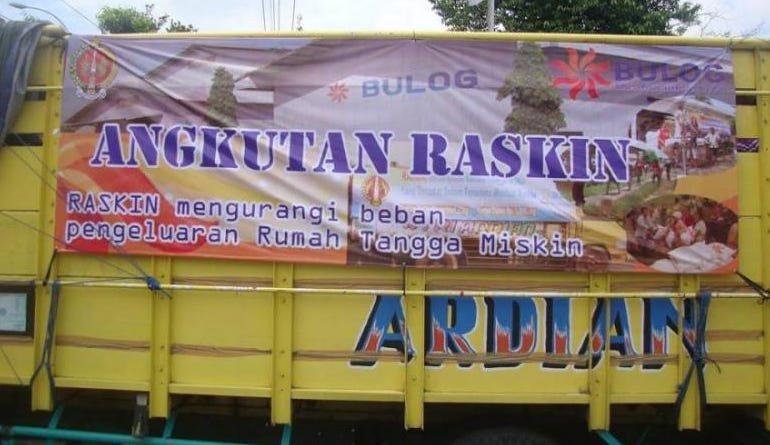
BKBBN datasets were eventually scrapped in favor of the growing Statistics Indonesia (BPS) agency, and the government began to conduct periodic censuses to regularly update the conditions of poverty in the country.
Despite procedural overhaul, non-poor households kept on receiving subsidized rice that wasn't meant for them. In 2005, poor households accounted for only 25 percent of Raskin subsidies, whereas the remaining 75 percent went to non-poor households. By 2010, little had changed as around 70 percent of Raskin’s total beneficiaries were still non-poor.
II. The cash transfer era: PKH and BPNT
Public policy researchers and policymakers have long recommended direct cash transfers as a better, cost-effective, and result-yielding alternative to in-kind distribution schemes in which goods are transferred from the government to households.
The first Direct Cash Transfer (BLT)
The first breakthrough came under President Susilo Bambang Yudhoyono’s (SBY) administration. In the wake of rising fuel prices in 2005, the government rolled out its first unconditional cash transfer program called Direct Cash Transfer (BLT), distributing Rp 1.2 million per household over the course of the year.
In this program, BPS was entrusted with identifying eligible households. The statistical agency conducted a basic national health and education survey, the SDKP, and found over 19.1 million households eligible for the cash transfer program.
Critics, however, argued that the program falsely targeted households that were vulnerable yet remained above the poverty line. They were afraid that this would create a practice of dependency on the program and that the additional income would instead be used for non-essential goods like alcohol or tobacco.
The Family Hope Program (PKH)
This one-off cash distribution scheme paved the way for the creation of the Family Hope Program (PKH) in 2007. Instead of “universal” coverage, PKH was turned into a conditional cash transfer program meant for the extreme poor (people living below 80 percent of the poverty line). Households are only eligible if they meet certain criteria and abide by strict conditions to receive money for a sustained period.
When designing PKH, the Indonesian government took inspiration from a largely successful conditional cash transfer scheme in Brazil, called the Bolsa Familia. Formally introduced in 2003 by then-and-current Brazilian President Luiz Inácio Lula da Silva, Bolsa Familia consolidated four of Brazil’s existing cash transfer programs into a single poverty aid scheme.
Bolsa Familia has been noted as generally successful in increasing household consumption, reducing rates of childhood stunting, and reducing overall poverty in Brazil.
Copying Brazil, Indonesia launched the program under the leadership of the Social Affairs Ministry. PKH was novel in its function and delivery.
Beneficiary households were initially intended to stay in the program for two to four years, over which PKH aimed to reduce poverty, child malnutrition, and work participation. While benefiting from this program, households were expected to boost consumption of high-energy and high-protein foods, as well as raise their children’s educational attainment and school attendance rates.
To keep receiving their quarterly transfers, recipients had to meet conditions such as frequent health and prenatal checkups for pregnant women, complete childhood immunization and health checkups for families with children aged 0 to 6, and school enrollment and high attendance for those with children above the age of 6.
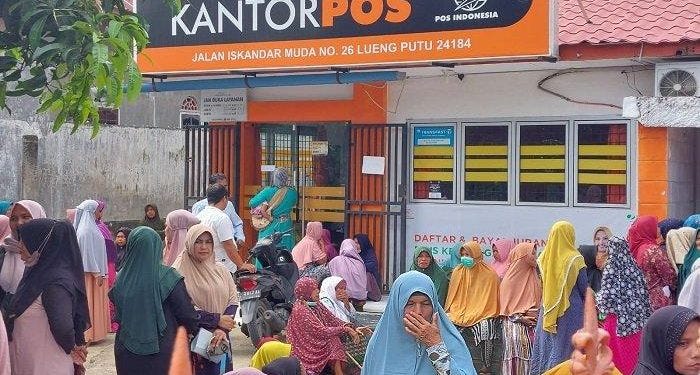
Each family receives a range between a minimum of Rp 600,000 and a maximum of Rp 2.2 million in quarterly payments. The more children a family has in the house, the higher the nominal amount they get. The cash is delivered and received through the post office, cutting out an intermediary figure who may use their discretion in bad faith.
When the program first piloted in 2007, PKH covered 300,000 families across seven provinces. By 2025, that number had skyrocketed to over 10 million households across the entire country.
How PKH solved Raskin’s mistargeting but exposed a new problem
While PKH and Raskin served two different goals, the former was able to mitigate mistargeting in ways that matter.
One 2019 study evaluating both programs found that Raskin suffered a significant inclusion error, meaning households who weren’t supposed to receive rice ended up eligible. Raskin reported beneficiaries of up to 35 percent of all Indonesian households, overshooting its 22 percent target.
PKH, on the other hand, did not suffer the same fate. Instead, it failed to include more families in the program. The same study found that PKH was only able to reach 9 percent out of the desired 14 percent of Indonesian families (this finding says more about the difficulty of reaching the poorest households than it does about targeting).
BPNT, an evolved Raskin?
Even with the introduction of the PKH, the Raskin program continued well into the Joko “Jokowi” Widodo presidency. The program was renamed to Rice for Welfare (Beras Sejahtera, Rastra) in 2015. The name swapped out the word “poor” for “welfare”, for a more optimistic tone. But this name change was largely cosmetic, offering little systemic change to the operationalization of the social aid program.
All the way up to 2017, the price for this program’s subsidized rice hovered at around Rp 1,600 per kilogram, despite two decades’ worth of inflation and the market price of rice leaping to approximately Rp 9,000 per kilogram.
It was in this year that the government only began implementing structural reforms to Raskin/Rastra. The theory: if rice was prone to local discretion, then it would be best to take that decision-making away from local leaders completely.
So what they did was replace the goods distribution system with a food voucher program called the Non-Cash Food Assistance Program (BPNT). During this transition period, the government also made Raskin/Rastra rice free before the new program kicked in nationally. In addition to rice, this new program also allowed for the purchase of eggs as an additional source of protein.
Instead of receiving rice directly from local leaders, each eligible household is given a Rp 110,000 monthly voucher that is transferred to a debit account owned by a female adult in the household. The figure was set slightly above the market price of rice at the time of the program’s launch (approximately Rp 9,700 per kilogram) to compensate for additional logistical costs, since rice is not distributed directly to households as was the case for Rastra.
For BPNT, individual households must now travel to local shops set up in each village to redeem their vouchers in exchange for goods. For each purchase with a voucher, the corresponding amount would be deducted from the voucher’s remaining credit.
The change to set up shop in localities resulted in cheaper administration costs for the overall program. Whereas for every rice package delivered under Rastra, the delivery took 4 percent in administration fees; BPNT only cost the government between 0.75 and 2 percent.
Importantly, these vouchers cannot be withdrawn from a bank account and can only be redeemed to purchase rice and eggs found in local shops, limiting misuse of funds.
The change from Rastra to BPNT was also met with local resistance, especially from representatives of Indonesia’s outer regions. Heading into 2019, the Rastra program was to be officially discontinued, but Papuan representatives pushed back on the change on the basis that the Rp 110,000 voucher would be ineffective in a region like Papua where 10 kilograms of rice could cost up to Rp 400,000.
Despite this pushback, the program ensued. At the macro level, the program was successful in generating better results than Rastra. A 2021 evaluation study that compared BPNT districts to those that were still running Rastra found that targeted households received 45 percent more assistance in voucher regions than in in-kind districts, and among the poorest households the poverty rate fell by 20 percent.
III. Bansos today: Wicked problems, digital solutions?
The underlying denominator for every social aid program that has appeared over close to three decades is the government’s adaptability in seeking the best data available.
When the Habibie administration launched OPK, it used data from the BKKBN because it understood that the agency had three decades’ worth of population data from its family planning program.
When BLT came around, BPS had started to set its mark as the government’s go-to database provider. The government continued to update its targeting procedure, but the problem remains that a national census can only be done periodically, is expensive to run at scale, and fails to catch up with the living conditions of individual households as time passes.
This is where the current era’s reform package becomes interesting. There are now greater opportunities for a demand-driven social aid program in the age of digitalization and artificial intelligence. Under the current administration, the Digital Transformation Acceleration Committee (KPTDP) has stepped forward as the agency responsible for these digital reforms.
The new system’s novelty is in the paradigm shift. Instead of relying on the government to begin, plan, and distribute social assistance, whether it be rice or e-vouchers, eligible recipients can now request them on-demand. A mix of self-targeting and institutional cross-checks.
Through a digital portal, individuals will only have to sign up with their identity card and credentials. Afterward, the system will take over, cross-checking an individual’s living conditions through BPS’s new central welfare database (DTSEN) decile classification, employment and income records via the Workers Social Security Agency (BPJS Ketenagakerjaan), chronic illness status via the Healthcare and Social Security Agency (BPJS Kesehatan), bank account activity, and land and vehicle ownership.
The graph below helps better explain the registration process of this new digital system.
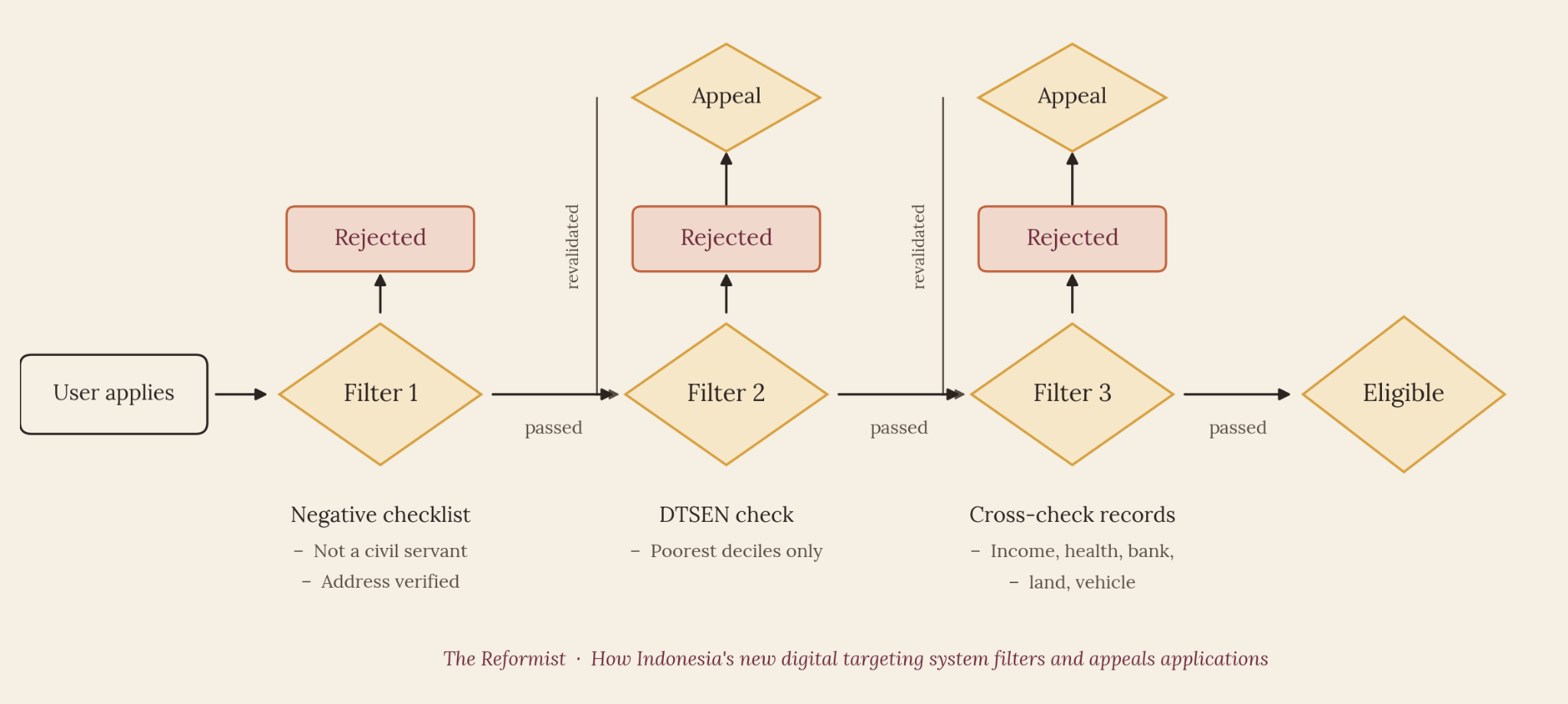
For PKH, this means an already pregnant mother would not have to go to the post office to receive her quarterly checks. If they also happen to be part of the BPNT program, e-vouchers would be distributed instantly within the same distribution cycle. For individuals without smartphones, extension workers will be deployed to aid in the registration process.
Since the end of 2025, the agency has been conducting a pilot program in Banyuwangi, East Java, to test run this system for both PKH and BPNT. Since then, the results have been noteworthy.
The pilot program drew over 300,000 registrations. Of that total, 44 percent of BPNT applicants and 30 percent of PKH applicants were deemed eligible. What is most striking is the PKH figure in absolute values. Over 87,386 households were eligible for the PKH program, over double the number of existing PKH recipients in Banyuwangi at 40,028, and more than the city’s 54 thousand quota if the DPI numbers were adopted.
This means that not only has PKH suffered a massive exclusion error, but government predictions on just how many poor households there are in this country are also staggeringly low. Nonetheless, the program’s findings highlight the potential of what a fully digital and integrated social assistance program may look like.
It also remains to be seen whether this digitalization program can reproduce the same effects for other districts and villages over the long-run. With the Banyuwangi pilot project done, the agency has announced that it will expand the pilot program to 143 new cities and regencies to further socialize and stress-test the new system.
Lessons from the past, present and future
Every generation of Indonesians living today has had a version of social assistance designed to solve one problem while creating or ignoring another. OPK sped up the delivery of goods but leaked badly. PKH and BPNT were better targeted but excluded its most marginalized beneficiaries. KPTDP promises to fix human errors, but what if the machines and algorithms become new barriers instead?
For the better part of this three-decade evolution, Indonesia has flipped the switch on how it delivers aid to the poorest citizens in the country. It has been a long and tumultuous process, but it is one filled with technocratic and policy-making rigor.
While reform stories like these usually take a back seat to high-stakes corruption cases and geopolitical news, it is important for us at The Reformist to highlight major reforms that have taken place and are currently taking place in Indonesia.
The three decades’ worth of persistent political support of the programs, despite regime changes, shows that a pro-poor program can withstand the test of time. While we are not naive to the fact that these programs have been misused by those in power to expand and secure political capital at the grassroots level, the ongoing reforms to the program show that at least real efforts are being made to raise the living conditions of Indonesian citizens.
Instead, the call to action is for Indonesia’s political leaders to protect these programs from partisan agendas. It shouldn’t be the case that social aid only makes the news when rice packages are plastered with faces of presidential candidates or that subsidies are rolled out months in advance to appeal to the electoral cycle.
Moreover, as the government continues to upgrade these programs, critical questions arise in this new age of digitalization. What happens if the data is wrong? What if the machines and algorithms make false assumptions about who should and shouldn’t receive aid? What if the lack of integration across the government’s many databases renders someone ineligible merely due to administrative mix-ups?
These are some of the most crucial questions that digitalization reforms must answer, or risk repeating the same mistakes of their predecessors. It is good that the government continues to evolve its social aid programs at a technical level. But technical improvements must come with a clear strategy to distribute bansos equally and equitably.
Perhaps in a year’s time, we can return to this topic with new information and evaluation notes. Perhaps by then, we will be looking back at this volume as nothing more than a cautionary tale — as real material benefits have been delivered in even greater numbers to the country’s neediest.
Writer's note: Reading this article back amid debates over decile classifications, it is not appropriate to say that PKH solved Raskin's inclusion error and that it only suffers from an exclusion error. While both statements have some form of truth in them, the statistics used to explain the point are wrong. The 14 percent PKH and 22 percent Raskin figures are the total quota of Indonesian households covered under the program. This translates to 10 million PKH and 15.6 million Raskin households. By eligibility rules, deciles 1 through 4 (~28 million households) are eligible for PKH, whereas deciles 1 through 5 (~ 35 million households) are eligible for Raskin (https://x.com/anshory72/status/2089185041247301949/photo/1). This means that the government has set a quota lower than the total number of eligible households in Indonesia. This could have been a budget constraint issue or perhaps just mere institutional incapacity to distribute that much social aid.
For the exclusion and inclusion error numbers themselves, the numbers are much more staggering. Based on 2025 Susenas data, over 76 percent of PKH-eligible households and 74 percent of BPNT-eligible households were excluded from the program. On the other hand, over 46 percent of PKH-ineligible households and 36 percent of BPNT-ineligible households were incorrectly included in the program (https://iemonitorm-hu9hzzzgzjvysu7k8mmj2y.streamlit.app/).
This is in combination with the fact that 16.5 million households are now jointly announced as PKH and BPNT recipients under the "Keluarga Penerima Manfaat" (KPM) label (https://setneg.go.id/baca/index/pemerintah_salurkan_bansos_pkh_dan_sembako_bagi_165_juta_keluarga).
Semoga Pak Prabowo bisa melanjutkan program baik ini💪🏽 demi pertumbuhan ekonomi 8%🇮🇩🇮🇩🇮🇩