

In late February, white Mahindra Scorpio pickup trucks began arriving at the port of Tanjung Priok in Jakarta, the words Koperasi Desa Merah Putih (Red and White Village Cooperative, hereafter ‘KMP’) stickered across their bodies. Nobody was quite sure what to do with them. They were meant to serve some of the 80,000 KMP planned by the Prabowo administration. But most of these cooperatives did not exist in any operational sense. So the trucks were sent to military district posts to… park.
The confusion didn’t stop there. Instead, more trucks were coming: 105,000 vehicles imported from India by state enterprise PT Agrinas Pangan Nusantara at Rp 24.66 trillion. This was a strange decision disputed by many. The Chamber of Commerce asked the president to cancel the purchase. The automotive association said domestic manufacturers could have supplied them. Indonesia Corruption Watch demanded procurement documents. Even the House Deputy Speaker, Sufmi Dasco, suggested postponing the purchase.
To make matters worse, the government is not only spending Rp 240 trillion on a program villages did not ask for, but it is also doing so by bypassing the open procurement process for vehicle purchases, violating the Cooperatives Law’s principle of voluntary member financing, and seizing village funds that communities are legally entitled to control.
This pickup truck saga is more or less a miniature of the larger KMP kerfuffle: money disbursed at speed, assets delivered before the cooperative units even exist, and questions around the program treated as background noise.
Blatant misallocation of the Village Fund
KMP is the latest in President Prabowo Subianto’s portfolio of megaprojects, each sharing the same DNA: staggering scale, compressed timelines, and eye-watering fiscal commitments. What sets KMP apart, however, is where its money comes from. Not the central budget in any conventional sense, but village funds, quietly repurposed to underwrite a program that villages did not ask for and will be forced to pay for regardless of outcome.
The math is simple. Each cooperative gets a credit facility of up to Rp 3 billion, channeled through state-owned banks (Himbara). Across 80,000 units, the total financing envelope is Rp 240 trillion, roughly a quarter of all ministry spending in the national budget. Himbara provides bridging loans to Agrinas, the sole construction executor appointed by the government. Then, the Finance Ministry repays the banks at Rp 40 trillion per year over six years. The repayment source? Village funds.
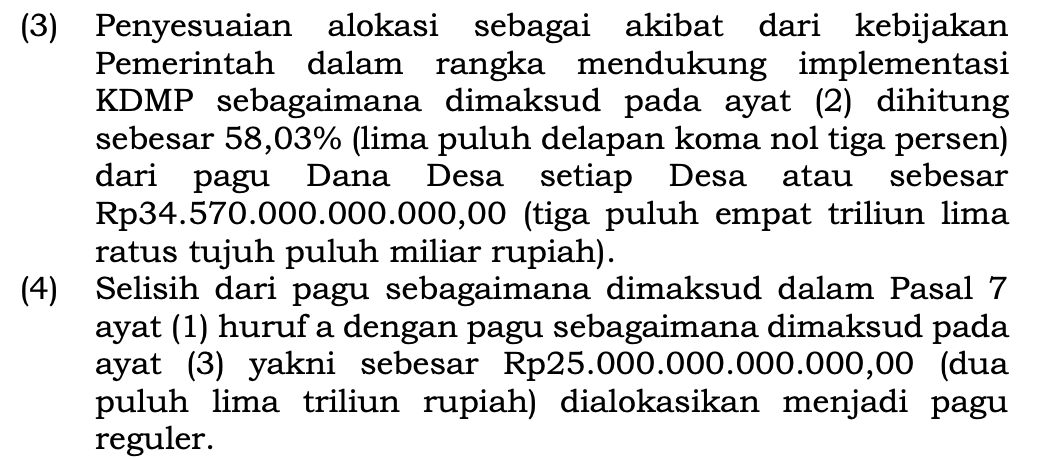
In February, the Finance Ministry issued a Finance Ministerial Regulation (PMK) No. 7/2026, mandating that 58 percent of the national village fund allocation, some Rp 34.57 trillion out of Rp 60.57 trillion, go toward KMP. What remains for roads, sanitation, schools, and clean water across 74,000 villages is about Rp 25 trillion.
This is ironic because village funds were designated under the 2014 Village Law to allow communities to set their own priorities through participatory planning. But now this principle has been overridden by a central decree. What happens now—between the central government and villages—is no longer a partnership. It is requisition.
The risk compounds further down the chain. Most KMP board members have no prior cooperative management experience, no bookkeeping skills, and no business planning capacity. A study of 108 village heads across 34 provinces found that 65 percent identified significant governance gaps, with many flagging the program’s vulnerability to fraud.
So what happens if cooperatives fail to generate revenue? Villages still pay through automatic deductions from their fund allocations. The state builds, the state lends, the state guarantees, but the village absorbs the loss.
With huge funds comes a huge responsibility (one that many villages are not equipped to take)
When Prabowo launched the 80,081 KMP in Klaten in July 2025, only 108 were operational. More than 99 percent existed only as legal entities on paper. By late 2025, the Cooperatives Minister himself asked the President to push back the March 2026 deadline to establish all units. Meanwhile, Agrinas had already received Rp 600 billion in construction advances and paid Rp 7.39 trillion as a down payment on the Indian vehicle imports.
The scope, too, keeps expanding. What began as village grocery stores and savings units now includes clinics, pharmacies, cold storage, logistics hubs, solar panel farms of up to 1.5 hectares per village, and over 100,000 imported vehicles.
Side note: We wrote about the administration’s 100 GW solar capacity ambition, 80 GW of which would be supported by village-level plants administered by KMP in this piece.
A cooperative meant to do everything risks becoming nothing clear. And through it all, Agrinas operates with no publicly disclosed cost breakdowns, no competitive procurement, and a CEO who tells parliament that Rp 1.6 billion per outlet is “very rational” without releasing the budget to prove it.
Let’s rethink this before it’s too late
We have been here before. New Order-era Village Cooperatives (‘Koperasi Unit Desa’) consumed vast resources, bred patronage, and collapsed when state support was withdrawn after 1998. Reform-era village-owned enterprises (‘BUMDes’) got a mixed record at best. Each attempt to engineer village prosperity from the top down has produced the same arc: impressive numbers at launch, institutional decay over time, and communities left to bear the costs.
The difference this time is the price tag: Rp 240 trillion. Six years of village fund commitments. 80,000 entities run by untrained personnel. 105,000 imported trucks parked at military posts.
We urge the government to halt the current rollout and conduct an honest assessment of what has actually been built; what is operational, and what is not.
Pause the vehicle imports until cooperatives are ready to receive them. Open Agrinas’ procurement records and cost breakdowns to public scrutiny, as the law requires. Most importantly, redesign the program around the villages themselves. Let communities decide whether a cooperative is what they need; if so, what form it should take, and what business is appropriate for their local economy. Last but not least, return the village funds to village control.
A cooperative imposed from above is nothing but a government-run shop with a different name, not a cooperative in its original sense, where a bottom-up establishment is imperative. Indonesia’s villages deserve better than this.
What do you think about KMP? Have you spotted one in your area? Share your thoughts in the comment box!
Something interesting that wasn’t discussed in the post was the placement of these newly built co-ops being in very close proximity to the next village overs own co-ops.
A video I saw which I believe was in Wonogiri, showed two being across the street from each other.
Keeping the scope small to them operating just as a small grocery, I struggle to see how this wouldn’t increase the difficulty for the individual co-ops to turn profit and more generally; another point to show how these projects are being ramped up way too quickly. Great post!