


We’ve written previously that a controversial provision in the now-passed Law on Financial Sector and Strengthening (UU P2SK), which adds a growth mandate to Bank Indonesia (BI), could erode investors’ trust in the central bank’s independence. But turns out there’s a provision more egregious in the newly minted law.
Meet Article 50A of UU P2SK. A provision that allows Indonesia’s sovereign wealth fund Danantara to issue specific loan instruments, dubbed “Patriot Bonds” and “Merah Putih Bonds,” carrying a startling perk: an absolute immunity from criminal, civil, and tax investigations.
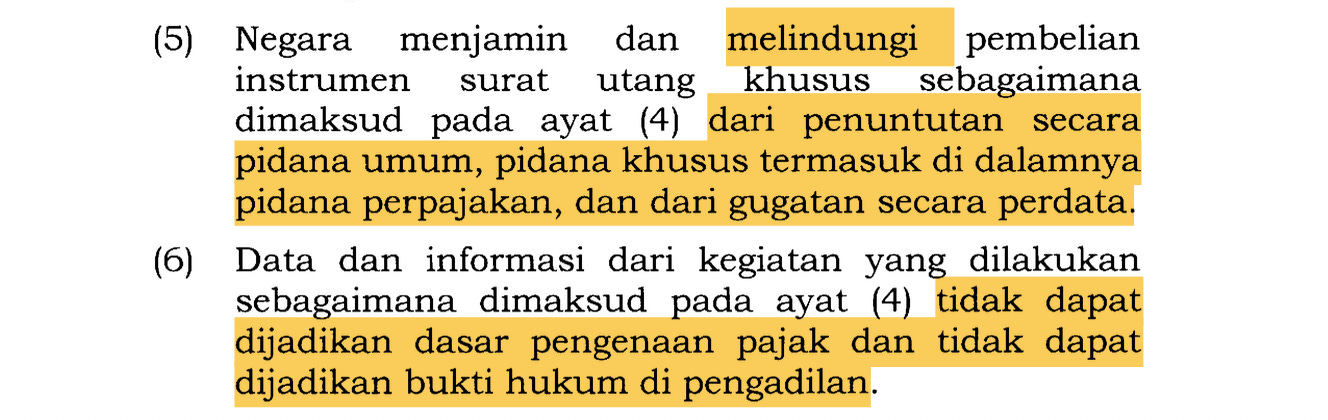
The article explicitly states that transaction data on the purchase of these bonds cannot be used as a basis for tax assessments or as legal evidence in court.
For all practical purposes, Indonesia has just institutionalized a recurring, permanent tax amnesty program, hidden inside the fine print of a financial sector law.
Let’s run the scenario. You have a stash of questionably acquired funds that you cannot spend without raising suspicions. If you purchase the Patriot Bonds, authorities can never come after you to ask how you acquired those funds. Now, doesn’t it closely resemble the tax amnesty program?
But a tax amnesty is supposed to be a historic, one-time compromise.
The logic is simple: the state offers a temporary clean slate to bring hidden wealth into the formal economy, widening the tax base for the future. Yes, it is problematic for the country’s economic justice, fiscal credibility, and institutional transparency — not to mention that it is fundamentally unfair to the millions of honest, taxpaying citizens — but it is somewhat tolerable as a pragmatic tool to reset the system if it happens once.
But when amnesties become a recurring fixture, disguised as “patriotic” investment bonds no less, the logic just collapses. Why would anyone comply with standard tax rates if they can simply wait for the next state-sanctioned amnesty? Instead of broadening the tax base, this “no-questions-asked” mechanism rewards tax evasion and shrinks tax receivables, creating a moral hazard that hollows out compliance.
Finance Minister Purbaya Yudhi Sadewa has denied allegations that Patriot Bonds amount to a form of tax amnesty, arguing that investors who purchase the bonds won’t automatically become immune from all legal ramifications.
“It’s just the money [used to purchase the bonds] that is immune, not the company. Unlike tax amnesty, which grants immunity [to the company too],” he said.
But that isn’t reassuring enough. If the funds used to purchase the bonds are protected from scrutiny, then purchasing the bonds effectively becomes a legal loophole for those seeking to launder illicit funds, just like the tax amnesty program. Even worse, whereas one would have to pay a penalty on declared assets under the tax amnesty program, the Patriot and Merah Putih bonds would instead generate some interest.
What’s more alarming, however, is how this policy came to light. Over two weeks after the law was reportedly passed, the official text of UU P2SK still cannot be found on any public government portal. One couldn’t simply find it on the House of Representatives’ (DPR) site or any official legal documentation and information network (JDIH) sites. To actually get our hands on the text of the P2SK Law, we were forced to find leaked drafts and press reports.
This case is just an instance of a worrying legislative trend in Indonesia, in which crucial bills are drafted behind closed doors, rushed through approval, and shielded from public scrutiny until it is too late. But this case is especially bad because a policy that could potentially grant alleged tax evaders immunity from criminal prosecution should be fiercely debated in the public square, not snuck into a final draft that the public couldn’t even find to read.
The government may argue that the Patriot and Merah Putih bonds are necessary to fund national development. But financing the future by dismantling the rule of law and undermining the fiscal contract is a losing strategy. Capital might flow in today, but institutional credibility—once burned—takes decades to rebuild.