

The author is a graduate student in Biological and Environmental Engineering at Cornell University with a passion for education issues. This article reflects the author’s own analysis and views and does not necessarily represent those of The Reformist.

Since 2013, Indonesia has sent around 58,000 students to higher education through its championed scholarship programs under the Indonesia Endowment Fund for Education, or LPDP. Half of these awardees pursued their degrees abroad, but what if they came home to find that the skills and knowledge they’ve obtained have no place in their homeland?
This is unfortunately not a hypothetical scenario, and I fear the Indonesian government is raising an army of scientists with no place to exercise their expertise. At the end of the day, no country wants a horde of unemployed talented experts. The question is, what can LPDP do to prevent this and actually foster national growth?
LPDP needs to change the way it’s spending money
At the time of this writing, the LPDP was kicking off another year of awarding scholarships to Indonesian students. An online debate would usually ensue, revolving around the awardees’ ethics and contributions, or whether or not they deserve the scholarship. Finally, by the end of the year, we would have the annual evaluation by the House of Representatives (DPR), often reiterating the same point as the previous year, closing the loop that feels destined to repeat.
While we remain stuck in this endless cycle of debating the fairness of the selection, we overlook why LPDP exists in the first place. To the public, LPDP looks only like a scholarship provider, a machine that hands out tickets abroad. However, when you look at its conception, LPDP was never just meant to print diplomas. LPDP’s raison d’être was (and is) to establish a national innovation ecosystem so that high-caliber individuals can thrive and contribute to the country’s growth.
Conceptually, helping nationals get diplomas and establishing a national innovation ecosystem would complement each other. But the current situation tells a different story, because LPDP has been focusing only on the sending-people-to-school part.
We could first look at LPDP’s past spending. Each year, they spend more than 80 percent of their budget on scholarship programs, hitting an all-time high of 92 percent in 2024.
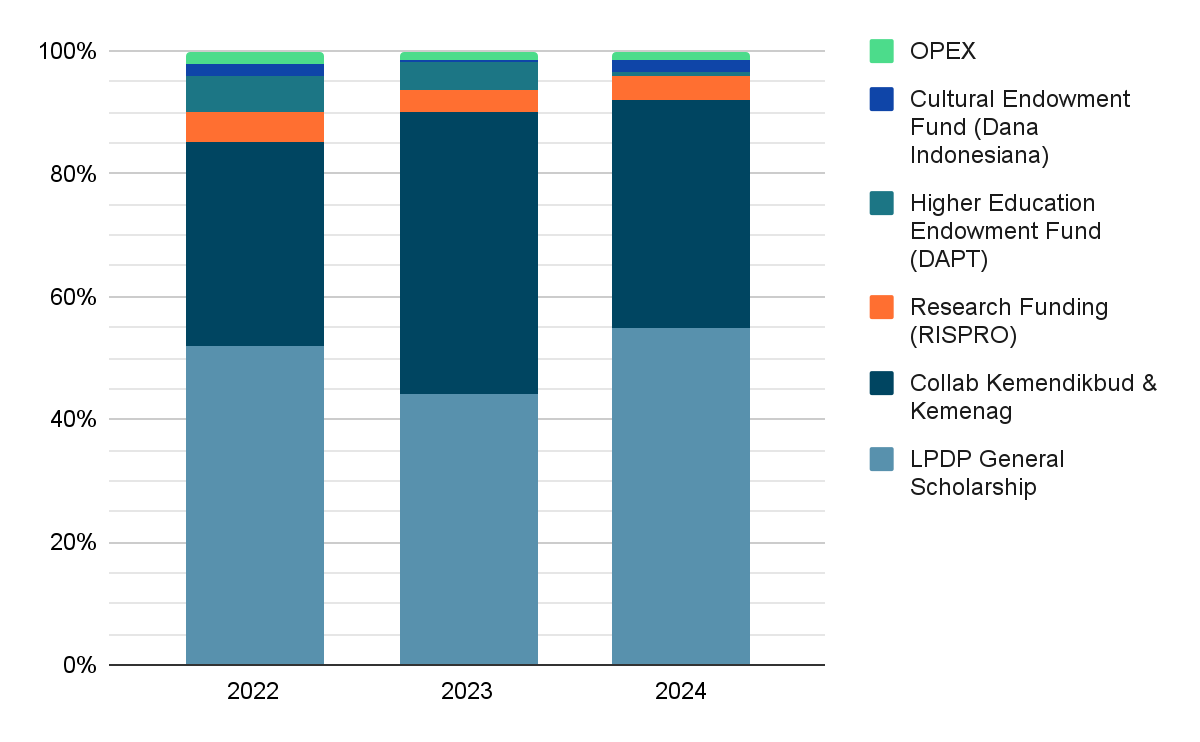
What is confusing is that with the total budget spiking by 137 percent between 2022 and 2024, research and ecosystem development programs saw a meager increase. This leaves them fighting for a shrinking slice. This spending decision suggests the government believes that by going all-in to produce more highly educated individuals, the dream of national growth will simply fall into place.
Now, here is the core question: given the goal to pursue national growth, prosperity, and inclusion, does the way LPDP utilizes its budget make sense?
I don’t think it does.
Producing more supply without growing the demand
Harvard’s Economic Complexity Index (ECI) tells an uncomfortable truth. Despite spending more than a decade investing in sending people to school abroad, Indonesia’s economic complexity remains at the same rank as it did in 2010.
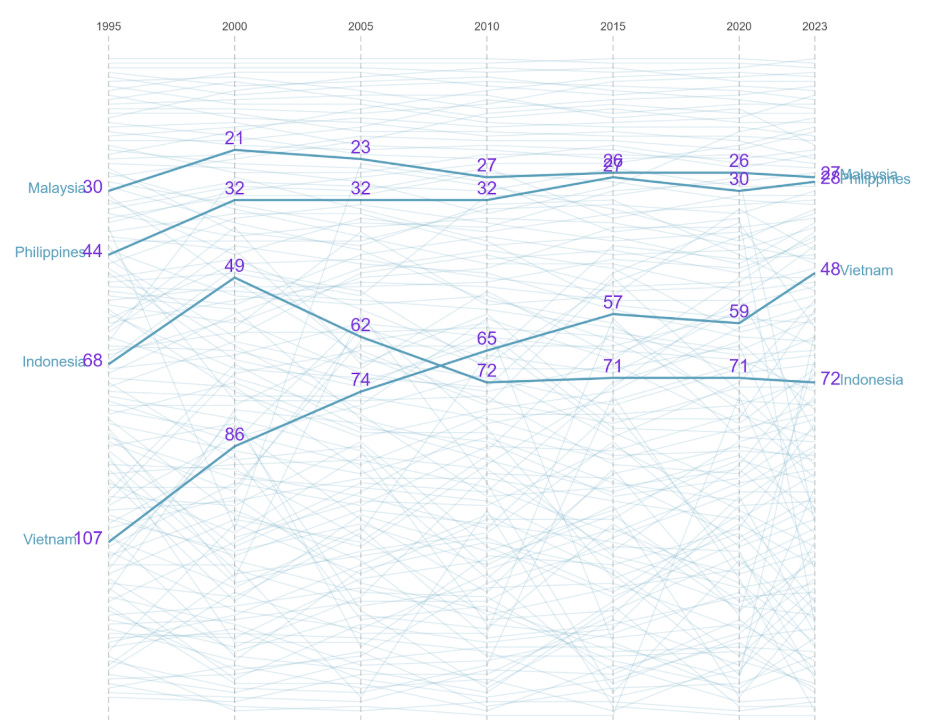
In 2023, we still do the same thing we did in 2010 to make money. To put it into perspective: We have people capable of making electric vehicles, but our economy still relies on making becak (pedicab) to generate wealth.
Some may argue that 10 years is not enough time to see the ROI of education. However, this data serves as a warning sign: our highly educated individuals lack the tools to translate their knowledge into real economic value. The pressing challenge now lies in providing the tools to materialize this advanced knowledge into productive outputs.
Another study confirms this disconnection. It finds that Indonesia suffers from an education-occupation mismatch: a majority of our university graduates are overqualified for the jobs they take. In other words, there are not enough appropriate jobs for the level of education we have.
This all means that Indonesia is at a critical point where it must develop an industry that can absorb the influx of highly educated Indonesians. If the government fails to do so, Indonesia is on the brink of a brain drain that, in recent years, has been amplified by younger generations through the “#KaburAjaDulu” (#RunAwayFirst) movement.
The missing link that leaves us in this critical juncture is the lack of a national innovation system. This is a system that must be deliberately grown and not left to chance. Conceptually, it will enable a network of institutions, usually government, industry, and research bodies, to coordinate and foster a well-oiled and synchronized innovation culture in a country.
Unfortunately, in Indonesia, the oil is pretty dry.
A key metric that best demonstrates this problem is the Gross Expenditure for R&D (GERD). Indonesia’s R&D spending took up just 0.28 percent of GDP in 2020 (this is Indonesia’s latest available data). To compare, present-day Malaysia and early-2000s China spent 1 percent of their GDP on R&D, while Vietnam’s latest spending stands at 0.42 percent. This commitment contributed to their good, if not great, ECI and national growth.
The bottleneck goes beyond the money. Reports have noted several issues that hinder Indonesia’s ability to improve its innovation environment, including the disconnect in our regulations, private institutions’ disengagement from the national innovation system, and the highly centralized innovation process. Although the same report deemed Indonesia’s conceptualization of the innovation system to be decent, the poor implementation has rendered its design ineffective.
We could contrast our situation with Vietnam. Despite its relatively smaller share of GERD compared to China and Malaysia, it has managed to establish its presence in the semiconductor industry through a robust implementation of its innovation system.
To sum it up, there is a huge disconnect between LPDP’s mission and its spending. The way they have been spending their budget is too concentrated on sending people to higher education without preparing the industry and innovation environment to absorb them. But, in theory, what can they do more?
From scholarship provider to innovation architect
While building the national innovation system sounds like a cross-ministry mandate, LPDP is actually well-equipped to lead this shift. It has the agility, the programs, the funds, and the talent pool to hit the ground running. To shift from printing diplomas to becoming an innovation architect, LPDP should shift three things: its mindset, its wallet, and its actions.
First, LPDP needs to challenge its definition of education. It is currently locked into the traditional frame of formal learning as the legitimate means of education, putting a red carpet for master’s and PhD, while sidelining other forms of education. This is a missed opportunity, since, as OECD has highlighted, non-formal and informal learning has its own merits in equipping individuals for actual industry needs.
A working model for non-formal learning can be seen in Australia Awards Scholarship (AAS) short-course programs, in which participants engage with industry-specific, highly relevant topics. Moving beyond a traditional definition of education will help LPDP establish not only credentialed leaders but also industry-capable leaders.
Secondly, LPDP should put the money where the mission is. The innovation system cannot be built if 92 percent of the budget is spent on creating supply, while the demand is struggling. Rebalancing the program portfolio is imperative.
LPDP has to increase its share of spending on its existing (but arguably underused) innovation-enabling programs, such as the productive innovation research (RISPRO) funds. As the supply of highly educated talent keeps growing in Indonesia, sectors that can absorb them (R&D, high-tech, creative sectors, etc.) need to catch up. This development is crucial to prevent exacerbating the current mismatch. In essence, we should avoid planting high-quality seeds on barren soil, where they are destined to wilt.
Finally, to fix the current disconnect with the private sector, LPDP must act as a matchmaker. It could establish strategic partnerships with major industries, providing spaces to foster high-impact research and match awardees’ skills and expertise with industry needs.
These steps could shift the dynamic entirely, pivoting LPDP from a scholarship provider into an active driver of the national innovation system.
These recommendations ultimately aim for one thing: ensuring our investment in education translates into real economic impact, not just vanity statistics. They could also address LPDP’s poor ROI risks by ensuring our graduates have a place to implement their expertise and flourish.
LPDP in itself is a great initiative. However, goodwill is not enough. It needs to evolve from just a scholarship provider to an innovation driver, ensuring that national growth is not just a pipe dream, but a delivered reality.

Getting an old software to top-university for an upgrade, then forcing it to fit in its old and outdated hardware is crazy. No wonder those upgraded softwares prefer to stay in another hardware in another country.