

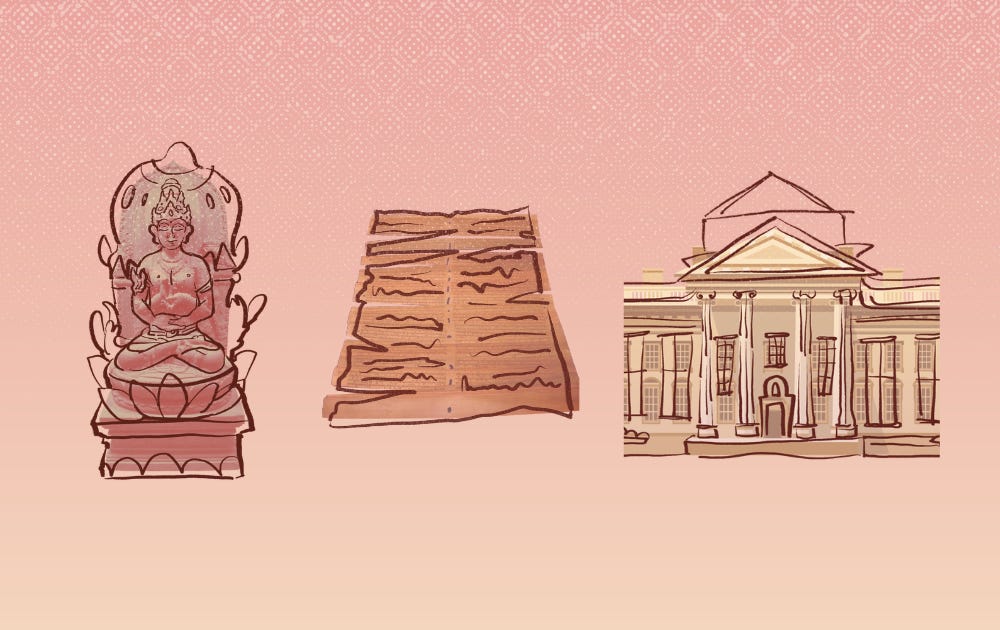
Last year, President Prabowo Subianto returned home from his visit to the Netherlands with a repatriation agreement. The Dutch government was to return about 30,000 artifacts that had been taken by the Dutch during their occupation of Indonesia.
This was great news—right?
Well, not according to the netizens. When the news broke, instead of high praise, the agreement was met with hefty skepticism on social media, with statements like “the artifacts will be safer in the Netherlands” and “can we even take care of them…?”
Some others went as far as expressing concerns that the artifacts will end up lost, decayed, destroyed, or stolen—be it in a museum fire, collection theft, or pure neglect—if they are returned to Indonesia.
These reservations are not unfounded. In 2020, a government report revealed that only 8 percent of Indonesia’s 439 museums are well-managed or “type A,” according to the government’s own museum management standards. Several museums—including the National Museum, Maritime Museum, and Clay Museum—have caught fire in the past decade, destroying invaluable collections. Museum lootings are also relatively common, as some museums have no security guards, some lack CCTVs, and many cases remain unsolved. The National Museum in Jakarta has been robbed five times throughout its history, most recently in 2013.
But the state of our museums and the lack of trust Indonesians have in their government to take good care of our treasured artifacts may have unearthed more pressing issues to discuss: Why haven’t we made culture and heritage preservation a priority? What reforms have been made since our independence to make sure we are getting better at caring for the items that carry our collective memories?
In this edition of The Reformist, we look into the evolution of Indonesia’s cultural and heritage sector from the colonial period to the present: through the regulations that were passed, the institutions that were built, the diplomatic struggles to reclaim what was taken, and the reforms that have only recently begun to test whether the country can do better.
Decades of colonial-style preservation
Before Indonesia gained its independence in 1945, the field of cultural heritage preservation existed under the colonial Dutch East Indies administration. The Dutch understood that the land they were occupying had centuries’ worth of history to preserve, though their approach was fundamentally orientalist.
The Batavian Society of Arts and Sciences, founded in 1778, was created by the Dutch East India Company (VOC) officials to study the cultural and scientific aspects of the archipelago. They conducted ethnographic and archaeological research, accumulating collections of objects of significant cultural and prehistoric importance to the archipelago. The society sat where the National Museum exists today in Central Jakarta.
Furthermore, the Dutch focused on restoring monuments to their former condition, preventing the removal of artifacts. It was under the Dutch that the Prambanan and Borobudur temples began to be restored in the 1910s. Their preservation principles were codified in 1931 through Monumenten Ordonnantie (MO) regulation, with cultural objects divided into three categories: (1) man-made objects of great importance for prehistory, history, or art; (2) palaeoanthropology objects; and (3) historical sites.
It was only six decades later that the colonial regulation was changed through the passage of Law No. 5/1992 on Cultural Heritage Objects. It officially designates every cultural heritage object as state property, regardless of its actual whereabouts and ownership, while permitting private citizens and foundations to possess them as long as their “social functions” are intact. Cultural heritage items and sites were defined similarly along the lines of “man-made” objects with significant historical importance and aged at least 50 years old.
Addressing the elephant in the room: Culture’s history of neglect
After the New Order fell in 1998 under the Reformasi movement, the spirit of decentralization carried hope that regional governments could participate in managing their own cultural heritage. This would only come in 2010—twelve years into Reformasi—through the passage of Law No. 11/2010.
It would take another 12 years and three different ministers to complete and promulgate the implementing regulation for that law, Government Regulation No. 1/2022. According to a former official involved in the process, this was due to ministries and government bodies repeatedly deprioritizing provisions requiring their sign-offs. A telling reflection of how cultural heritage preservation has long been neglected by the government.
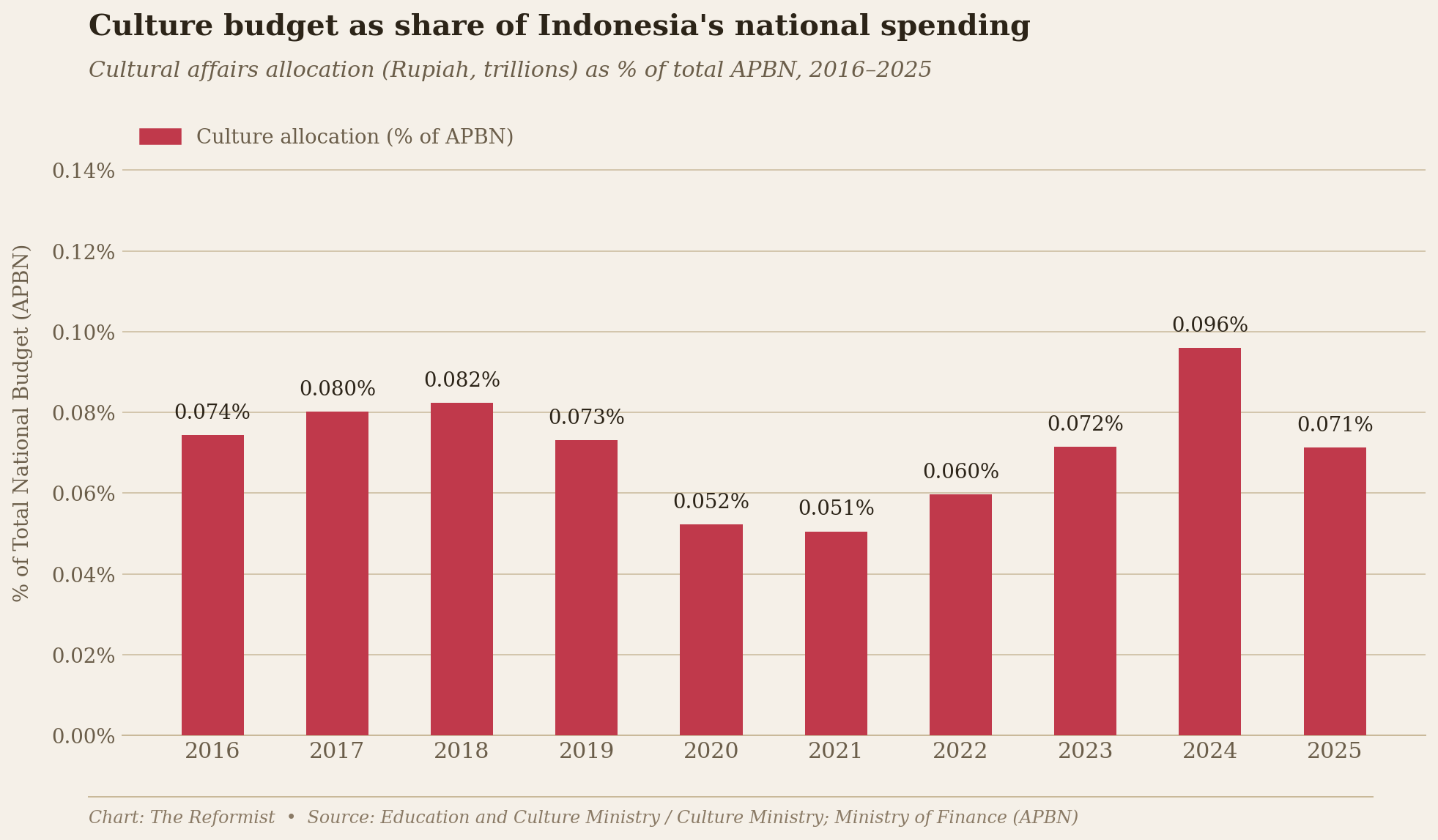
Over the past decade, and likely for long before that, cultural affairs have consistently received less than 0.1 percent of Indonesia’s national budget. Even after the Directorate General for Culture was elevated into a standalone ministry in 2024, its fiscal standing has stagnated.
That said, there is a bright spot. When it comes to Indonesia’s cultural heritage, repatriation from abroad, particularly the Netherlands, is a selling point.
Reclaiming our collective memory from the colonial gaze
Repatriation of Indonesian heritage items was among the demands of the new Republic in the 1949 Round Table Conference. While the transfer of sovereignty was formalized, the tense relations between the infant country and its former colonizer prevented any act of repatriation at the time. In fact, one of the articles in the conference agreement stipulated that the Dutch must return every Indonesian cultural heritage item it possesses.
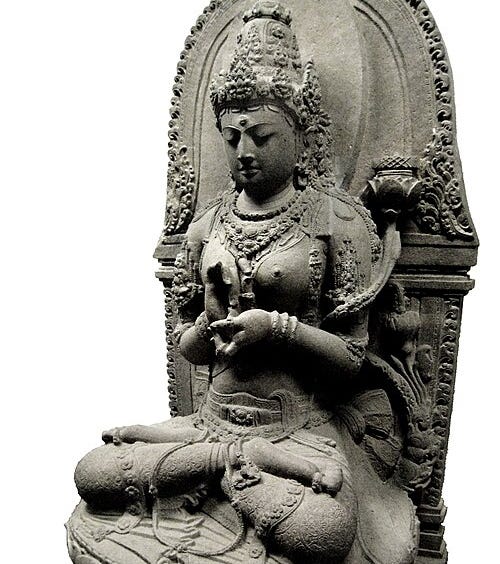
It was under President Suharto that Indonesia’s first significant repatriation efforts with the Netherlands took shape. During his state visit to The Hague in 1970, Suharto was received by then-Queen Juliana, and the Nagarakretagama—a 14th-century Majapahit manuscript of enormous historical significance—was eventually returned to Indonesian hands. In 1978, the Dutch returned the famous 13th-century Prajnaparamita statue from the Singhasari Kingdom.

These returns were framed entirely within a Dutch paradigm of benevolence. The Netherlands decided what would be returned and how the narrative would be framed. According to archival research by heritage scholar Jos van Beurden, when talks of returning the Nagarakretagama manuscript surfaced, then-Dutch Prime Minister Piet De Jong supported its return as it would allow the Dutch to retrieve valuable VOC archives located in Indonesia’s National Archives building.
There was no overarching policy guiding what Indonesia should claim or what would happen to objects once they returned home.
The tides only began to shift 40 years later in the late 2010s. Former Western colonizers started to reckon more seriously with their colonial past. In 2017, French President Emmanuel Macron publicly vowed to return African heritage items looted by the French colonial forces. This reckoning added pressure on the Netherlands to do right by its own colonial history. For the first time, the Dutch cultural sector began engaging with its Indonesian counterparts in a fundamentally different register.
It was in this context that the Nusantara Museum in Delft, facing bankruptcy, offered its entire collection of 14,000 artifacts to Indonesia without charge. Then-Director General for Culture Kacung Marijan accepted the offer swiftly. A year later, his successor Hilmar Farid annulled the agreement, drawing confusion from both Indonesian and Dutch observers.
Indonesia, he argued, was not a warehouse, and it would only receive an artifact if it possessed historical significance to the nation’s story.
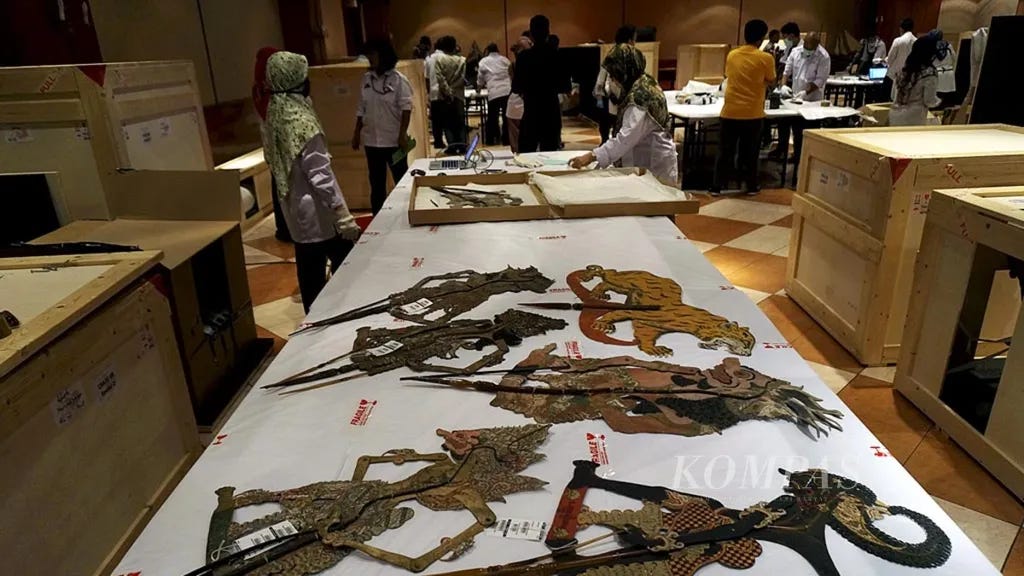
He called for the deal to begin from scratch, mandating that provenance research be conducted first to trace the historical and ownership origins of each object in the collection. Of the 14,000 items from the initial agreement, Indonesia agreed to receive 1,500 of them under the new agreement.
:quality(80):watermark(https://cdn-content.kompas.id/umum/kompas_main_logo.png,-16p,-13p,0)/https://asset.kgnewsroom.com/photo/pre/2020/01/03/Repatriasi-Koleksi-Museum_86103536_1577985663_jpg.jpg)
“It’s not simply about the return of objects; it’s about knowledge production. It’s about rewriting history; it’s about dealing with past injustices. That’s where I would locate the discussion of returning objects,” said Hilmar on the significance of provenance research.
Hilmar’s insistence on joint provenance research, rather than passive acceptance of whatever the Dutch offered, directly led to the creation of the Pilot Provenance Research on Objects of the Colonial Era (PPROCE), a joint project by Dutch cultural institutions, including the Rijksmuseum. It was the first-ever Dutch state-sponsored provenance research program for colonial artifacts, funded and commissioned by the Dutch Education, Culture, and Science Ministry. Over two and a half years, the project produced fifty provenance reports on 65 objects from Indonesia and Sri Lanka.
What followed from the methodological reset was a cascade of returns rooted in provenance. In July 2023, the Netherlands returned 472 cultural artifacts to Indonesia in a ceremony at the Museum Volkenkunde in Leiden. Among them were four 13th-century Singhasari statues depicting Hindu deities held in Dutch collections since the 19th century, as well as objects looted during colonial military campaigns in Java and Bali.
A second return followed in September 2024, when 288 more objects were handed over at the Wereldmuseum in Amsterdam, including 284 items from the Puputan Badung collection—weapons, coins, jewellery, and textiles taken after the Dutch conquest of southern Bali in 1906. In total, over 800 objects were returned under the 2022 repatriation deal by the end of 2024, with the Indonesian government committing to dedicated conservation programs, scholarly research, and public exhibitions to give the returned objects meaning beyond their display cases.
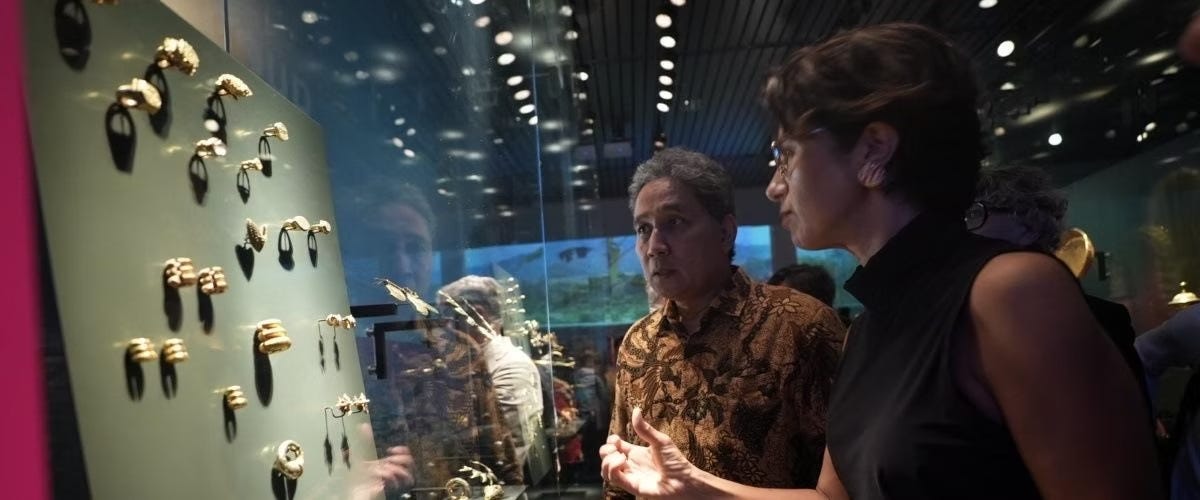

Despite the modality shift in repatriation efforts, the lingering concern about whether these artifacts could actually be cared for at home persisted. The Indonesian government had gained diplomatic leverage in negotiations with the Netherlands, but the domestic infrastructure to safeguard what came remained a work in progress.
Getting our museums in check
It is simply impossible for the state to maintain every museum and heritage site, given the sector’s political and financial neglect. Museums and heritage sites are often poorly managed, forgotten, or left to rot.
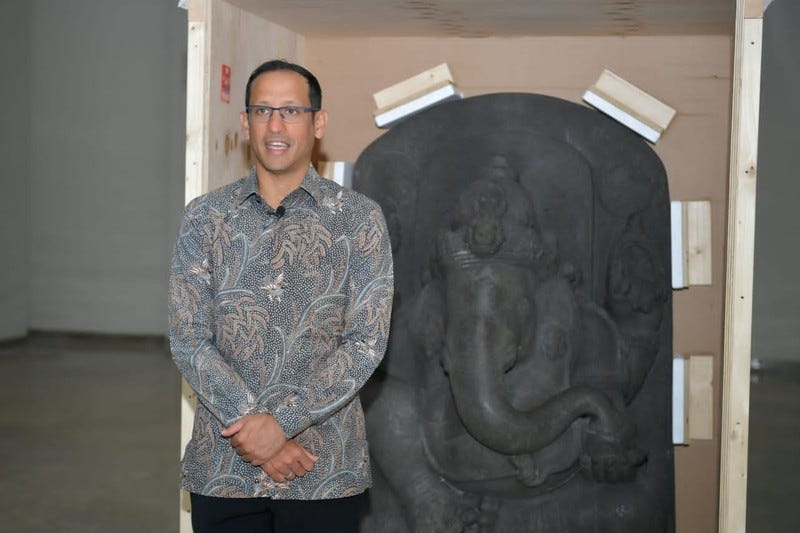
In 2020, the former education and culture minister Nadiem Makarim declared that only 39 museums, or 8 percent of Indonesia’s total museums nationwide, met the government’s own highest standard of management and service. Of the 288 government-managed museums at the time, the majority were categorized as Type C, meaning they had buildings and collections but minimal funding, no digital infrastructure, and inadequate conservation facilities.
Nadiem noted that a flawed governance system and the lack of competent human capital within the bureaucracy explained the troubling situation. Before his regime, government-run museums and heritage buildings were directed by third-echelon civil servants from the ministry, under a rigid bureaucratic system. Human capital for museum management was also obsolete, lacking adequate experts and professionals.
The term “museumkan,” which literally translates to “to museum” (verb), was widely used to describe ageing or disgraced civil servants who were transferred into museum management because it was seen as an undesirable sector.
“Most museum staff are themselves ‘museumified’, those who are no longer useful elsewhere, who are about to retire or are underperforming, get stationed in a museum,” said Irmawati Marwoto, archeology professor at Universitas Indonesia.
These historic challenges became the reason why the former Education and Culture Ministry created the Indonesian Heritage Agency (IHA) in 2023. The IHA was made to introduce an innovative public-private partnership model for museum and heritage site governance. It designated 34 museums and heritage sites as autonomous Public Service Agencies (BLUs). The National Museum in Jakarta, Fort Vredeburg in Yogyakarta, Sangiran Early Man Site in Srangen, and many more notable museums and heritage sites were all turned into autonomous institutions under the IHA.
The BLU model can be seen as a push towards enterprising the public sector without the for-profit motive of the private sector. Management of BLUs is rooted in maximizing efficiency and self-sufficiency for public service, allowing these agencies the freedom to reel in new funding models and acquire talent from outside the bureaucracy. This model is most common in the healthcare sector, wherein public hospitals are turned into BLUs to reel in healthcare specialists from the private sector who are absent from the bureaucratic talent pool.
In the cultural heritage context, the BLU model allows for greater independence for historical institutions to govern efficiently without the constraints of bureaucratic inertia. Cultural experts, museum curators, academics, and other professionals from the private sector can now be recruited to participate in conservation and preservation efforts. BLUs can also directly receive grants and donations from the private sector to help fund their operations.
This public-private partnership model is a step towards raising Indonesia’s museum governance to international standards. In the United Kingdom, major national museums incorporate a blended governance model, pooling funds from private endowment and government support.
The British Museum, for example, is also an independent non-departmental public body, a structurally similar model to Indonesian BLUs. The museum is governed by an independent Board of Trustees and funded through a combination of government aid from the Department for Culture, Media and Sport and income it generates through commercial activities, private donations, endowments, and exhibition fees.
This dual-funding structure gives the museum financial flexibility to operate autonomously without being wholly dependent on the state, while remaining publicly accountable as an institution that is adjacent to the government.
While it may take years or even decades before museums in Indonesia can reach the institutional standards of the British Museum, the IHA is a significant step towards realizing that dream, with cultural heritage items that actually belong to the land they originated from.
Where to go from here
Under the current Prabowo administration, creating a standalone Culture Ministry is a start. It signals political will and is a good sign that cultural affairs will hopefully be taken more seriously. However controversial, perhaps having a figure like Minister Fadli Zon, who has close ties to the President, may also help in sustaining said political will.
Political appeal, however, should come with grace and humility. The current regime should follow through with what its predecessor has done for the sector without shaking things up too fast out of ego. It is too soon to tell how effective the IHA will be, but it is important to allow the agency and the cultural institutions inside of it time to work autonomously without interference from the ministry.
Perhaps, in time, more museums and heritage sites can follow suit, revitalizing the industry and opening up more jobs for cultural practitioners and experts in a field that has historically been neglected.
Credits:
Writer/Researcher: Rayhan Kalevi
Editors: Nea Ningtyas, Nathaniel Rayestu, Ravio Patra
Visual designer: Liana Tan