


Last year, Jakarta topped the list of the world’s most populous cities, according to the United Nations (UN), with a population of 42 million residents, beating major metropolises like Tokyo, Shanghai, and New Delhi.
But this number includes people living in satellite cities surrounding the capital. In reality, only 12 million actually reside in the administrative region of Jakarta, and the rest are commuters who enter and exit the metropolitan area daily to work. They are victims of urban sprawl, driven out of Jakarta by the rising cost of housing.
Kompas estimates the average rent in Jakarta (Rp 3.976 million) rounds up to 75 percent of the average salary (Rp 5.25 million) a worker makes in the city. For the same salaryman to then purchase a home, they would need to save 13 years’ worth of their salary without spending a single dime, according to 2025 statistics.
This reality is compounded by Statistics Indonesia’s (BPS) 2022 survey, showing that only 36.69 percent of all Jakarta households have access to adequate housing. A more recent BPS survey conducted in 2025 has even revealed that the city currently lacks over 1.39 million housing units for its citizens.
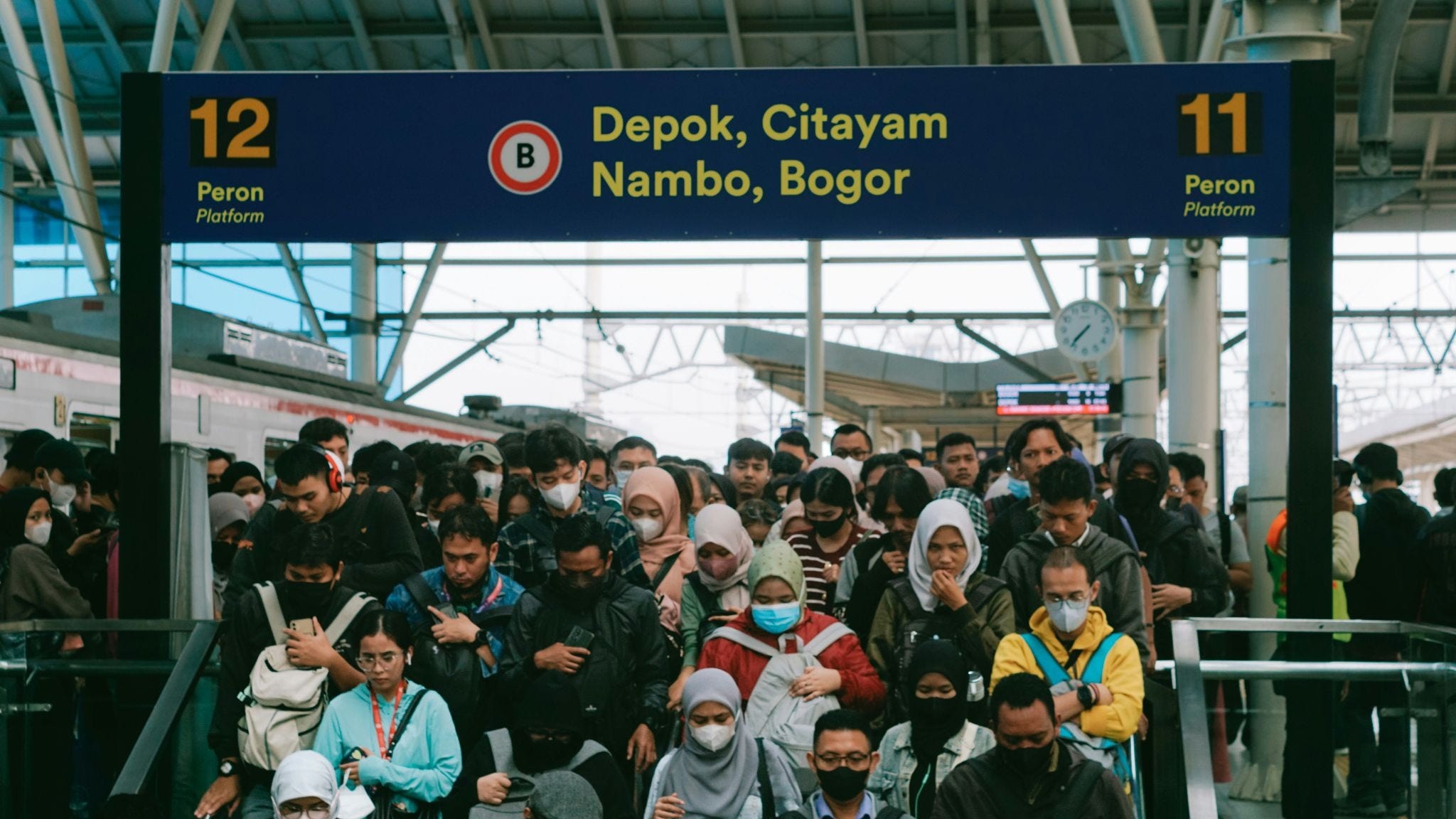
What if we told you that the city is actually not dense enough, and that there are still many policy mechanisms the provincial government can do to make Jakarta more affordable and hospitable for each one of its citizens?
In this edition of The Reformist, we go hyperlocal to cover Jakarta’s housing crisis. We investigate the outdated zoning regulations that have largely disincentivized the construction of vertical housing units, the regressive tax regime that benefits rich landowners with multiple plots of land, and how political will, or lack thereof, has prevented any sustainable housing solutions from succeeding.
Jakarta is not dense enough
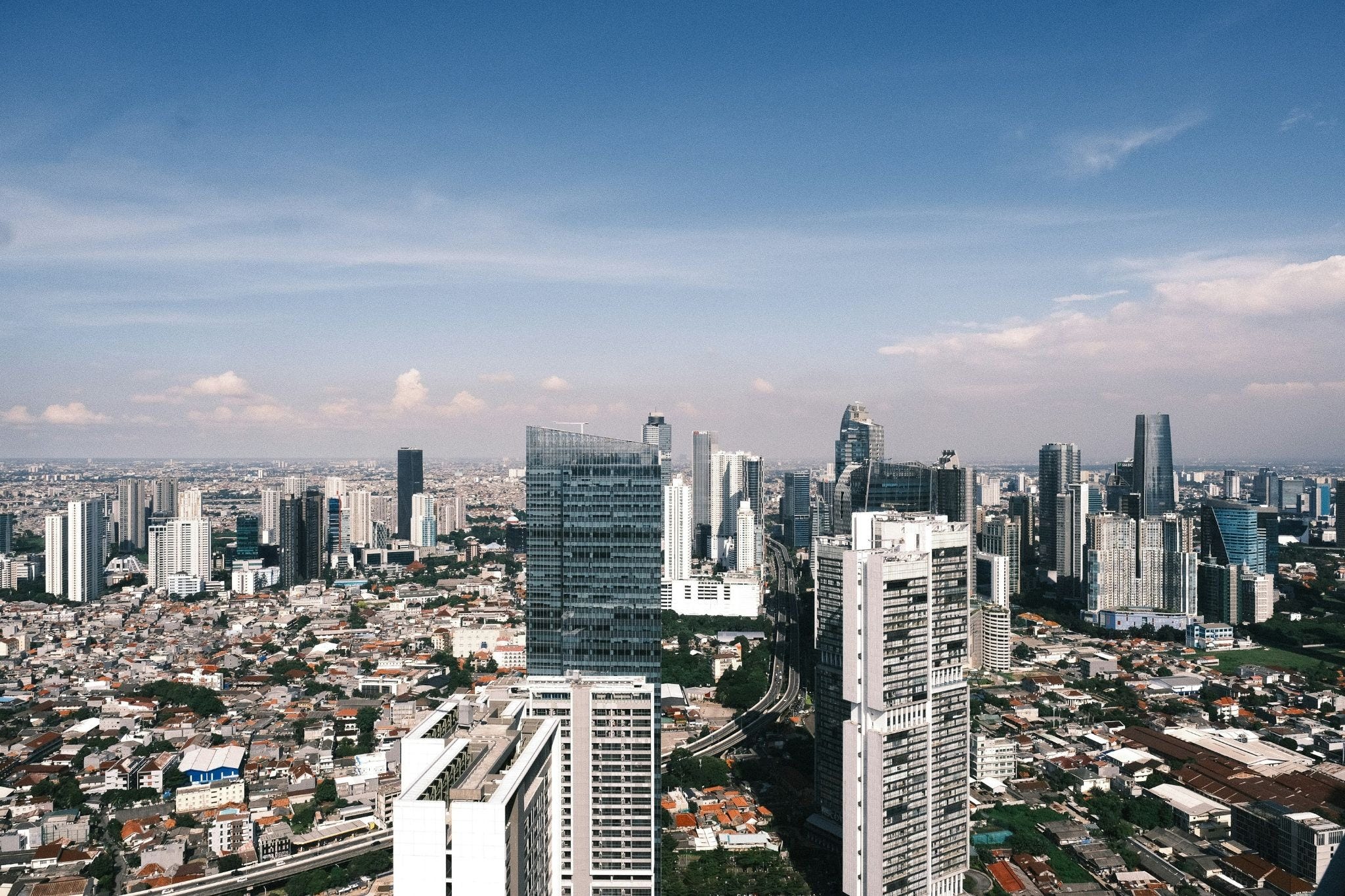
In reality, the city is far less dense than it should be. Most of Jakarta’s residential land is legally barred from creating buildings over four storeys. Here is why.
Across Jakarta, housing projects must comply with the city’s Floor Area Ratio (KLB) regulation. The KLB limits the total floor area a building can have on a given plot of land, which effectively controls building height and intensity.
A 100-square-meter plot of land with a KLB of 2, for example, could have a total building capacity of 200 square meters. These 200 square meters can be distributed horizontally or vertically by dividing the building into four floors, for example, with each floor being 50 square meters large.
The higher the KLB, the more housing units can be built under a single plot of land. KLBs vary by district depending on multiple factors like land use classifications and geographical location. Areas in close proximity to public transport are given higher KLBs due to their perceived economic benefits, while residential plots are designated lower KLBs to control density and maintain neighborhood character.
The Jakarta provincial government administers these zoning regulations under a two-tiered hierarchical system. First, the overarching spatial master plan is governed by the Regional Spatial Plan (RTRW), which designates broad land-use classifications such as residential, commercial, and non-residential zones.
Second, this is then regulated at the micro level under a Detailed Spatial Plan (RDTR), which specifies the zoning of individual streets, sets height limits for buildings, determines green space to building ratios, and establishes other detailed provisions governing Jakarta’s urban landscape.
Jakarta’s RTRW is currently governed under Regional Regulation No.7/2024, whereas the RDTR was released in 2022 through Gubernatorial Regulation No.31/2022.
Under the 2022 RDTR, residential plots in Jakarta’s Very High Density Residential zone (classified as R-1) face surprisingly low ceilings, despite the name. A plot between 240 and 400 square meters in this zone is capped at a KLB of 2 with a maximum height of four floors. For plots greater than 400 square meters, the ceiling drops further to KLB 1.6 with the same four-floor cap.
According to Elisa Sutanudjaja, executive director of the Rujak Center for Urban Studies, 89.37 percent of residential-designated land in Jakarta carries a KLB below 2 in 2022. In practice, this means most of the city’s residential blocks are restricted to single-family home units that are no more than three floors on any given plot.
That said, Jakarta’s zoning regulations do contain some progressive intensification schemes. Plots of land within 1.2 kilometers of Jakarta’s major public transportation lines (Commuter train, MRT, and Bus) are given a KLB between 7 and 11 if they are repurposed for vertical housing units. This provision, however, is limited to vertical housing units, which are an entirely separate zone classification from residential plots that dominate Jakarta’s total landscape.
According to another study by University of Indonesia scholars that examines the impacts of zoning regulations on Jakarta’s property prices, raising the KLB for residential plots by just one unit can decrease housing prices in the city by 10 percent. This would provide more accessible prices for the average Jakartan.
Hong Kong, for example, is just as dense as Jakarta—if not more—but its KLB levels can reach around 8 to 10 for residential buildings. In Jakarta, the same intensity is reserved for narrow patches of land hugging the city’s main public transport lines. The rest of the capital is zoned for two to four-story development that favors the creation of single-family housing units.
Overly stringent zoning regulations in residential plots have made affordable housing nearly impossible to deliver at scale in the city.
Is regressive land value tax to blame? Only the rich benefit from it
Apart from the need to reform zoning regulations, Jakarta remains too lax on rich landowners. At present, affluent citizens with multiple plots of land throughout the city are able to hold onto their assets without any significant economic pressure.
Jakarta’s land value tax (PBB-P2) regime remains regressive, incentivizing these landowners to hold onto their assets as the appreciation in land value offsets the losses from taxes. The PBB-P2 tax rate is currently set at a flat 0.5 percent for all land categories, regardless of whether the land is productive or idle, as regulated by Jakarta’s Regional Regulation No. 1/2024.
Compare this with Jakarta’s vehicle ownership tax (PKB). Under the same 2024 regulation, the minimum PKB rate is not only larger than the PBB-P2 but also progressive, increasing with each additional vehicle a person owns. Owning one car costs you two percent, two at three percent, three at four percent, climbing all the way to six percent for owning five or more vehicles. Before the 2024 tax regulation, owning 17 or more vehicles would’ve triggered a 10 percent PKB tax rate, so perhaps even this tax regime has become less progressive over time.
However, there have been past efforts to introduce schemes resembling a progressive PBB-P2. In 2019, then-governor Anies Baswedan increased the PBB-P2 by 200 percent for idle land to incentivize the creation of new open green spaces in Jakarta’s main arterial roads, namely Sudirman, Thamrin, Rasuna Said, Gatot Subroto, and MT Haryono. Landowners who opted to convert their land to open green spaces would then be given a 50 percent tax break for that financial year. It was either let your land sit and pay double, or turn it into a park and pay half the taxes.
These regulations, however, failed to systemically change how the city’s landowners manage their idle assets, as they only targeted a small segment of the city and lasted for only a year. Now, every Jakarta citizen is subject to the flat 0.5 percent rate.
Let’s paint a real-life example of Jakarta’s current PBB-P2 tax regime. A 576 square meter plot of vacant land is currently on the market in Menteng, Central Jakarta, described in the listing as situated in a “strategic and commercial location.” The asking price is Rp 21 billion. The plot sits in the middle of one of Jakarta’s oldest neighborhoods, an area close to every public transport option Jakarta has to offer.
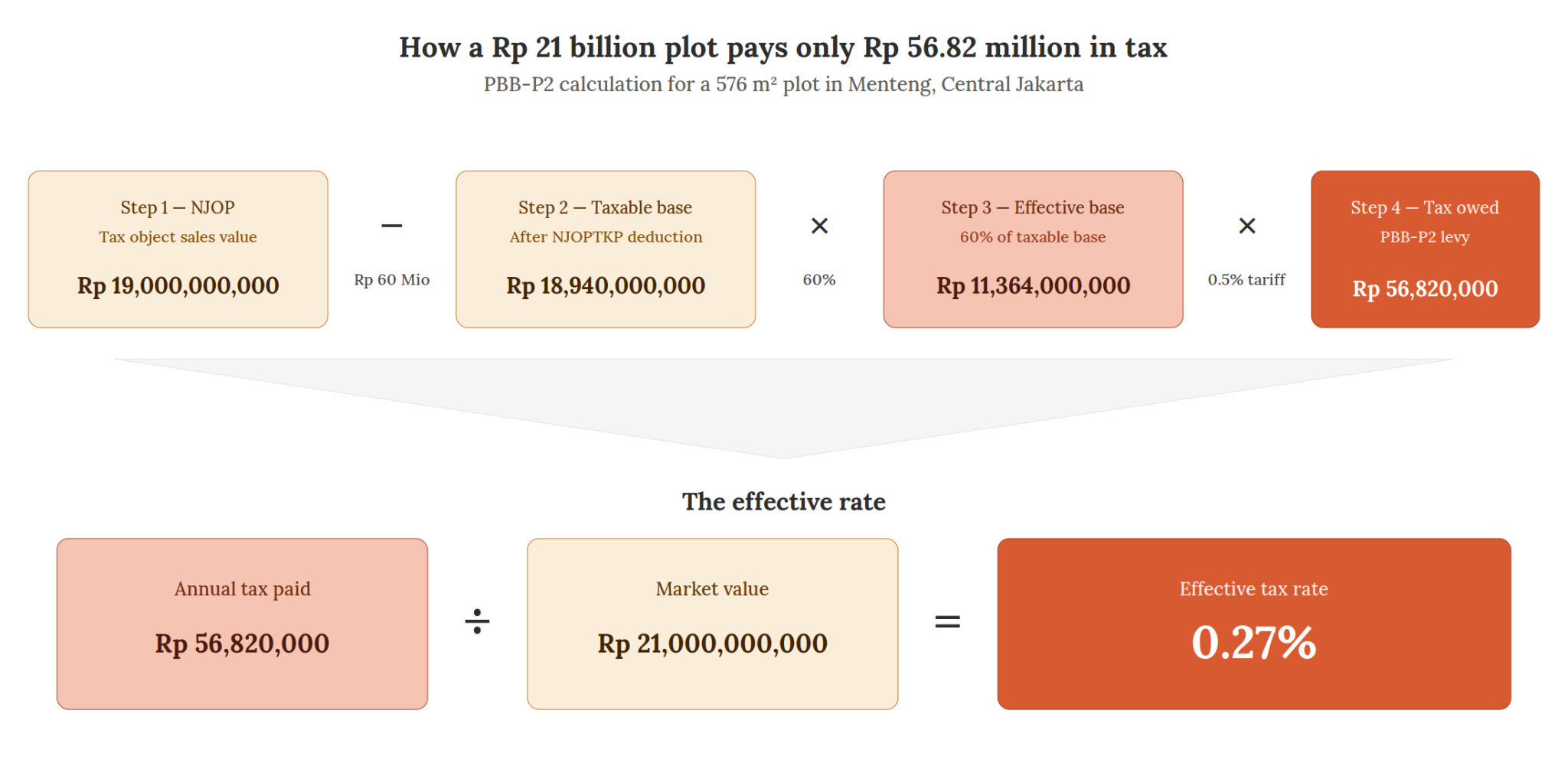
After running the numbers, the owner of this Menteng kavling would pay Rp 56.82 million in PBB-P2 taxes, which sounds substantial until you compare it to what the land is actually worth.
With a Rp 21 billion asset, the effective annual tax rate boils down to only 0.27 percent of market value. Meanwhile, land prices in Menteng continue to climb at astronomical rates year after year. While the landowner has chosen to put their asset on the market today, they have already accumulated wealth far beyond what the PBB-P2 levy can do to hurt their pockets.
Real estate math aside, the 0.27 percent figure highlights the city’s regressive tax regime. Without a more progressive tax regime that directly incentivizes the construction of new residential units, Jakarta’s housing crisis will continue as supply remains constrained.
The regressive tax regime also extends to a large amount of old, unused, or idle plots of land owned by government entities like state-owned corporations, ministries, and even law enforcement bodies that spread throughout the city. These types of idle land are subject to even looser tax regulations, or even worse, exempted from them entirely.
On top of that, the recent influx of padel courts in the city can also be attributed to this regressive tax regime. With landowners having no reason to sell their idle land or use it to build residential units, they can simply wait for the next viable business venture. Padel courts today happen to be the most lucrative economic opportunity for landowners without any significant costs.
One abandoned program after the other
Moving away from rigid city policy, any reform effort to tackle this issue will never succeed without institutional continuity that outlasts any individual governor. Promises to address Jakarta’s housing are not novel. Every governor who has worked at city hall has pledged, in one form or another, to solve the housing crisis.
Before ascending to the presidency, then-Jakarta governor Joko “Jokowi” Widodo championed vertical housing as his solution to the city’s housing crisis. When his deputy, Basuki “Ahok” Tjahaja Purnama, took over in 2014, he continued these housing projects but drew fierce backlash for his “inhumane” relocation programs, which forcefully cleared “illegal” neighborhoods.
Under former governor Anies Baswedan, the administration oversaw the creation of dozens of vertical housing units on top of his flagship “zero down payment” housing project. He initially planned to construct over 200 thousand units, but by the end of his term in 2022, that number had gone down to only 9 thousand. Since then, subsequent administrations have effectively sidelined the program with no signs of rebooting it.
Perhaps with current Governor Pramono Anung, who has publicly stated that he would continue any good policy that his predecessors had come up with in the past, regardless of partisan lines, things might be different. The technical solutions, in theory, already exist. Every piece of this puzzle has been debated, drafted, piloted, and abandoned. The question for Pramono, and whoever succeeds him in the future, is whether Jakarta can finally build a housing institution that outlasts the governor who promised it.
Towards a more affordable Jakarta
Although Jakarta’s land area spans just 664 square kilometers, it commands a fiscal capacity unmatched by any other regional administration in the country at Rp 81.32 trillion. Yet despite the city’s vast resources, the city’s housing affordability crisis has only deepened, with land prices climbing faster than wages and homeownership slipping further out of reach for the average Jakartan.
Now, it is up to the provincial government to use the policy mechanisms at its disposal to make affordable housing more viable in the city. Just a few days ago, Governor Pramono pledged to cover tuition costs at 103 private schools. The same political will to improve the city’s education should also be directed toward reforming Jakarta’s housing policy. By doing so, the city can finally make steps to mitigate the plaguing urban sprawl phenomenon and begin housing Jakarta’s 12 million residents, or even the “42 million” figure the UN reported.
Governor Pramono and the Jakarta government must revisit the city’s existing KLB policy to allow taller residential buildings alongside a more progressive land tax regime that benefits the majority of Jakartans rather than just the affluent, reduce housing costs, and create a denser, more affordable city.
For those of you living in Jakarta or facing similar housing and livability challenges in your city, what housing reforms could help your city’s current situation?
I also think Jakarta’s housing crisis is not just about a lack of housing, but also about how cities are planned and land is used.
As someone living in Indonesia, I see how many people are pushed farther away from where they work, spending hours commuting every day. Affordable housing is not only an economic issue—it affects quality of life, family time, and even productivity.
I’m curious: which reform would have the biggest impact first—zoning changes, tax reform, or stronger continuity between political administrations?
The enemy is closer than what u think, its crazy how a goverment keeps manipulating its own country