

On July 14, the Prabowo administration began its implementation of Sekolah Rakyat (‘The People’s School’), an initiative that aimed at providing educational opportunities for children at risk of dropping out of school due to financial limitations. The tuition-free schooling initiative is spread across 63 schools (with 37 more planned to open), and run by the Ministry of Social Affairs. Students would live in on-campus dorms that provide meals and receive “character-building education” in the evenings along with formal lessons in the daytime.
Sekolah Rakyat has its critics, and rightfully so, but to expand on that would need its own article. What we want to talk about in this edition is that Sekolah Rakyat was hardly the country’s first education reform initiative where a sitting president instructed the building of new schools to solve an outstanding education problem.
In the New Order era, President Soeharto released a Presidential Instruction (Instruksi Presiden, or Inpres) No. 10/1973 ordering the building of elementary schools, along with providing the books and teachers. The schools, famously known as SD Inpres, sought to expand learning opportunities for elementary school children through a larger emphasis on spending on educational initiatives.
This edition of The Reformist is taking you back half a century to zoom in on what made SD Inpres work – and what can we learn for future policy decisions, including perhaps (or especially) the continuation of Sekolah Rakyat.
The schools that improved lives–and the economy
In 2001, now-Nobel winner Esther Duflo wrote her PhD dissertation that set the foundation of using scientific evidence gained from field experiments to inform policy decisions. The object of her breakthrough study was Indonesia’s New Order-era elementary school expansion program SD Inpres.
SD Inpres was one of the most ambitious reforms launched during Indonesia’s New Order regime, leading to higher levels of education and national economic growth, as Duflo’s study proved.
Duflo also reported that from 1973 to 1980, up to 61,000 schools were constructed under the program. Former students of SD Inpres saw a 1.5 to 2.7 percent increase in wages in comparison to those who did not participate in SD Inpres. This then translates to national economic returns in education ranging from 6.8 to 10.6 percent.
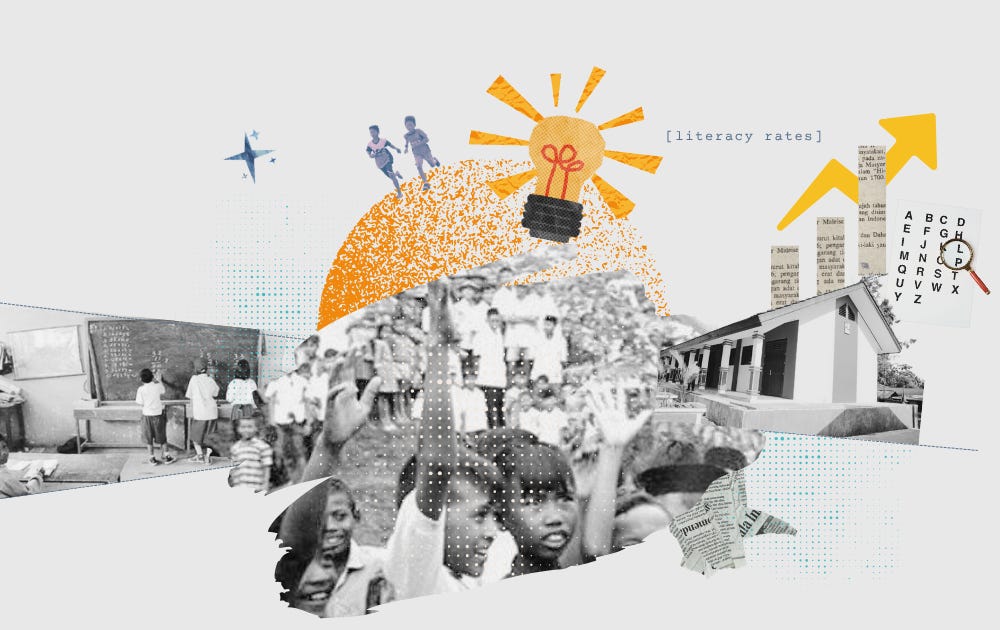
Beyond economic impact, SD Inpres reduced illiteracy rates across Indonesia from 39.1 to 15.8 percent, between 1971 and 1980. Recent studies have built upon this by showing that SD Inpres in turn increases the probability of household heads being literate by 49.4 percentage points.
But what made SD Inpres work? Let’s get through it one by one:
1. Money, money, money (must be funny!)
SD Inpres was made possible by Indonesia’s sudden profit from soaring global oil prices in the 1970s.
Despite multiple attempts at reforming the education system, the Sukarno administration largely failed to achieve universal primary schooling. In the subsequent Suharto regime, there were additional attempts in 1967 and 1972, both of which incentivized state-run schools in exchange for greater fiscal subsidies - and largely failed.
In the mid-1970s, global oil prices began to surge dramatically, giving Indonesia—then a major oil exporter—a huge boost in government revenue. The Soeharto regime then allocated a huge influx of these windfall oil revenues for primary school construction.
This gave way to the launch of SD Inpres. With a huge influx of windfall oil revenues, the regime allocated considerable resources for primary school construction.
Under Presidential Instruction No. 10/1973, there were specified funding allocations to each district, based on the child population who weren't yet enrolled in school – from the total 61,000 schools built, districts received between 16 and 824 new elementary schools.
Funding for this program, by the end of the First Long-Term Development Plan (PJPT I, which lasted from 1969 to 1994), amounted to as much as Rp 6.5 trillion (not adjusted for inflation).
Here’s the problem: in the early 1980s, another global oil crisis led to declining oil revenue that respectively caused cutbacks in education spending. This meant that planners were unable to fulfill intentions to begin constructing the junior high school (Sekolah Menengah Pertama, or SMP) buildings, and that millions of primary school-educated children were faced with far too few local middle schools to continue their education.
Takeaway: Beyond learning that we need money with clear budgeting, there’s a key question that asks: if Indonesia were to have another influx of cash, what would we do with it? SD Inpres was driven by dedicated leaders such as Widjojo Nitisastro and Ali Wardhana, who advocated for oil money to be utilized for education, among other things. In this day and age, who do we trust to do this?
2. Long-term policy commitment
Similarly to the story we did on what made BPJS work as a reform (read here), the SD Inpres program worked because it was a long-term policy commitment that had frequent updates. Under Pelita II (Suharto's Second Five-Year Development Plan), formulating the expansion of schooling opportunities was listed as one of the core priorities of development in the education sector. This cleared the way for a sustained focus on SD Inpres as a policy priority.
From 1973, each two-year interval saw thousands more elementary schools built, based on continued policy prioritization. Here's a key breakdown:
1973–74 (Inpres 10/1973 and 6/1974): 6,000 new schools approved
1975–76 (Inpres 6/1975 and 3/1976): 10,000 new schools approved
1977–78 (Inpres 3/1977 and 6/1978): 15,000 new schools approved
1979–80 (Inpres 12/1979 and 6/1980): 14,000 new schools approved
By the early 1980s the vast majority of Indonesian villages had an SD Inpres, often the only formal school for miles around. Most importantly, many of the subsequent policies were building on existing needs. For example, at the first launch of SD Inpres through Presidential Instruction No. 10/1973, the 6,000 schools were equipped with three classrooms, one teacher's room, toilets, and school support equipment.
Two years later, Presidential Instruction No. 6/1975 added upon the previous progress by additionally requiring clean water supply facilities, additional teaching arrangements, as well as textbooks and children's reading books in the library.
This consistent focus meant the SD Inpres policy didn’t stagnate: instead, it evolved alongside local needs and budget realities. By layering improvements upon each other (from basic buildings to sanitation, teaching tools, and books), the program illustrates how long-term commitments work best when they are designed to adapt, not just expand.
Takeaway: We need sustained focus – enough so that subsequent policies do not just follow up, but build upon previous ones!
3. Clear standardization and scale
The SD Inpres program is a great example of data-driven decision making in the public sector, because it was designed explicitly to target children who had not previously been enrolled in school. Keeping the limited budget in mind, authorities were able to use data on the number of children not enrolled in school and determine where SD Inpres would be most effective.
This was called the general allocation rule – wherein the number of schools to be constructed in each district was proportional to the number of children of primary school age not enrolled in school in 1972, then listed the exact number of schools to be constructed in each district.
The specificity of these instructions facilitated clear expectations that were to be fulfilled in each area. Additionally, the schools were standardized—same size, layout, teaching rooms—which made the rollout fast and relatively simple to monitor.
Takeaway: By using a fixed school design and the general allocation rule, schools could be constructed exactly where they were needed, without getting bogged down in bureaucratic fragmentation.
The legacy of SD Inpres
In the realm of education alone, SD Inpres led to a sharp rise in net enrollment ratio among children aged seven through 12. In fact, one report notes that in 1974, children aged between two and six years old were receiving 0.12 to 0.19 years more education, raising literacy rates nationwide.
The economic impact of SD Inpres is hard to overstate. It was the research focus of Nobel Prize-winning economist Esther Duflo in her PhD dissertation, which reported that between 1973 and 1980, up to 61,000 schools were constructed under the program. Crucially, she proved that education is directly related to economic growth – former students of SD Inpres enjoyed a 1.5 to 2.7 percent increase in wages than the previous generation, and she estimates economic returns to education ranging from 6.8 to 10.6 percent. In isolated areas, the chance to finish primary school often meant the difference between subsistence work and a paid job or civil-service employment later on.
SD Inpres set a precedent for national education policy. The idea of wajib belajar (compulsory schooling) was later expanded to nine years in the 1980s and 1990s. In fact, perhaps subsequent developments to educational policy would not have been politically or logistically possible without the base of primary schools that SD Inpres established.
SD Inpres no doubt has some flaws, but the sheer scale must be celebrated. It has given way to national educational policy as well as a game-changing academic understanding of the relationship between education and economic growth.
What does all this mean for Sekolah Rakyat?
Today, the Prabowo administration’s Sekolah Rakyat initiative is another part of Indonesia’s long journey towards expanding access to education. However, as we reflect on what made SD Inpres work—clear funding priorities, long-term commitment, and data-driven implementation—the real question becomes, can Sekolah Rakyat follow through?
So far, maybe not so much. Education watchdog JPPI reported that there was mass quitting amongst Sekolah Rakyat teachers due to “fundamental” planning flaws. Student activists also warn that the program will require a huge amount of funding, yet so far does not have a clear plan for integration with existing systems. These are not just random mistakes – they reflect key knowledge gaps in sectors where SD Inpres won.
When bold new programs are launched today, knowing what worked in previous historical reforms (in this case, SD Inpres) allows us to know what to look for, and what not to repeat.
If Sekolah Rakyat seeks to succeed, it must learn from the successes of earlier efforts. Times have changed, but the fundamentals remain: strong planning, sustained political will, and policies rooted in data. Most importantly, reform requires much more than a vision.
If you’ve come to this point, you’ve read the question we posed in our first takeaway: If Indonesia were to have another influx of cash, what should we do with it? Who would you trust to advocate for this cause?
We thought it could be interesting to hear what you think - perhaps it could also be a prompt for us to write our next edition.
Click the comment button at the bottom of this email and join the conversation!
Interesting article! Reading archives and historical records of development reminds us of two things: 1) the progress we have made as a nation; and 2) that many of the challenges we face are recurring issues, largely because we have failed to learn from the lessons of the past.
A small comment from me: comparing the SD Inpres program with Sekolah Rakyat is not quite accurate, or at the very least, should be done carefully and proportionally. The two were framed within different theories of change.
SD Inpres had a clear theory of change: the centralistic President at the time allocated surplus state funds to invest in the education sector because of 1) high illiteracy rates, 2) a severe lack of elementary school facilities, especially in remote areas, and 3) efforts to raise national education levels. Of course, there were more precise metrics used under the PELITA plans. Moreover, Esther Duflo’s research also measured the “impact” of SD Inpres, providing another set of useful metrics.
On the other hand, Sekolah Rakyat operated under a different rationale. Does expanding access to education for the poor necessarily require building new schools? The establishment of Sekolah Inpres took place in areas where infrastructure was lacking. In contrast, Sekolah Rakyat relied on facilities under the Ministry of Social Affairs to build new ones without considering the existing facailities surrounding, which clearly was not cost-effective. Expansion of access to education could instead be pursued through enhancing the existing programs like the Kartu Indonesia Pintar or the School Operational Assistance Program (BOS).
Furthermore, we cannot ignore the factor of decentralization in education, which makes both norms and implementation of primary education, let alone for the poor, highly dependent on the capacity of local governments, the fiscal capacity of those regions, and the political landscape (both power struggle and budgetary) in each regions.
Further question: Is Sekolah Rakyat intended to bypass that decentralization in primary education? Perhaps it’s based on the assumption that the central government needs to take over the issue of expanding access to education for the poor>
This edition's discussion question: If Indonesia were to have another influx of cash, what should we do with it? Who would you trust to advocate for this cause?
We'd love to hear your take. Discuss here!
- The Reformist Team