

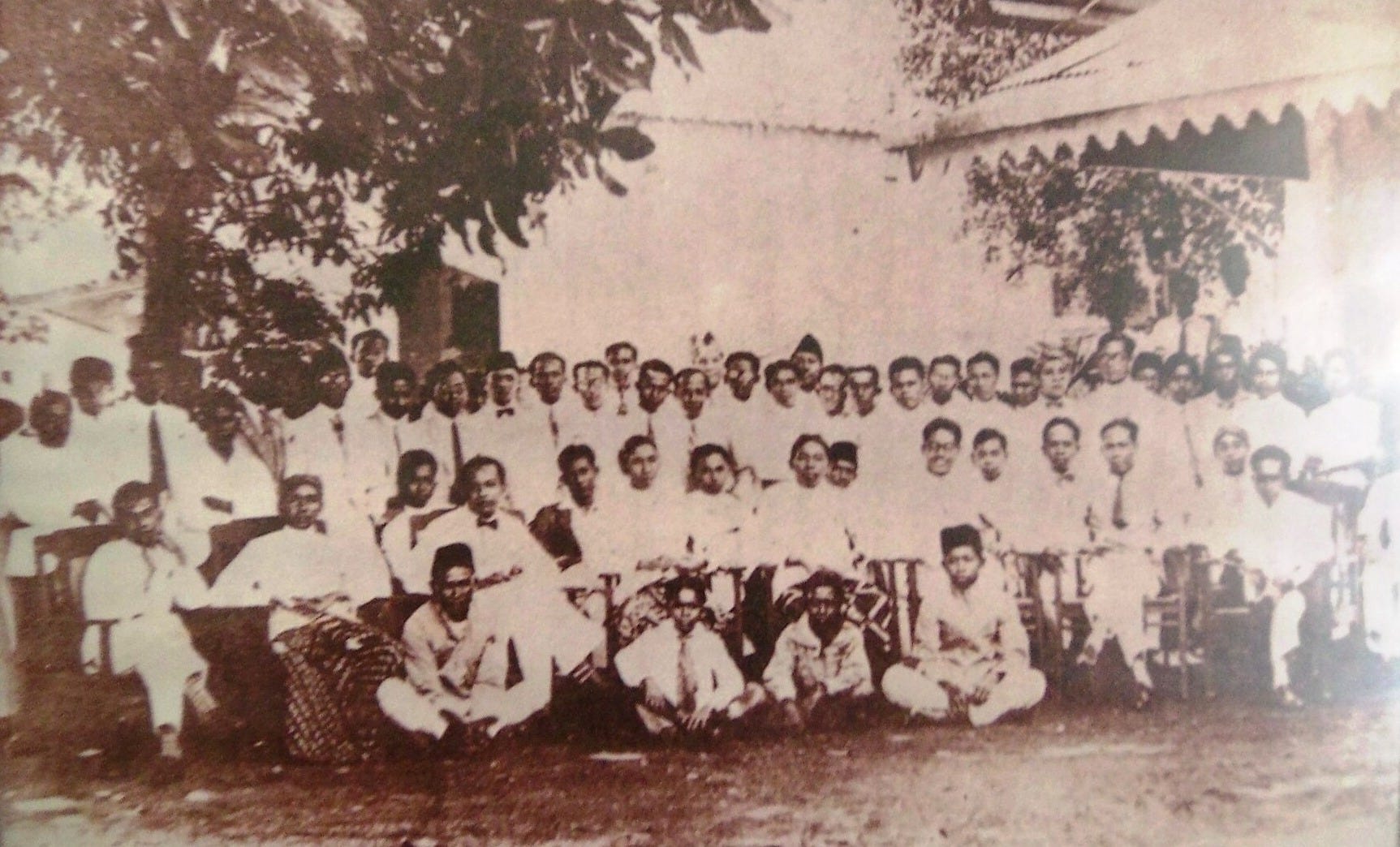

Imagine yourself living under colonial occupation. You are a young native scholar, formally educated, currently enrolled in higher education. Filled with an undying wish for independence, you organize with like-minded peers.
Your country — or rather colony — is a vast archipelago, home to thousands of ethnicities and local languages. You are a native of its most populated island. At school, you speak the colonial language; at home, your family still calls you by your childhood nickname in your mother tongue.
Then you joined youth organizations to champion your people’s right to freedom. This year, you attend the annual meeting as a representative of your island’s faction, Jong Java. Like your peers from across the archipelago, you speak the language of the colonial powers, because it is the one you have used and been taught your whole life. Your teachers tell you that it is the pathway to intellectual advancement.
Then comes the decision: this meeting will be the moment you set yourselves apart from the colonial administration. A defined nation that represents the unified will and demands of the natives.
Together, you settle on a name: Indonesia. Easy enough. You settle on an identity: Indonesian. Pretty straightforward. But the lingering question remains: how can you truly set yourself apart from the colonizer if you still speak their language?
How does one choose the most representative language of a very diverse set of people?
Your native language, Javanese, is spoken by millions, so surely that is the most rational choice to mobilize a large mass. But Dutch, your colonizer’s language, is practically native to the educated youth sitting around the table. If you want to progress quickly, it is best to stick with it.
Instead, you go a different route. You choose a lingua franca native only to a minority group from the archipelago’s westernmost islands: Malay, or what you and the rest of your peers now call Bahasa Indonesia (the Indonesian language).
This is the story of the Sumpah Pemuda (Youth Pledge), known in Indonesia as the day the Indonesian “nation” was born. Though independence would arrive only 17 years later, the idea of a unified “Indonesia” had already been planted.
Today, Indonesia is one of the very few countries in the world that has adopted a national language that was neither the mother tongue of the plurality nor the language of the colonial occupier.
Perhaps in a bit of irony, this edition of The Reformist will talk about the legacy of the Indonesian language… in English. In commemoration of the 98th anniversary of the Youth Pledge this 28 October, we look back over the past century to unpack the history of the Indonesian language, from its first formal recognition in the congress to its nationwide adoption after independence.
The country’s founding fathers could have chosen to adopt a language already native to many. Instead, they chose idealism: a neutral language to achieve their goal of a united nation, not dominated by any single group.
The case for choosing Malay
The First Youth Congress, held in 1926, was conducted primarily in Dutch, but even then a growing consensus emerged to adopt Malay as a unifying language. Among its leading participants was Muhammad Yamin, who later helped draft the preamble of the Indonesian constitution and served as Information Minister under President Sukarno.
At the congress, Yamin weighed two options: Javanese and Malay. The former because it was spoken by a plurality of natives, but remained optimistic that the latter was the more promising choice for unity. “Malay will gradually become the language of social intercourse and the language of unity,” Yamin said.


The urge to use Malay did not come out of nowhere. The language already had some standing as the go-to vernacular for the inhabitants and visitors of the archipelago for centuries before the pledge.
During the Dutch East India Company (VOC) period, Dutch was hardly used, and by 1940, it was only spoken by a mere two percent of the entire archipelago. Many regions relied on Low Malay as the language of trade. Low Malay, also called Bazaar Malay or Melayu Pasar, is generally believed to have been a pidgin shaped by contact among Malay, Chinese, Indian, Arab, Persian, Portuguese, Dutch, and English traders.
As the Dutch cemented their standing in the archipelago, the Malay language grew with it. Alongside Low Malay ran High Malay, the historical Riau-Johor standard of literature, the Malay courts, and Islamic religious life, which the colonial government promoted.
By the early 20th century, political organizations like Sarekat Islam and the Indonesian Communist Party (PKI) already used Malay as their main language of communication. They did so under the same pretext the Youth Pledge’s youth shared: In an archipelago with over 200 regional languages, a lingua franca was the most effective tool for political education.
The Youth Pledge therefore carried more of a symbolic weight. According to an author, Keith Foulcher, it was most likely in this pledge that the term Bahasa Indonesia was first used publicly.
Perhaps the most defining aspect of the Youth Pledge for the Indonesian language is its prose. The first two lines of the pledge are firm declarations:
We, sons and daughters of Indonesia, declare that we have one homeland, the land of Indonesia.
We, sons and daughters of Indonesia, declare that we are one nation, the Indonesian nation.
Then, the third line changes the verb:
We, sons and daughters of Indonesia, uphold the language of unity, the Indonesian language.
The delegates explicitly declared an Indonesian nation and homeland. Meanwhile, the line on language reads more like an action to be taken than a firm declaration, largely because many people in the congress were still unaccustomed to the language.
This uncomfortable shift in vernacular was a lived reality for many nationalist figures in the Dutch East Indies. Yet, they persisted.

Javanese nationalist figure Sitti Soendari best embodies this. At the Youth Pledge, she spoke only Dutch because “she did not understand Indonesian.” Just two months later she addressed a women’s congress in full Indonesian, prefacing her speech:
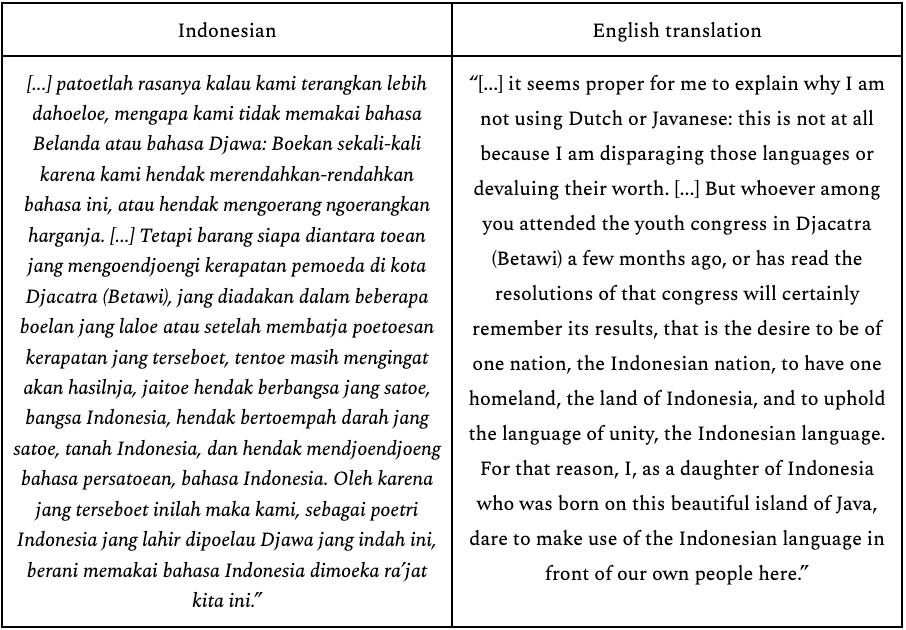
In 1928, a promise was all that the youth could offer. Outside their political bubble lay the watchful Dutch colonial administration. Dutch observers at the congress still called the language Malay, with “Indonesian” in quotation marks, and noted in contempt that the chair — Soegondo Djojopoespito, a Javanese student and later a cabinet minister under Sukarno — could hardly speak it. Then came the Japanese.
The unlikely push under Japanese occupation
As controversial as it may sound, Japan’s occupation in Indonesia was perhaps a catalyst for the language adoption alongside the persistent effort of nationalist movements that had birthed the Indonesian language. Under Japanese rule, the Indonesian language, then merely Malay under a different name, was forced to mature quickly.
After the Japanese took over Indonesia in 1942, the new regime prohibited the use of Dutch, with the expectation that they would eventually start to adopt Japanese after the war. In the short term, the “newly” established Indonesian became the practical choice, given its status as a lingua franca.
Nationwide, the government implemented the language from top to bottom. School teachers to government officials — irrespective of rank — were mandated to switch from Dutch to Indonesian.
On 20 October 1942, the occupying Japanese government formed the Indonesian Language Commission (KBI). Its primary goal was to develop the language from Malay into its own standalone language, reflecting the cultural and social context of the archipelago.
Local elites cleverly used this opportunity to develop, modernize, and institutionalize the Indonesian language. Sutan Takdir Alisjahbana (STA), best known today as a writer, was a member of the committee. In a historical account by his daughter Tamalia Alisjahbana during a talk at Georgetown University SFS Asia Pacific, STA and the KBI refined grammar structures and added new vocabulary by pooling words from different segments of society. The military, merchants, teachers, and other professionals were consulted to contribute words that were then included in the new language.
Indonesian author Sutan Takdir Alisjahbana (Wikimedia Commons/Public Domain)


Different ethnicities and racial groups like the Javanese, Minangkabau, Chinese, and Arab all partook in this modernization program. By the time Indonesia declared independence in 1945, there wasn’t a need to meticulously develop this new language, as its foundations had already been planted a few years prior.
According to STA’s own reflection, “the Japanese decision to develop Indonesian as quickly as possible forced every leader to abandon Dutch and caused a period of ‘forced growth.’” He added that by the end of the Japanese occupation in 1945, the committee had produced about 7,000 new official terms.
But even after the Japanese conceded the war and Indonesia declared independence, the Indonesian language was only native to roughly 5 percent of the entire population. The path forward, therefore, was still unclear. What policies and nation-building strategies took the language from being native to only 5 percent of the population at independence to being spoken by 98 percent of Indonesia in 2022?
The double-edged language policy
Language as education
At the policy level, education became the most important vehicle for ensuring the mass implementation of the Indonesian language. The 1947 Lesson Plan — the first of its kind after independence — officially replaced Dutch with Indonesian in educational materials and instruction, playing an essential role in expanding Indonesian comprehension and use after independence.
In 1984, the government under President Suharto launched a national literacy campaign, the Six-Year Compulsory Education Program. As an initiative to increase primary school enrollment, the program enforced a strict directive to use Indonesian in state offices, public spaces, and commercial signage to phase out both colonial relics and regional dialects. Indonesian replaced local languages as the primary mode of teaching, with the exception of local vernacular used informally to explain concepts until the third or fourth year of primary education.
As a result, enrollment and literacy rates skyrocketed. In 1945, only 21 percent of all elementary school-age Indonesians were enrolled in school; this increased to virtually 100 percent by 1982 for the first grade. Literacy rates went from 5 percent of the population in 1945 to almost 70 percent just 35 years later.
The dissemination of mass media also contributed to the language’s high uptake. Between 1918–1925, the number of native newspapers grew from 40 to 200, mostly in Malay. That media landscape only gained relevance during the independence movement, when nationalist newspapers and writers adopted Indonesian as a political language.
A vast majority of radio stations, television networks, and print news and magazines were published in Indonesian, allowing those across the country to contribute to a national conversation in a shared language.
Language as a consolidation of power
But as much as language is a source of unity and a major vessel for mass education, language is also a weapon of power. In the early days of Indonesia’s nation-building, the government’s push for unity also came at a cost. Under Sukarno, the Youth Pledge was altered to fit his political agenda. Under Suharto, the pursuit of a unified Indonesian identity introduced the controversial decision to suppress other language groups and practices.
At the 30th anniversary of the Youth Pledge in 1958, President Sukarno embraced a reworded version of the third line. Instead of a call to action, the line now reads “We, sons and daughters of Indonesia, speak one language, the Indonesian language.” A firm declaration akin to the two other lines in the Youth Pledge.
Sukarno galvanized the Youth Pledge in his favor, calling his opponents traitors to the Indonesian nation. Speaking one language became code for loyalty. If the pledge said all Indonesians shared a tongue, then rejecting centralized rule could be framed as rejecting the nation itself.
This occurred during a period of great domestic turbulence. In the 1950s and 1960s, Indonesia faced separatist movements by figures from non-Java islands, driven by growing disenfranchisement with Sukarno’s centralized rule.
Propaganda like the poster below packaged the language as a patriotic duty, with speaking Indonesian standing in for resisting the colonizer.
A 1960 Sukarno-era propaganda poster with the line “one nation, one homeland, one language” alongside a fist striking an imperialist

Only after the New Order regime replaced Sukarno did the original script return. Suharto did this to distance his administration from the provocative use of the Youth Pledge under Sukarno’s rule.
Yet, under Suharto’s New Order, Indonesia’s nation-building mandate continued to wield significant strength through language control. Fearing ethnic fractionalization, Suharto signed Presidential Instruction No. 14/1967, which accelerated the forced assimilation of Chinese Indonesians by restricting public expressions of Chinese religion, beliefs, and traditions in Indonesia. This included an effective ban on Chinese-language publications and the public use of Chinese characters (these restrictions were lifted in 2000).
The government justified the erasure directive under the guise of combating threats of communism and addressing the so-called Chinese problem of integrating the ethnically Chinese minority group into an Indonesian nation-building narrative. The campaign largely achieved its goal, at the expense of alienating a minority group and trading one language for another.
Indonesian is still the main mode of communication among Chinese Indonesians despite attempts in recent years to offer more Chinese language learning in schools. One study found that only 9 percent of young Jakartan Chinese Indonesians maintain the use of Chinese, Teochew, or Hokkien in the family, with an English-Indonesian mix being a more frequently used second language.
Indonesian also became the language of economic opportunity as a result of these top-down national language policies, which then reinforced a bottom-up incentive for individuals to adopt and encourage using Indonesian to be competitive in the job market. Urban communities bring together individuals across the country of different ethnic backgrounds, and the lingua franca is expectedly filled by Indonesian.
“People applying for jobs in Makassar, for instance, will be tested on their proficiency in English or Indonesian. And, naturally, local languages are considered unimportant,” wrote journalist Eko Rusdianto for online publication Historia about the endangerment of regional languages. Although Indonesia has more than 700 regional languages, some 527 of them are endangered, while at least 12 have gone extinct, according to the language database Ethnologue.
The language centralization, therefore, came at a potential cultural erasure cost. It is a challenging tradeoff leaders must make to shape a national identity. Whose voices do you protect, and whose do you serve?
A nuanced legacy
Nearly a century later, the legacy of the Youth Pledge offers some interesting nation-building lessons that have served as case studies for linguists and political scientists alike. The country’s mission to develop a national identity rallied around a shared language, while simultaneously integrating Indonesian into education and public life to increase uptake, has largely been viewed as a success by scholars and policymakers, despite its complicated legacy with minority groups.
But there’s still some room for growth in a globalized world. A 2009 study from the University of Rochester compared Indonesia’s language policy to those of Malaysia and the Philippines. It argued that Indonesian fulfilled three “symbolic” functions in language planning more successfully than its peers, including: 1) unifying a larger speech community in spite of dialect differences (offering a shared language across more than 300 ethnic groups); 2) separating the language from others; and 3) bestowing prestige on those in the community who have developed the language (inherited from its centuries-old Malay origins).
Overlaying these functions of a national language is also a “participatory” function. It means the capacity for a speech community to use its native tongue in international discourse, trade, or higher education without relying on a foreign or colonial lingua franca. This is especially relevant in a globalized world.
For Indonesian, it is also an area that lags behind the success of the language’s other functions of unity and identity. Despite the widespread use of Indonesian in the country and among the diaspora, English has become the default secondary language in Indonesia’s urban centers and business environments. English-medium instruction is offered at the secondary and tertiary education levels, with the understanding that English is the lingua franca in global forums and will make Indonesians competitive globally.
To infinity and beyond
Granted, reforming the global lingua franca is beyond any single country’s nationalism-building scope. But as Indonesia has grown its global relevance over the past several decades, Indonesian has gained a more global recognition. In 2023, UNESCO designated it as one of 10 official languages used in the United Nations General Assembly. As of 2025, 61 countries have sought to adopt Indonesian classes in their classrooms.
When thinking about the future of the language’s policy, and considering the 100th year of the Youth Pledge in two years’ time, it is worth celebrating the wins of this national project and recognizing that this pride can grow further on a global stage.
In 1928, the delegates at the Youth Pledge were deliberate not to make the Indonesian language a firm declaration and instead a collective goal that every Indonesian must make to acquire and grow the language. As Indonesians reflect back on the Youth Pledge, it is worth seeing it not just as a remnant of the past, but as an active call to keep using the language and carry it further than the founding fathers could have imagined.
As we commemorate the 98th anniversary of the Youth Pledge, we’d like to hear from our readers: what’s your reflection on the language we perhaps have been taking for granted?
Subscribe and leave a comment on our Substack: thereformist.id
Credits:
Writers, researchers: Clara M. Fong, Rayhan Kalevi
Editors: Nea Ningtyas, Nathaniel Rayestu
Siapa sih yang nulis artikel ini, masa topiknya tentang Bahasa Indonesia tulisanya bahasa Inggris?
“Perhaps in a bit of irony, this edition of The Reformist will talk about the legacy of the Indonesian language… in English.” As an American of Indonesian heritage who cannot (yet!) speak Bahasa Indonesia, I appreciate it 😅
Thank you for writing this! A fascinating history, and makes me feel even more motivated to learn our language.