

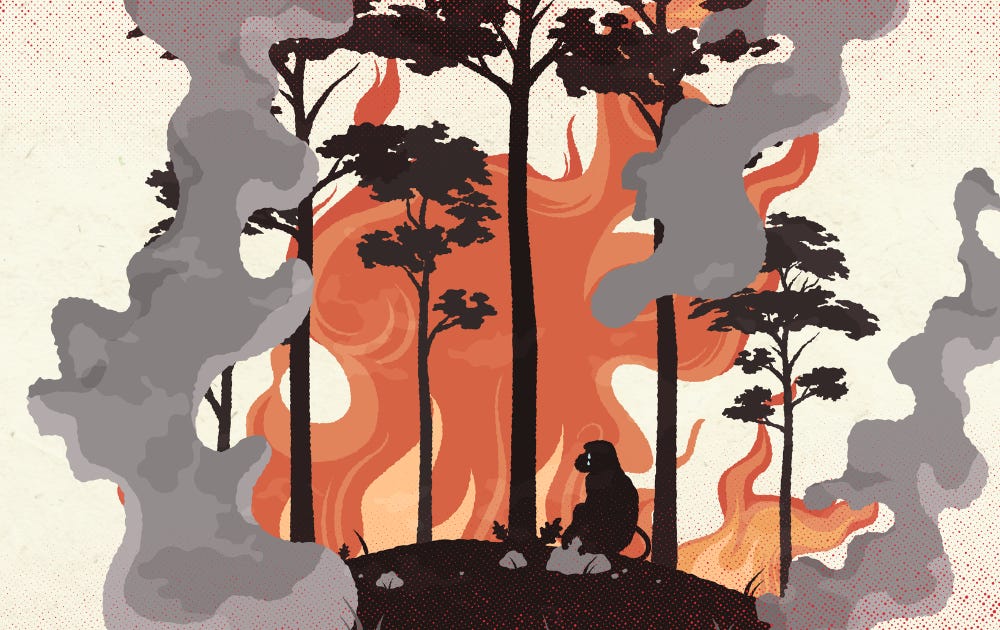
The second episode of our “Second Thoughts” video series on this topic drops this week on our YouTube channel.
Read this passage and think about when this diagnosis was made:
“The forest and land fires that engulfed vast areas of Indonesia were an unprecedented human and ecological disaster. A prolonged dry season caused by the El Niño climatic phenomenon created the conditions for the conflagration. But the fires were mostly ignited deliberately by plantation companies and others eager to clear forest land as rapidly and cheaply as possible, no matter what the consequences.”
If you think this was an international news report from a month ago about the forest fires in Kalimantan, you would be wrong. This diagnosis was the opening paragraph to a policy paper on the fires of 1997.
Titled “Trial by Fire,” this World Resources Institute (WRI) report from 2000 detailed the root causes behind the fires that engulfed over 10 million hectares of forest in Indonesia. The answer? Land clearing for agroforestry plantations, namely oil palm. It has now been 26 years, and yet their analysis still rings true.
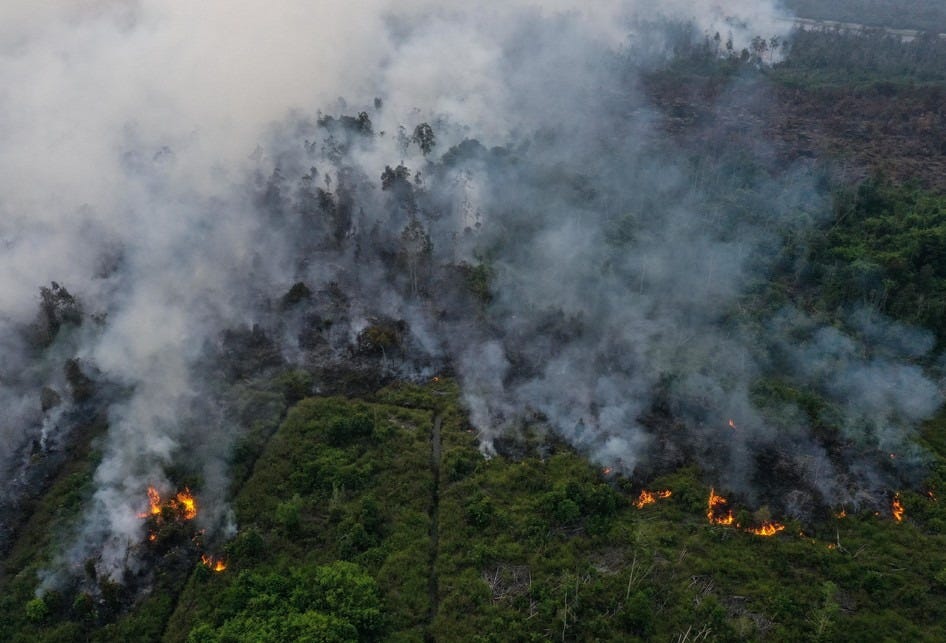
As of August 2026, over 202,000 hectares of forest are burning in oil palm-rich Kalimantan. The resulting haze has made living in the region deadly for the millions of Indonesians on the island.
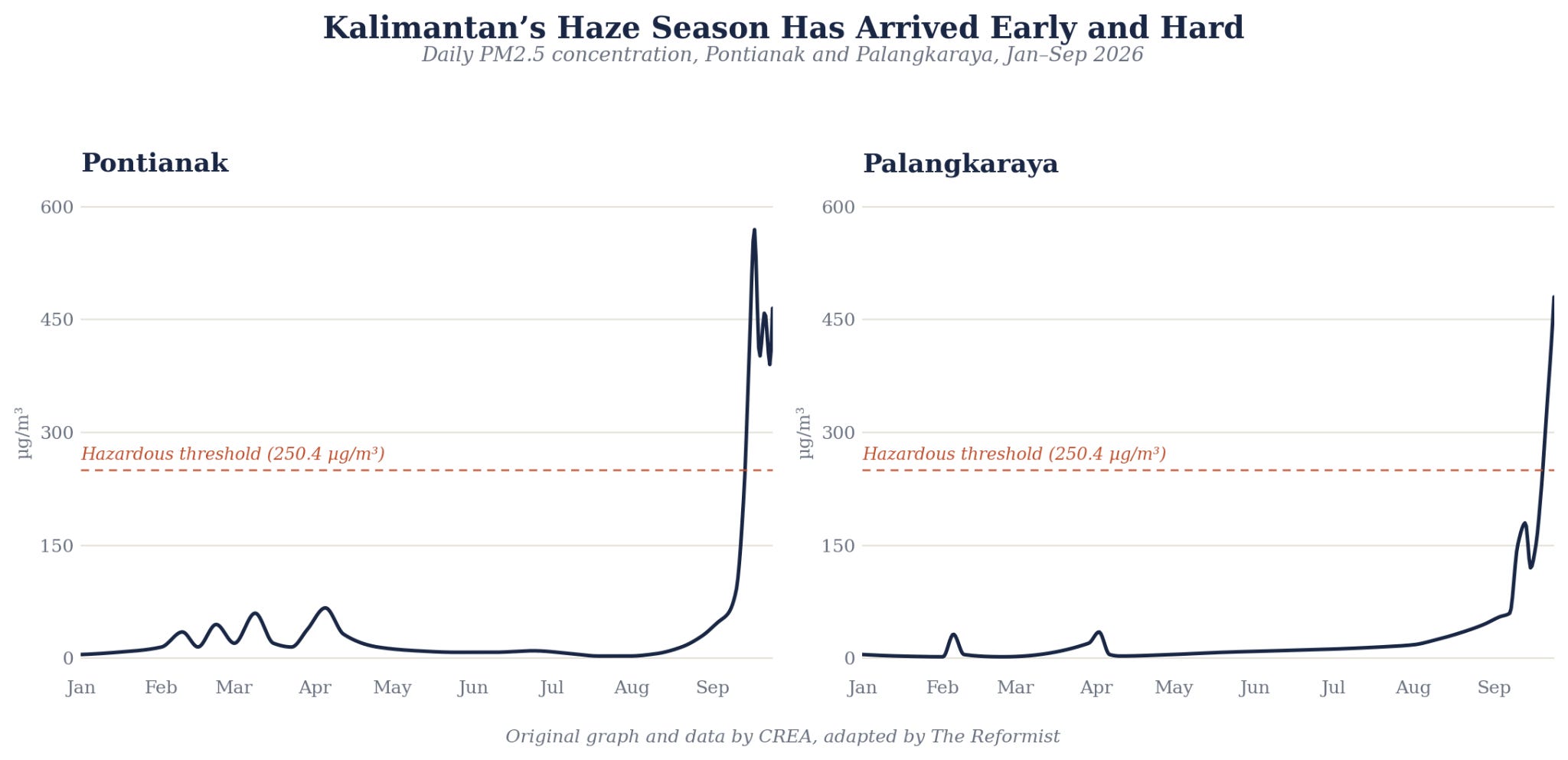
At its peak in early September 2026, the cities of Pontianak and Palangkaraya in West Kalimantan reached 507 micrograms per cubic meter of pollutants, making the air hazardous to breathe. As of 24 September 2026, both cities remain hazardous to live in because of fire-related pollution, according to air monitoring data from the Centre for Research on Energy and Clean Air (CREA). Not only at home, but neighboring countries have also been affected as smoke spreads to Malaysia and Singapore.
While the forest fires were an ecological disaster, they were by no means natural. As this edition of The Reformist will cover, Indonesia’s forest fires are — and have been — a direct byproduct of a lackluster forest management ecosystem, including legal loopholes that manipulate customary practices and the economic exploitation of land clearing for the monoculture palm oil industry.
The loopholes in the law
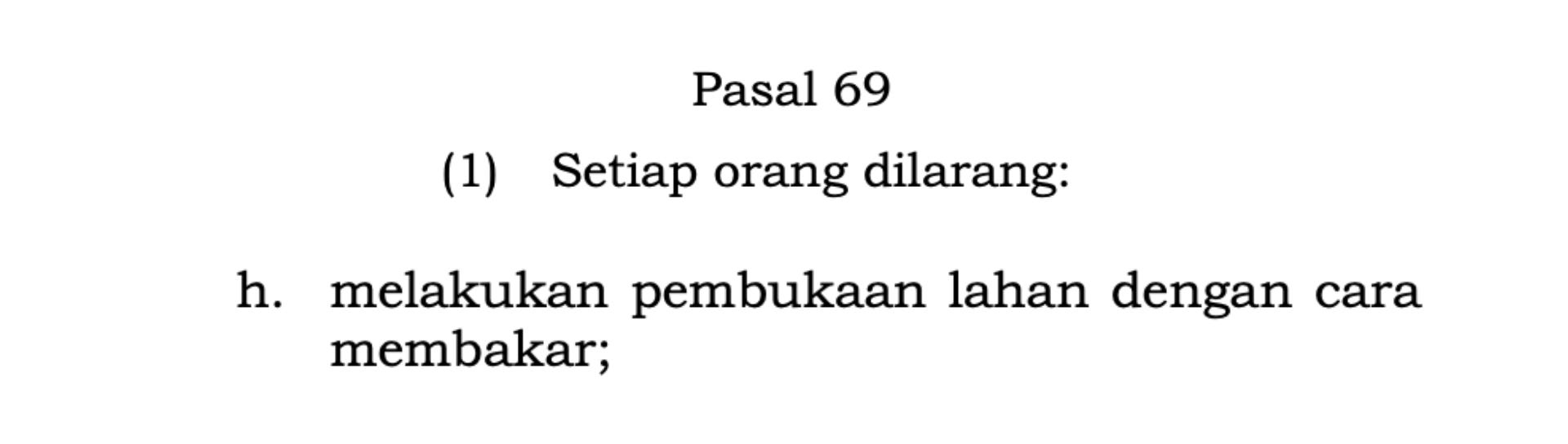
Indonesia has banned land clearing by fire since 2009. Article 69(1)(h) of Law No. 32/2009 on Environmental Protection and Management (‘UU PPLH’) states it in one line: no person may clear land by burning.
The Forestry Law (No. 41/1999) carries up to 15 years for deliberate forest burning. The Plantation Law (No. 39/2014) bans the practice outright for plantation operators. On paper, the question is settled.
But a complication sits just one subclause below. Article 69(2) of UU PPLH requires that the ban “give serious regard” to local wisdom:
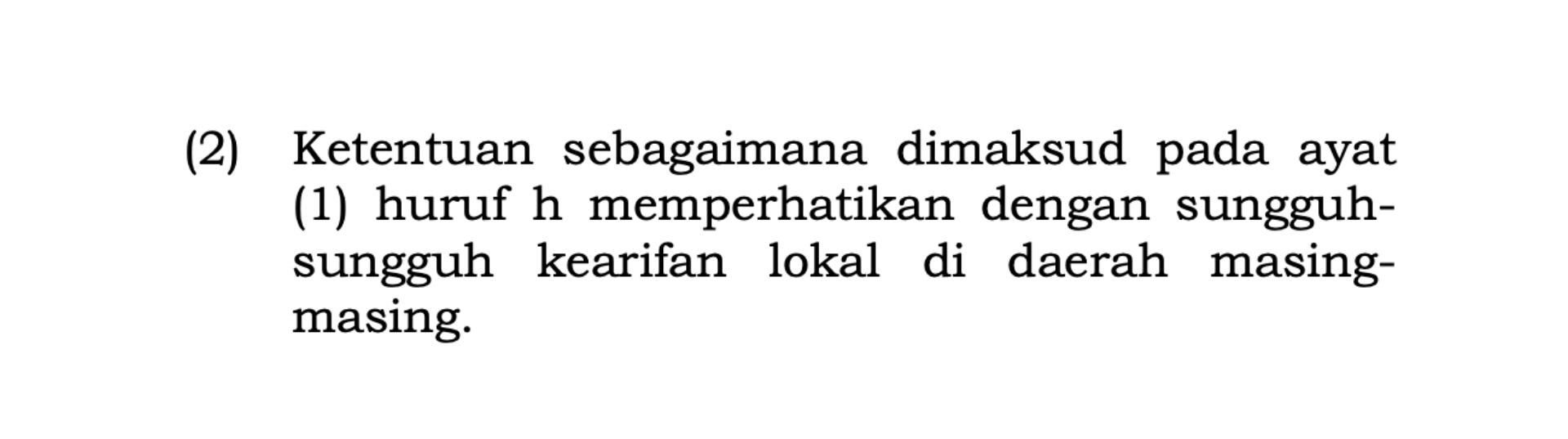
The law’s own elucidation defines what this provision allows: Fire can be used only for a maximum of two hectares of land per household, planted with local varieties, and ringed by firebreaks so the fire cannot spread.
The provision exists to honor local farming traditions, as indigenous people have used fire to manage land across the archipelago for hundreds of years before the concept of Indonesia came to be. Scientific evidence even dates burning done by humans in East Kalimantan to at least 17,500 years ago, as prehistoric settlers used forest fires to clear land for agriculture.
But if we read the three conditions against modern oil palm concessions, the mismatch is obvious. No large corporation would hold concessions below two hectares; it just doesn’t make economic sense. Oil palm is also not a local monocot (it arrived from West Africa). And the land in question is often drained peat, where fire doesn’t stay inside a firebreak as it travels underground.
So, the exception cannot protect a concession holder. It can, however, protect an individual and smallholders, and that is where the complications for accountability start.
Last month, law enforcement named 72 suspects in Kalimantan for forest burning.
One of them, identified in a report as BS, allegedly set fire to twelve hectares in Tanjung Batu, Pulau Derawan, East Kalimantan. According to police, BS acted on a landowner’s instructions to prepare the land for oil palm plantations by burning it, on the practical grounds that ash fertilizes soil.
That particular case is unproven, and the person giving the order was an individual, not a company.
Despite playing into the loophole, UU PPLH actually anticipated this. Article 88 established strict liability: Anyone whose activity poses a serious environmental threat bears absolute responsibility for the resulting damage, without the plaintiff needing to prove fault. The point was to ask “whose concession burned,” not “who lit it.” A permit holder could not escape by pointing at a farmer.
But then came the Job Creation Law (UU No. 6/2023 or ‘UU Ciptaker’), passed under former President Joko “Jokowi” Widodo’s administration. The Law rewrote Article 88 of UU PPLH, deleting the phrase “without needing to prove the element of fault.” Instead, it delegated this requirement to the same elucidation that existed in the original Law.
The big caveat, however, is that in Indonesian law, legal elucidations do not translate to legal norms. This is why courts have since split on what the provision now entails, creating a large legal gray area that only further complicates cracking down on troublesome agroforestry companies.
The numbers show the result. Searching the Supreme Court’s decision directory for the phrase “kebakaran hutan” (forest fires) returns 1,185 first-instance criminal decisions, dating back to 2007.
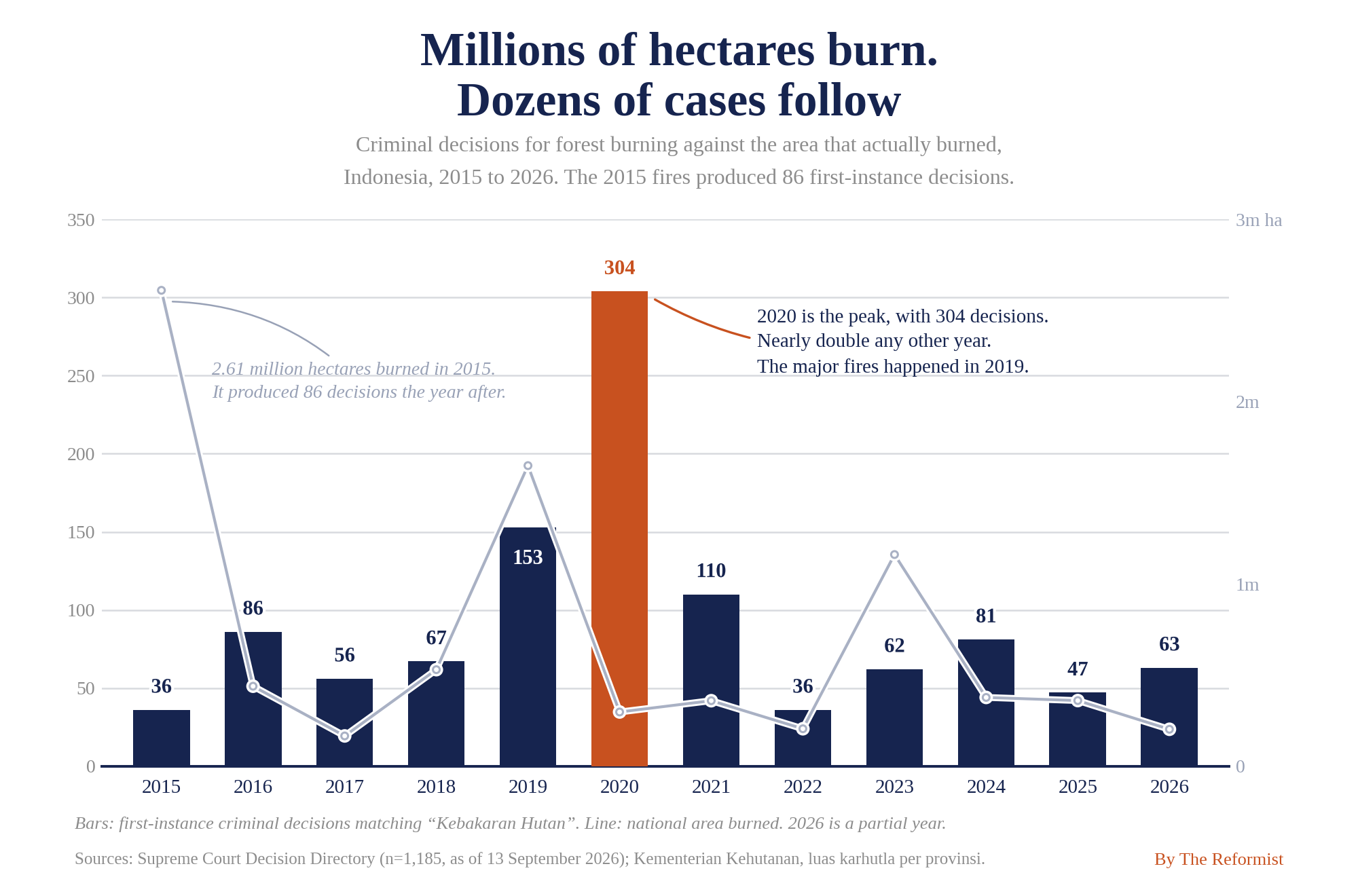
Criminal decisions for forest fire cases peaked in 2020 at 304 cases, roughly double any other year, after the catastrophic 2019 fire season. The 2015 fires, which burned 2.6 million hectares, produced 86 decisions the following year. Compare those numbers against the scale of what burns annually, and the ratio speaks for itself.
However, the directory cannot tell us how many fires those cases cover, whether the penalties were ever paid, or where the money went.
If there is one low-hanging step of legal accountability the government can take amid endless backlash over the last month, it is to open Pandora’s box. Show the people how effective — or rather, ineffective — the legal system has been at cracking down on these fires. Only then can citizens begin to trust that corporate crackdowns actually mean anything.
The economics of fire
But the legal question only answers part of the problem. The other, more sinister, is the economics of burning forests to acquire land concessions. It’s no secret that most forest fires are concentrated in concessioned areas, particularly palm oil plantations.
Shortly after the fires of 2015, one of our editorial staff members went to the peatlands of Jambi, Sumatra, with the World Resources Institute (where she previously worked). The question put to a local resident there was simple: If everyone knows this will cause a fire, why still use fire?
The answer was equally simple: It has always been done this way. Other methods cost far more and aren’t always possible because heavy machinery cannot reach much of this terrain.
They were right. Modern estimates show that clearing land with fire costs only between Rp 50,000 and Rp 90,000 per hectare. In contrast, heavy-equipment land clearing can cost between Rp 1 million and Rp 15 million. Faced with this kind of gap, the rational choice is to burn.
But that cheapness is an illusion, because these costs rarely cover the negative externalities attached to them. One study estimated the cost of damages from the 2015 fires was twice that of the 2004 Aceh tsunami. From last month’s disaster, the fires have led to more than 72,000 acute respiratory infection cases in the third week of August alone
For the actors involved, however, every step is simply profitable. One study follows this trail in the Riau province. Degraded secondary forest, usually already illegally logged, is claimed and sold for about US$ 113 per hectare (Rp 1.61 million; 1 USD at that time = Rp 14,200). The land is then cleared and given paperwork to look legitimate, then resold for US$ 655 (Rp 9.33 million). Burning it — to get it planting-ready as fast and cheaply as possible — costs US$ 15 (Rp 213,554). Three years after the oil palm goes in, that same hectare is worth US$ 3,077 (Rp 43.8 million).
From Rp 1.61 million to Rp 43.8 million, that is roughly a twenty-seven-fold return.
Meanwhile, GAPKI, Indonesia’s palm oil producers’ association, has argued that the arithmetic is not so simple. Why would companies use fire if penalties for corporate burning can reach Rp 1.8 billion per hectare, which would dwarf any saving on land clearing?
This argument would be persuasive if the penalties were reliably collected. The only time the Environment Ministry (then the Forestry and Environment Ministry) announced successful legal proceedings against agroforestry companies was in 2023, when the government won judgments worth roughly Rp 5.6 trillion.
Early this year, in May 2026, President Prabowo Subianto and the forestry task force established last year, known as Satgas PKH, staged a ceremony marking Rp 10.27 trillion in fines collected and 5.9 million hectares of forest area recovered from “dirty” agroforestry companies.
Despite the hefty numbers, critics warn the recovery effort had underlying intentions. Some 4.12 million hectares of that seized land were given to Agrinas Palma Nusantara, a state-owned palm oil and biodiesel company, rather than designated as a natural forest. The process was also hasty and lacked public oversight. The regulation meant to govern these land handovers wasn’t issued until seven months after the seizures began.
The move felt like a land grab dressed up as forest restoration, showing that current laws fail to effectively curb bad actors. As this section shows, this may be by design.
The government and the palm oil industry are closely entangled through concessions and through campaign financing. Last year the industry recorded record exports of US$ 40 billion and contributed 3.5 percent of the country’s entire GDP. The larger the economic stake, the stronger the disincentive to enforce.
When enforcement does happen, it isn’t a shocker to see senior public officials dragged down along with the naughty corporate leader. For example, in 2007, the owner of the palm-oil Surya Dumai corporate group, Martias “Palm Oil King” Fangiono, was convicted after being found guilty of collusion with the local government to secure the clearing of forested land for palm oil concessions. The then-governor of East Kalimantan and several senior Forestry Ministry officials were also brought down.
Behind every business tycoon that breaks the law are public officials who gave it the green light.
Disincentivizing fire
If burning is a rational response to the price signals in front of a land clearer, then the policy question is not simply how to ban it harder. It is how to change the economic incentives behind the entire forest management ecosystem.
Here are six initiatives the government can do:
First, fund the local governments that actually manage each forest. Spatial planning, plantation supervision, fire response, and community protection all happen at the district and provincial level, and all of them are chronically under-resourced. A national crackdown enforced by one ranger per 26,000 hectares is an inefficiency in the making.
Second, supervise on-the-ground operations. The questions that matter are whether a concession’s canals are draining its peat, whether its firefighting equipment works, and whether fire keeps recurring in the same concession year after year. All three are measurable, and the last one is already visible in satellite data long before it reaches a courtroom. For permits still in process, the sustainability standard should bind at site selection, not be waved through afterward.
Third, make the permit trail public. This includes who owns the concession, where its boundaries run, what permits it holds, and whether villages or customary territory lie inside it. Right now, none of that is reliably available to the people living next to concession lands. The One Map policy, first introduced in 2010 under then-President Susilo Bambang Yudhoyono (SBY), was meant to resolve this issue, but it still leaves overlapping claims and competing map versions circulating between ministries. Early this year, in January, Agrarian and Spatial Planning Minister Nusron Wahid urged completion of the map within the next two years, suggesting the program is far from finished. What a travesty that three consecutive administrations, across 16 years, have failed to muster the political will to finish an imperative product.
Fourth, prioritize peatland restoration. As this article covers, drained peat can lead to uncontrollable burning. Canals must be blocked or managed, land rewetted, and planting matched to the peat’s condition rather than forcing the peat to match the crop.
Fifth, reduce the economic pressure that puts people near the match in the first place. Poverty drives smallholders to take up the work of forest burning, and the evidence is stronger than most people expect. Research by Johns Hopkins University and The Nature Conservancy in 2020 found that Indonesia’s conditional cash transfer program (PKH), designed purely for health and education outcomes with no environmental objective whatsoever, was associated with deforestation reductions of up to 30 percent. Expanding the program to concession-rich areas, in coordination with the Social Affairs Ministry responsible for PKH, should be considered.
Lastly, a more appropriate long-term model leaves the extractive mode behind for something restorative, regenerative, and redistributive. Protecting forests does not mean halting economic activity. Agroforestry, non-timber products like coffee, nutmeg, honey, and bamboo, paludiculture on wet peat, community-based ecotourism, and payments for environmental services. All of these generate income precisely because the forest is still standing.
The “Trial by Fire” report named the economic incentives, the governance failures, and the enforcement gaps in 2000, and every subsequent fire season has reaffirmed these findings. What the country has lacked is a willingness to make burning so unappealing that no bad actor even thinks about touching it within a ten-foot pole.
It’s time we put the fires out for good
“For more than three decades, since the exploitation of Indonesia’s forests began in earnest, key policy decisions related to forests (and almost everything else, for that matter) have been tightly controlled by small groups of unelected officials and their patrons in the large cartels that have dominated the economy.”
While this paragraph would have been an apt concluding analysis for the latest forest fires, it wouldn’t have been original. Because — surprise, surprise — this excerpt came from the same 2000 report we cited at the beginning of this article.
So while our present analysis looks back at “Trial by Fire” with 26 years of sorrow and anguish, especially the Indonesian government’s lack of action to govern wisely and effectively, our analysis is anything but novel.
Forest fires in the country have been the focus of analytical research by environmental activists, economists, and technocrats for far longer than most of you reading this have been alive. And yet for over half a century, inaction is still the leading cause behind tackling this persistent and pervasive issue that has and will cost millions of lives not just in Indonesia but regionally.
Perhaps our one question to the Indonesian government then is: If not now, then when? The time to act should have been decades ago; the next best time to act is now.