

The author is a policy analyst at the Just Transition Finance Lab of the Grantham Research Institute on Environment and Climate Change, London School of Economics and Political Science. This article reflects the author’s own analysis and views and does not necessarily represent those of The Reformist.

On 22 September 2026, Singapore-based BDx Data Centers announced the construction of AI Campus 2, better known as CGK4. It is a 640-megawatt artificial intelligence campus in Jatiluhur, Purwakarta, about five kilometers from the Jatiluhur Dam.
Two months earlier, on 28 July, West Java Governor Dedi Mulyadi and Purwakarta Regent Saepul Bahri Binzein laid the first stone, calling the site safe from natural disasters and a step towards Indonesia’s digital sovereignty. But it is worth scrutinizing what the provincial revenue agency said about why the CGK4 is being built near Jatiluhur: the area has enough electricity and clean water.
Of all the justifications, that last one deserves a second look. BDx said the project will work with the state utility company, PLN, and the local water provider, PDAM, and promises that supply won’t disturb household needs. But the water that makes Jatiluhur attractive to a data center is the same water that irrigates nearly a quarter of a million hectares of paddy fields, fills most of Jakarta’s taps, and keeps alive the villages rebuilt around a reservoir that once drowned their homes.
As the story develops, Governor Dedi recently halted this project because of its missing environmental impact assessment (AMDAL) and building permit (PBG), and demanded proof that its water use would not cut into supplies for farmers and residents who depend on Jatiluhur.
But building a data center next to a critical public facility needs more than an environmental impact assessment because it carries real social risk.
CGK4 is marketed as clean, hydro-adjacent, and job-creating. But without enforceable water priority, public disclosure, and genuine benefit-sharing, it risks becoming an unjust transition, with a global commodity like AI compute placed on top of a local commons just as El Niño intensifies.
Civilizations by the river and the social cost of the Jatiluhur reservoir
Mesopotamia flourished between the Tigris and the Euphrates, Egypt along the Nile, Harappa along the Indus. West Java is no different. If we trace the Citarum River far enough back, it ties to Tarumanagara, its namesake kingdom. From its earliest written record, statecraft in this region has focused on managing water: the Tugu inscription records King Purnawarman ordering a canal dug around the river for irrigation and flood prevention.
Similarly, Bandung was founded on a riverbank. Regent Wiranatakusumah II moved the capital from Karapyak (today’s Dayeuhkolot) to the banks of the Cikapundung. The colonial town used the river as an ornament. Yet the river that made the city later became its drain. Bappenas now lists Cikapundung as the city center’s main drainage channel and an outlet for domestic and industrial waste.
Although hundreds of kilometers away, Cikapundung is one of the Citarum’s 13 main tributaries and joins it at Baleendah. From there, the Citarum runs through three dams: Saguling, Cirata, and finally Jatiluhur. The water travels as far as Purwakarta, and Jatiluhur is where it all meets.
Construction of the Jatiluhur Dam began in 1957, and it was inaugurated in 1967. Its reservoir covers about 8,300 hectares and stores 2.44 billion cubic meters. It runs a 187.5 MW hydropower plant, irrigates some 242,000 hectares, and is called the backbone of national food security. It also supplies about 80 percent of Jakarta’s raw water.
But Jatiluhur’s social cost went largely unnoticed. Filling the reservoir submerged 14 villages and moved 5,002 people to its shores and to Karawang. Those who stayed rebuilt their lives on the water.
IIn 1974, families whose farmland had gone under started making their living from floating-net fish cages. A whole economy grew around them: hatcheries, feed shops, boat ferries and household fish processing, much of it run by women. Then the cages outgrew the lake. By late 2022, official counts put 46,270 cage plots in the reservoir, about four times the 11,306 allowed under a West Java Governor’s regulation. So the state reversed course, ordering clearances under Presidential Regulation No. 15/2018 that carried serious social risks for everyone who depended on the fishery.
Those were the two times Jatiluhur people have been affected by two waves of “national interest”. After the dam’s construction displaced them, the clean-up took away the livelihood they rebuilt.
Now the CGK4 AI campus might become the third wave.
Water should stay a public good
We tend to treat water as if the supply never runs out. Political ecologists such as Erik Swyngedouw and Karen Bakker argue that scarcity is produced locally, not just by nature. It is rarely just about rainfall; rather, it’s a decision-making process about who gets water first when there isn’t enough.
On paper, Indonesian law has already solved this. In a 2013 ruling, the Constitutional Court struck down the 2004 Water Law and set five limits on commercial water use: (1) business use must not undermine people’s rights; (2) the state must fulfill the right to water as a human right; (3) management must protect the environment; (4) water stays under absolute state control; and (5) priority for commercial use goes to state and regional enterprises. The replacement, Law No. 17/2019, still allows private users, but under stricter licensing and priority rules.
Like other natural resources, water is tested during the climate crisis. In October 2023, Jatiluhur surface fell to 93.77 meters above sea level, below the 94.44-meter crisis line set by its operator, Perum Jasa Tirta II (PJT II), and about 14 meters under its normal maximum. The pattern recurs this year, as PJT II data show the reservoir dropped from 106.79 to 99.37 meters between 8 June and 5 August, and by 31 August it stood at 96.34 meters. BMKG expects El Niño to last into early 2027.
Chart 1. As Jatiluhur fell 10 meters, a 640 MW data center broke ground 5 km away
Reservoir water level (2026) meters above sea level. Last public reading 31 August; vertical lines mark the BDx data center groundbreaking and halt.
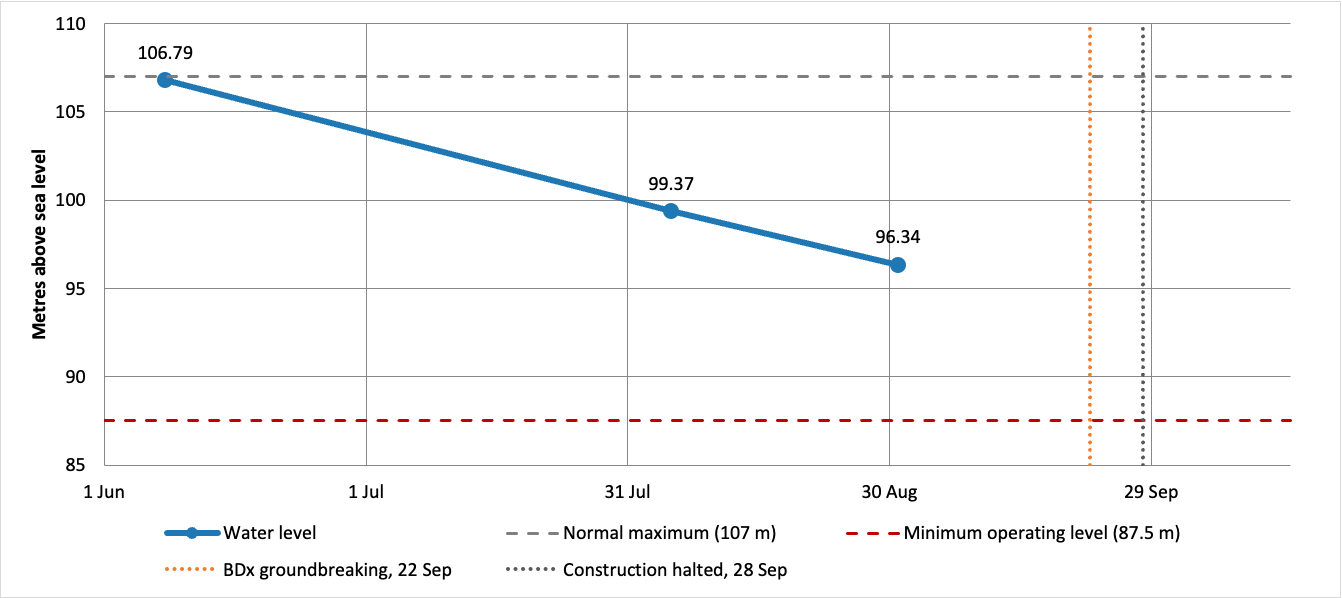
Downstream, 10,673 hectares of rice in western Indramayu were at risk of crop failure by late July, and farmers were asking for Jatiluhur water to be released. Closer to the dam, police have been trucking clean water to Desa Babakan Cikao in Purwakarta, where wells have run dry. On 27 September, police delivered water to about 200 families in Desa Kutamanah, on the reservoir’s own shore, who had been short for roughly three months. It’s a lingering irony that people closest to Indonesia’s largest reservoir are waiting for water trucks.
So where do local people sit? While PJT II insists the reservoir can still meet every user’s needs until the end of the year, allocation follows a hierarchy in practice: Jakarta’s piped supply first, then irrigation and industry, and last the households on wells nearest the dam.
Even Jakarta’s officials admit that the stress shows first in shallow wells, not in the pipes. Yayasan Amerta Air Indonesia’s Hotmauli Sidabalok has warned that data-center water demand could turn this into environmental injustice, pitting a basic human need against industrial cooling. However, the question of environmental impact assessment remains largely undisclosed.
Other countries show where this can lead. In 2023, as Uruguay went through its worst drought in 74 years and Montevideo’s tap water was mixed with brackish estuary water, Google planned a data center in Canelones that would use about 7.6 million liters a day, the domestic use of 55,000 people. Its projected impact stayed hidden behind a confidentiality clause Google insisted on, until local researchers sued to see it.
Protesters answered with a slogan that is a political-ecology thesis on its own: No es sequía, es saqueo. It’s not drought, it’s plunder. In Querétaro, Mexico, eight of eleven aquifers are overexploited, and families in nearby Viborillas get water three days a week, while well concessions keep industry supplied. In neither place was scarcity simply natural.
A closer look at the promise of CGK4
The hydropower promise
CGK4 will rise to six buildings over about three years. The first will deliver 120 MW of IT capacity in phases from early 2027, using direct-to-chip liquid cooling for racks of up to 500 kW. The headline partnership is hydropower. But the company’s own statement says power will come through the state utility PLN, while a hydro arrangement with PJT II is only being “actively pursued.” An Indonesian trade outlet put it bluntly: the hydro option is still being explored, so it would be wrong to say CGK4 runs on Jatiluhur’s power.
A bit of math shows why: running at full load all year, 640 MW of IT capacity would use about 5,600 gigawatt-hours. PJT II says Jatiluhur’s plant produces about 830 million kWh, or 830 gigawatt-hours, in an average year. The full campus would need almost seven times the dam’s entire output. Building 1 alone would need more than the dam produces, and that is before accounting for cooling energy.
Chart 2. The data center would need 3.4 times the dam’s own hydropower capacity
Installed or design capacity, megawatts. Its water need (384 L/s at full build-out) equals about 2.1% of the raw water Jakarta takes from Jatiluhur.
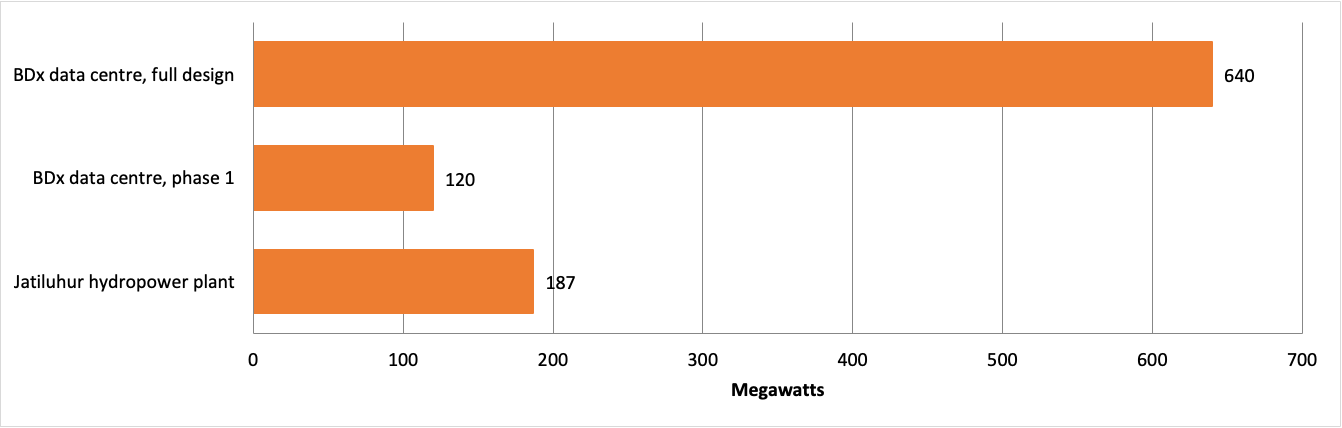
This means most of CGK4’s electricity will come from the Java–Bali grid, which still runs mostly on coal. So “hydro” may end up as more of a label than an energy source.
Moreover, hydropower has an El Niño problem. In 2024, drought drained Zambia’s Lake Kariba to about 8 percent of usable storage, forcing the country to shut its Kariba North Bank station while daily power cuts stretched to 20 hours. If CGK4 does sign up for Jatiluhur hydro, a simple question follows. In a dry year, who gets cut first: the data center, other grid users, or the irrigation releases that farmers depend on?
The employment promise
The employment promise deserves the same scrutiny. Official statements speak of 2,000 to 3,000 jobs for a Rp 3.5 trillion first phase. However, most construction work is temporary, and permanent data-center jobs are few and require high skills. In Johor, 51 approved projects together account for about 7,561 skilled jobs, roughly 150 per project.
West Java legislator Maulana Yusuf welcomed the jobs amid more than 10,000 layoffs in the province this year, but he asked whether they are worth the project’s impact, and demanded an open environmental assessment and guarantees for farmers’ irrigation water.
Mexico offers a sobering comparison. In Querétaro, big tech firms have promised jobs by the thousands, yet one Microsoft facility employed only 64 people in 2025. Data centers are highly automated, and the market does not warrant a huge transfer of skills, but rather electricians and security guards.
An implementation gap?
Proponents said that Indonesia’s permitting system is meant to prevent harm. So are the rules for coal and nickel mining, which also look impeccable on paper.
The Citarum has long been branded one of the world’s most polluted rivers despite decades of regulation. And when Maulana asked colleagues across the West Java People’s Representative Council (DPRD) about CGK4’s permits and AMDAL, he said most of them knew nothing. This means the gap lies not in the law but in implementation, disclosure, and enforcement.
To be fair, there are real benefits. Domestic compute supports data sovereignty. Direct-to-chip cooling can use far less water than evaporative towers, if the heat is released through dry coolers. An inland, low-hazard site reduces disaster risk, and a large, steady customer can justify grid investment. But none of these benefits is guaranteed to reach the people living beside the reservoir.
Towards a just transition
In the International Labor Organization’s (ILO) 2015 guidelines, a just transition means decent work, social dialogue, and social protection. At Jatiluhur, it has to mean a bit more: a fair share of water and power, openness about who gets to see the data, and recognition for the people already displaced by the dam and the cage clearances.
Other places offer a menu of options. Malaysia stopped approving high-water-use data centers and now requires reclaimed water instead of the public supply. Ireland — where data centers use almost a quarter of the country’s electricity — froze new Dublin grid connections in 2021 and reopened them only for those who bring their own generation (and source at least 80 percent of their demand from new renewables).
In Chile, residents of Cerrillos took Google to an environmental court, which in February 2024 ordered its permit re-evaluated for climate change and aquifer risk. Google said it had already switched to air cooling. In Hamina, Finland, Google’s seawater-cooled data center gives its waste heat to the town’s energy company for free, enough to meet an expected 80 percent of local district heating.
The warning comes from Memphis, where xAI ran dozens of unpermitted gas turbines next to Boxtown, a neighborhood already facing four times the national cancer risk.
So what would a just CGK4 look like? At the very least, here are five recommended commitments:
A published water budget, with no reservoir or municipal water used for cooling.
A binding drought clause: when Jatiluhur falls below the crisis line, the data center cuts back before irrigation or households do.
New renewable capacity, with co-benefits for local people.
A public environmental assessment and a monitoring board that includes fish-cage households and farmer water-user groups.
Local hiring targets and a benefit-sharing fund tied to electricity consumed, directed to restoring the upper Citarum.
Guarding Jatiluhur people’s source of life
Tarumanagara dug canals, Bandung was founded on the Cikapundung, and Jatiluhur displaced five thousand people from their hometown so the nation could have rice and electricity. Each generation’s infrastructure has been built on the same river, and on the people alongside it.
The proposition CGK4 puts forward is not whether it should be built; it asks whether this generation will repeat the old bargain, where locals carry the costs and distant users enjoy the benefits. Or shall we give them the benefit of the doubt that they will honor the Constitutional Court’s principle that water belongs to the people first?
