

The recent flood catastrophe in Sumatra is a direct consequence of the ongoing climate crisis. While the death toll keeps increasing and conditions in Aceh, West, and North Sumatra are far from being restored, the government’s response to necessary mitigation and adaptation efforts in the past decade has also been lukewarm at best. In many ways, the country has been misguided in reducing its economic dependence on environmentally damaging sectors.
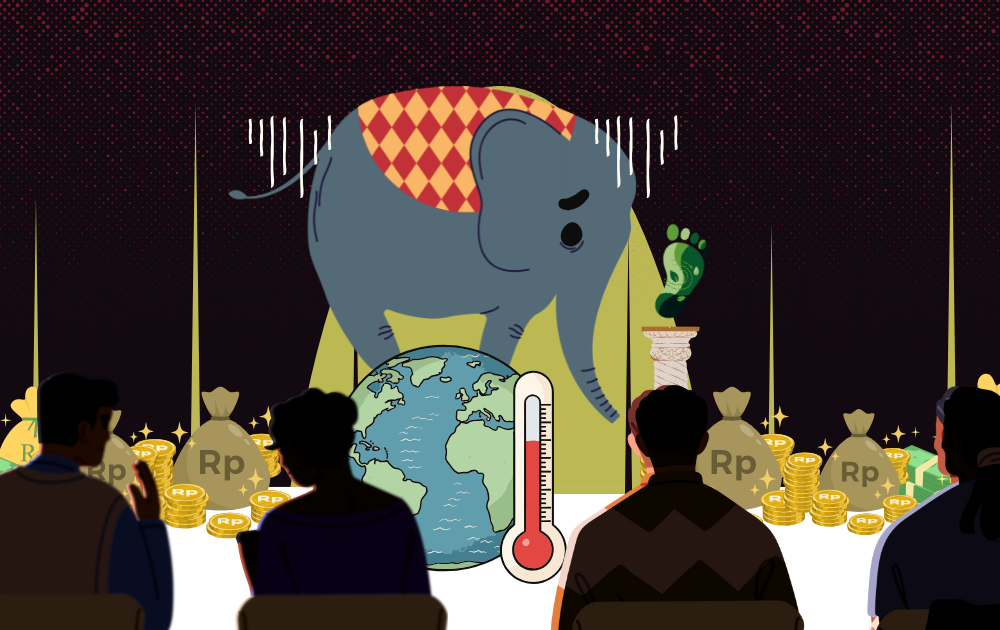
Evidently, at the United Nations’ (UN) 30th Conference of the Parties (COP) climate summit in Belém, Brazil, Indonesia came not to cooperate in rooting out carbon emissions but to advertise itself as a ‘green’ investment partner to legitimize them.
As a platform meant to keep the world from exceeding a limit of 1.5°C temperature increase—to prevent catastrophic and irreversible damage—COP has failed to deliver this goal even after 30 iterations, warned the UN Environment Programme. Instead, COP offers us insight into the perils of collective action and raises a question of whether the international community needs a different approach altogether in achieving the indispensable mission to stabilize the Earth’s temperature.
In this edition of The Reformist, read along to a summary of what transpired over COP30 and Indonesia’s hodgepodge climate commitments under President Prabowo Subianto’s administration.
From Rio to Belém: 30+ years of climate diplomacy ended up in avoidant leadership
It was in Rio de Janeiro in 1992 where the United Nations Framework Convention on Climate Change (UNFCCC) was born, the treaty that would give rise to these annual gatherings and spark three decades of climate negotiations.
COP30 arrived at a critical juncture where COP21’s binding Paris Agreement is at risk of falling through. Under this accord, signed in 2015 by 196 countries, signatory nations agreed to limit the Earth’s temperature rise to well below 2°C above pre-industrial levels, with efforts to limit the increase to 1.5°C.
To achieve this goal, each country must submit a Nationally Determined Contribution (NDC), a climate action plan outlining its emissions reduction targets and strategies by 2030. COP30 marked a pivotal moment as it was the deadline for countries to submit their updated commitments post-2030, referred to as the Second NDC.
Before COP30 in Belém, countries were meant to submit their post-2030 climate NDCs by 10 February 2025. About 13 out of 194 participating countries met this deadline, with 103 more countries turning theirs in by the end of COP 30, including Indonesia.
Beyond the formal commitments, however, Belém found itself tangled with avoidant leadership.
I. The fossil fuel phase-out avoidance
While countries like the Netherlands and Colombia were steadfast in pushing for the creation of a national roadmap for phasing out fossil fuels, their proposal never made it into the final COP30 accord. The support from over 80 countries (including host Brazil) was lost to the majority of participating nations, including Indonesia, that refused to commit to language that would legally bind them to a fossil fuel phaseout.
Domestically, President Prabowo’s ambitions of realizing energy sovereignty and 8 percent economic growth drew fears about whether sustainability and a green transition were even possible. While the President pledged to reach Net Zero Emissions before 2050 and the complete phase out of non-renewable power plants in the next 15 years at the G20 Summit in Rio last year, his administration’s domestic policies yield significant doubts.
It began when Energy and Mineral Resources Minister Bahlil Lahadalia released the 2025-2034 Electricity Procurement Business Plan (RUPTL), a document that sets out how the state-owned electrical company (PLN) will source and expand the country’s power supply over the next decade.
Despite Presidential Regulation No. 112/2022 banning new coal-fired power plants from being built after 2030, the new RUPTL circumvented this regulation by reinstating plans for additional coal and gas capacity throughout the decade. Of the 69.5 gigawatts (GW) of new energy planned, 16.6 GW will come from non-renewables, including new coal units, 42.5 GW is slated for renewables, and 10.3 GW from energy storage. The plan, however, front-loads fossil fuel development from 2025 to 2029, delaying the bulk of renewable additions until 2030–2034, only after Prabowo finishes his term as President.
Yet, a month later, in a state visit to Brazil, the President confidently affirmed in front of an international audience that in ten years, the nation would be completely supplied with electricity from renewable energy. Things are just not adding up.
II. The financing avoidance
The ‘Baku-to-Belém Roadmap Report for US$1.3 Trillion’ was a key talking point, outlining an ambition to mobilize that amount annually by 2035 for climate action in developing countries.
The roadmap provides five mechanisms: replenishing (grants and concessional finance), rebalancing (debt and fiscal space), rechanneling (private finance), revamping (capacity and coordination), and reshaping (systems and structures for equitable capital flows). Under this framework, funds can be mobilised through both public and private sources, encompassing foreign aid, private investment, and international financial institutions.
However, while participating countries endorsed the plan, geopolitical squabbles have dimmed its projected efficacy. Developing countries, such as China and India, argue that developed countries must shoulder a clearer and larger share of responsibility, in line with Article 9(1) of the Paris Agreement. They argue that the roadmap places excessive reliance on mobilising private finance, which shifts pressure away from public funding from developed countries.
In contrast, richer countries such as Canada advocate for a broader approach that leans more heavily on private investment and innovative financial instruments to meet the US$1.3 trillion aspiration.
Another climate-finance pledge introduced at COP30 is the Tropical Forest Forever Facility (TFFF). The facility was launched as an innovative financing model to support the conservation and protection of tropical forest ecosystems through performance-based payments and blended financing mechanisms.
While the initiative has been widely welcomed, the commitments made so far fall short of the TFFF’s target of US$125 billion. Indonesia, Brazil, and Portugal affirmed their intention to contribute US$1 billion each, but developed countries such as Norway, France, and Germany have announced varying contribution levels or have yet to determine their commitments.
III. The enforcement avoidance
The crux of the problem lies in the Paris Agreement’s structure. While it is legally binding in terms of participation and reporting, its climate targets are entirely self-determined. This flexibility was designed to secure universal participation, but it also means that national ambition is deeply vulnerable to domestic politics, as demonstrated by the United States, which has withdrawn from and re-entered the agreement depending on who occupies the White House.
A contrast can be seen in the Kyoto Protocol. Adopted at COP3 in 1997, it was the world’s first attempt at a legally binding, top-down climate action protocol. Kyoto assigned emissions-reduction targets only to developed nations under the principle of “common but differentiated responsibilities.” On paper, this created a clearer plan than Paris. In practice, however, it proved politically unworkable.
One of the obstacles was the reluctance of developed nations, particularly the United States, to bind themselves to legally binding climate commitments when countries such as India and China were not subject to the same obligations.
Indonesia’s climate pledges and their dependencies
Indonesia submitted its Second Nationally Determined Contribution (SNDC) on October 27, two weeks before the start of COP30. The country’s last submitted commitment was through its Enhanced NDC in 2022. The new SNDC marks an unambiguous outlook into Indonesia’s climate commitments, with a few notes.
First, the SNDC’s projected 19 to 23 percent renewables share within the country’s energy mix by 2030 is far below the President’s 100 percent ambition in 2035. It also pledges an 8 to 17,5 percent emission reduction in Indonesia’s total greenhouse gas (GHG) emissions across all sectors, including Forestry and other Land-Use (FOLU) and non-CO₂ gases, compared with the previous NDC.
Under the new SNDC, Indonesia also aims to peak its GHG emissions in 2030 at 1.35 gigatons of carbon dioxide equivalent (CO₂e) in the low-economic-growth scenario and 1.49 gigatons of CO₂e in the high-economic-growth scenario.
Critics, however, point to the SNDC’s overreliance on reducing emissions through the FOLU sector. While the government claims the sector will reach a “FOLU Net Sink” by 2030—meaning land use will absorb more carbon than it emits—relying on FOLU-based emission cuts allows the government greater leeway to justify continued fossil-fuel usage, as reflected in the RUPTL.
Even then, at the lower peak, Climate Action Tracker warned that if every country were to follow Indonesia’s climate plan, the world would overshoot the 2°C limit and instead surpass 4°C. According to their analysis, Indonesia has to decrease its peak to as low as 0,72 gigatons of CO₂e by 2035, outside of the government’s FOLU net sink pledge.
While the outcome is filled with question marks, the administration’s methods of getting there also present glaring dependencies:
I. The carbon-trading dependence
Instead of tightening pathways to reduce fossil fuel emissions, the Prabowo administration has opted to double down on carbon trading. This turn toward commercialization was formalized through Presidential Regulation No. 110/2025, which establishes Indonesia’s national carbon-market architecture and places nature-based conservation solutions at the center of its climate strategy.
Under this Presidential Regulation, trading carbon emissions became the ‘selling point’ of Indonesia’s time at COP30. The market-based mechanism allows domestic and international companies to offset their emissions by purchasing carbon credits or paying a carbon tax, rather than reducing their reliance on fossil fuels.
While the system presents a mutually beneficial solution by offering additional revenue for the state and a compliance pathway for emitters, it is also the least disruptive option for Indonesia’s fossil-fuel industry.
The delegation carrying this agenda reflected these priorities. Prabowo appointed his brother and climate envoy, Hashim Djojohadikusumo, to lead the Indonesian team at COP30. Notably, Hashim has had a longstanding business career in the mining and extraction industry through his Arsari Group conglomerate.
He was joined by Forestry Minister Raja Juli Antoni and Environment Minister Hanif Faisol Nurofiq, who publicly stated that Indonesia was prepared to “sell a large portion” of its carbon emissions on the international market.
Even before setting foot in Bélem, the Indonesian delegation had set an internal target of selling over Rp 16 trillion (≈US$1 billion) worth of carbon credits. They ended up coming home with Rp 7 trillion in sales.
Carbon trading, however, has faced criticism and doubt from civil society groups on whether it can create real emissions reductions. By trading carbon emissions, rich countries can continue their business-as-usual operations and not have to reduce their own emissions by simply offsetting them through the purchase of carbon credits abroad.
Once traded, monitoring the results tends to become a castaway. A 2023 study showed that over 90 percent of issued carbon credits from 26 global forest conservation projects were either overcounted or unable to produce real emissions cuts. Environmentalists also note growing concerns over Indonesia’s conservation pledges amid growing peat degradation and deforestation. The tragedy in Sumatra–which was largely attributed to mass deforestation and rising oil palm plantations– certainly doesn’t help in shaping Indonesia’s legitimacy.
II. The fossil fuel dependence
This year, the Indonesian delegation was awarded the ‘Fossil of the Day’ title by activists at COP30. Their criticism centered on Indonesia’s inclusion of 46 fossil-fuel lobbyists and the delegation’s decision to use the conference to market carbon credits as a way to legitimize emissions at the same summit where negotiators were convening to eliminate them. Companies such as state-owned Pertamina, Golden Energy Mines, Adaro Energy, MedCo Energy, Vale Indonesia, and many more are listed as the official sponsors of this year’s Indonesian delegation.
Indeed, for years, lobbyists from the fossil fuel corporations have been given access to mingle with world leaders at the meeting that seeks to phase out the industry. Historically, the rising emergence of fossil fuel lobbyists began at COP26, five years after the Paris Agreement. The Guardian reported that from COP26 to COP29, over 5,000 fossil fuel lobbyists were present in COP summits. In COP30 alone, over 1,600 fossil fuel lobbyists participated in the event.
III. A global north dependence?
The truth is that climate financing has always been fraught, as seen through the Baku-to-Belem roadmap. Since COP1 in Berlin, the global fight against climate change has relied on one fragile premise: that wealthy, industrialized nations would help developing countries in their climate action through either financial aid or technical transfer of knowledge. The former has always been the hardest to materialize.
Speaking of climate financing, the current administration has bold energy transition ambitions that have raised concerns over its unclear sources of funding. A few months back, the government introduced a new ambitious pledge to build 80 GW of solar energy projects in rural villages. For context, Indonesia has yet to reach 1 GW of solar energy in its energy mix. This responsibility will now fall on the 80 thousand village cooperatives created through the President’s flagship Red and White Village Cooperatives program.
The theatrics of climate financing deserve a separate article in itself, which is why we will be extending this article into a two-part series on climate change. For our next edition in January, The Reformist will take a closer look at the nuances of climate financing and just how ambitious, and perhaps unrealistic, this solar energy plan really is.