

The author is the Head of Unlearning at Think Policy and has nearly a decade of experience designing and advocating for high-quality learning initiatives. She holds a master’s in education from Columbia University. This article reflects the authors’ own analysis and views and does not necessarily represent those of The Reformist.
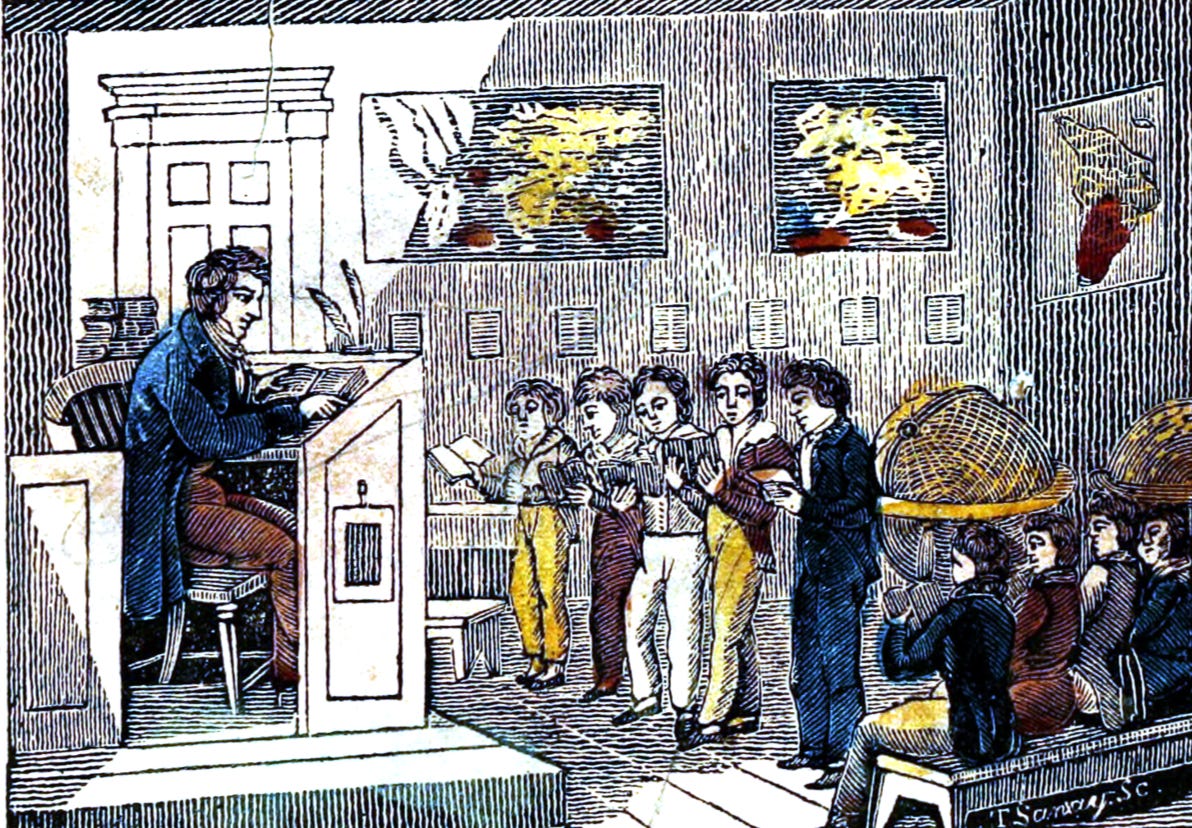
Twelve years in school, I thought I did everything a good student should do: listened to my teachers for 6-8 hours a day, did my homework, passed the exams, and graduated to continue my higher education at one of the best universities in the country.
But once I got there, I had to unlearn that belief. A project in my second-year Social Marketing course was my first real-world problem-solving project: finding a feasible problem on campus grounds to solve, mapping the stakeholders, and designing a social campaign to address it. I remember loving it, mostly because it was the first time I had a real avenue to apply what I learned conceptually to a real-world problem.
Then it dawned on me that many other students must have shared my experience — it took more than a decade to connect what they learned at school to real-life scenarios. And I thought: what a waste of time.
For 12 years, students — including myself — tend to think they must memorize every formula possible, from math and physics to chemistry. A lot of memorizing, perhaps so little understanding.
But when I got the chance to guest-teach at Sekolah Murid Merdeka (SMM) Bandung, I saw a glimpse of what could have been: students learning problem-solving skills early on. The skills are integrated into their curriculum through the Independent Learning Project, where students (grades 10–12) are tasked with solving real-world problems. They are free to choose their own topic of interest and the medium of their proposed solution.
During my visit, I helped them understand the problem first. Students learned how to differentiate between symptoms and root causes, common traps and fallacies when identifying root causes, and how to use data to prove or challenge their assumptions.
I enjoyed learning about each student’s projects. Instead of telling them what they should be thinking about, I asked them why (multiple times!) the problem they brought up exists in the first place. As they got their “aha” moment, I saw their eyes spark with joy. Ah… the beauty of learning.
Unfortunately, not all schools have the same commitment and flexibility to exercise this approach. More often than not, schools rely on teachers’ content knowledge to create an effective learning environment. Additionally, teachers find it difficult to use this dialectic approach.
But this is the reality. Instant answers are more appealing. Books promising shortcuts to mastering something, for example, “reading without spelling” or “lightning-speed calculation methods”, are ubiquitous in the best-selling sections of Indonesian bookstores.
Then came Artificial Intelligence (AI), indulging our obsession with instant problem-solving. On social media, people ask Meta AI to unpack a nuance, clarify something vague, or do the research for them. It is tempting to ask when AI can answer our questions for us in a matter of seconds. Have we become so lazy that we handed our thinking to machines?
But I wonder whether the habit is older than the technology. We learned to chase tips, hacks, and formulas at school. The tools have changed, but perhaps we have not.
Of course, there is nothing inherently wrong with formulas and shortcuts. But it becomes a problem when we rarely learn the long process that leads to an answer. We memorize the formula without understanding how it was derived. When we face a new problem, we search for a familiar pattern from past problems and apply the fix we remember.
At school, we are not trained to question authority (teachers), question knowledge, or hold different opinions. When given a problem set, we cannot sit with uncertainty or work through ill-structured problems to find what is really causing them. We either wait for the tutor’s instructions or rush to the formula book.
Finding the root cause of a problem does not seem to be included in our school syllabus. This can be dangerous because the real world doesn’t come with a manual offering answer keys to solve predestined obstacles.
As adults, when we start thinking about solutions, we tend to treat symptoms rather than address root causes. In public policy, this leads to solutions that are ineffective or, worse, create another problem.
Here’s a thought exercise:
Is an even-odd street policy the right policy to minimize traffic in Jakarta? Is giving a smart TV to every school in remote and rural areas the right policy to increase students’ learning outcomes? Is a free meal program the most effective policy to address stunting?
This is the kind of exercise we need to ask (and train) so we’re not rushing to come up with some answers that will cost us even more later.
Our education system should incorporate this kind of training. The good news is, children are actually well equipped for it. They are blessed with what experts call neuroplasticity, the brain’s ability to change its structure and function in response to experience. This helps a sixth grader remember a math formula. The same mechanism can help young people become problem solvers, given they practice consistently. Synapses strengthen with use and weaken without it. The catch is that plasticity slows and becomes more demanding with age, so habits formed in childhood are harder to change later.
This science-backed information should point educators and policymakers toward shaping an education system that nurtures school-age children into apt problem solvers. One option is to apply problem-based learning.
What is problem-based learning?
Problem-based learning (PBL) is an educational approach that uses a real problem, or a realistic simulation of one, that the learners must solve. It did not begin in kindergarten or grade 1-12 classrooms. It was introduced at McMaster University’s medical faculty in Canada, where it was developed to replace the exhausting and ineffective clinical teaching.
PBL is an approach, not a single technique. The problems serve as the platform through which students acquire the knowledge they need. This is the opposite of the traditional classroom, in which students listen to lectures for hours, take tests, and leave without knowing how to apply what they learned beyond the exam hall.
But PBL is not the same as project-based learning (PjBL). PBL problems are usually open-ended and can be solved in several defensible ways; students then decide what counts as a good answer. Meanwhile, PjBL projects tend to have clearer deliverables and milestones.
In PBL, the teacher is a facilitator, asking guiding questions without giving answers. In contrast, in PjBL, the teacher works more like a coach, managing schedules, resources, and the quality of the final product.
PBL is assessed on the quality of reasoning, the use of evidence, and the content knowledge students demonstrate. This method has four defining features:
First, independent study matters more. This is because the proponents believe knowledge grows and the boundaries between fields keep shifting. No lesson can cover everything a student will need, so the goal is to help learners learn quickly and well on their own. The teacher becomes less a lecturer and more a sherpa who knows the terrain and keeps students on a sound route.
Second, students work in small groups. They divide the work, argue over interpretations, and pool what each member has found, because no one begins with the full picture.
Third, a stimulus starts the inquiry. A video, a case study, a dataset, or a role-play can present a problem rich enough to spark debate.
Fourth, reflection closes the cycle. Students consider what they concluded, what they still need to know, and how they learned. Over time, they begin to see their own learning as something they can monitor and improve.
In PBL, real-life problems are used in a way that goes beyond the surface – or what the internet calls it these days: “performative”. For example, it does not ask students to make posters about protecting the forest. It makes them think about the whole forest ecosystem: who “owns” the land, and who is responsible for the forest fire in 5 regions in Kalimantan, Sumatera, and Papua. The aim is to spark students’ curiosity about the problem before anyone jumps to solutions.
But PBL does not reject direct instruction entirely. Some big concepts still need clear instruction, although educators continue to debate how effective direct instruction is. PBL can be woven into any subject, and sometimes into several at once.
The general objectives of PBL seem to be aligned with the new focus on higher-level thinking skills and socioemotional competencies.
Indonesia’s past attempt to incorporate PBL into the national curriculum
Many countries are shifting toward 21st-century learning, preparing students for a rapidly changing, interconnected world by emphasizing cross-curricular skills like digital literacy, communication, collaboration, and problem-solving.
Indonesia, like South Korea, has undergone several changes to the national curriculum since 1947, when it was first initiated, a couple of years before South Korea established a national curriculum in 1950. Like South Korea, our national curriculum also changed with each regime change. Something to do with ‘legacy’, perhaps.
From the 1947 ‘Rentjana Pelajaran’ (Lesson Plan) curriculum — a transition from colonial schooling — and the heavily centralized 1968 curriculum under the New Order to the competency-focused 2004 curriculum, Indonesian education policies have slowly progressed into student-centered learning. This means teachers are no longer expected to be content experts, but rather facilitators who cater to students’ different needs.
In the 2013 curriculum, the government changed the national education system, moving away from the banking model and working towards making students become independent learners. The curriculum wants students to ask as many questions as they solve problems, be analytical, and collaborate. Take a look at the graph below:
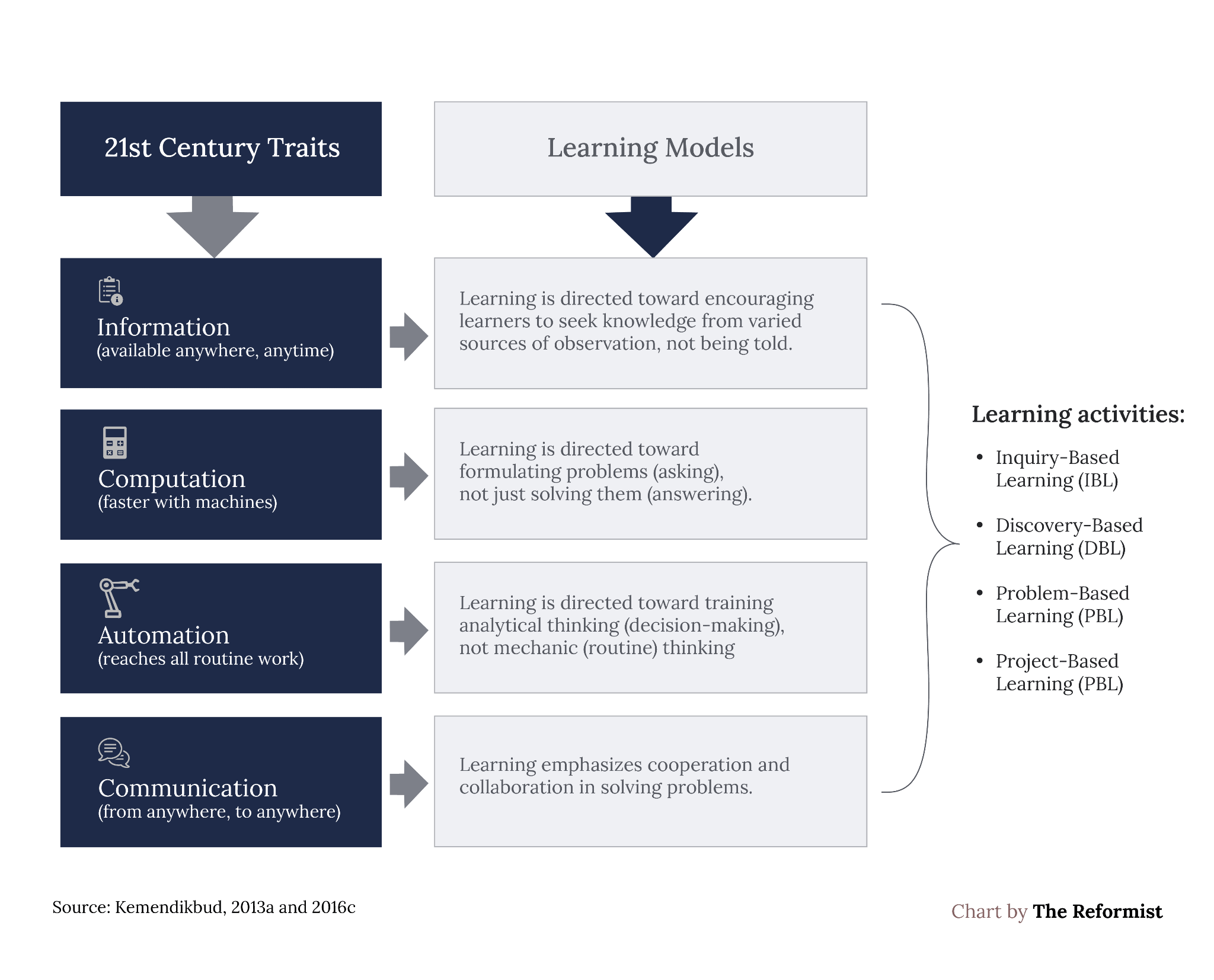
The methods named in this policy included problem-based learning (PBL), inquiry-based learning (IBL), discovery learning (DBL), and project-based learning (PjBL). Education and Culture Ministerial Regulation No. 22/2016 set out these expectations.
Implementation, however, has lagged behind the design. The 2013 curriculum covers too much material, sacrificing students’ depth of understanding, as evaluated by the Education, Culture, Research, and Technology Ministry. It also placed excessive focus on meeting national process standards and compliance, diverting attention from preparing and delivering engaging lessons.
That was the result of an evaluation conducted in 15 junior high schools in 5 cities (Yogyakarta, South Tangerang, Sorong, Balikpapan, and Denpasar). The study used a mixed-methods approach, combining a literature review, class observations, interviews with heads of education offices, superintendents, and principals, and focus group discussions with 8th-grade math and science teachers.
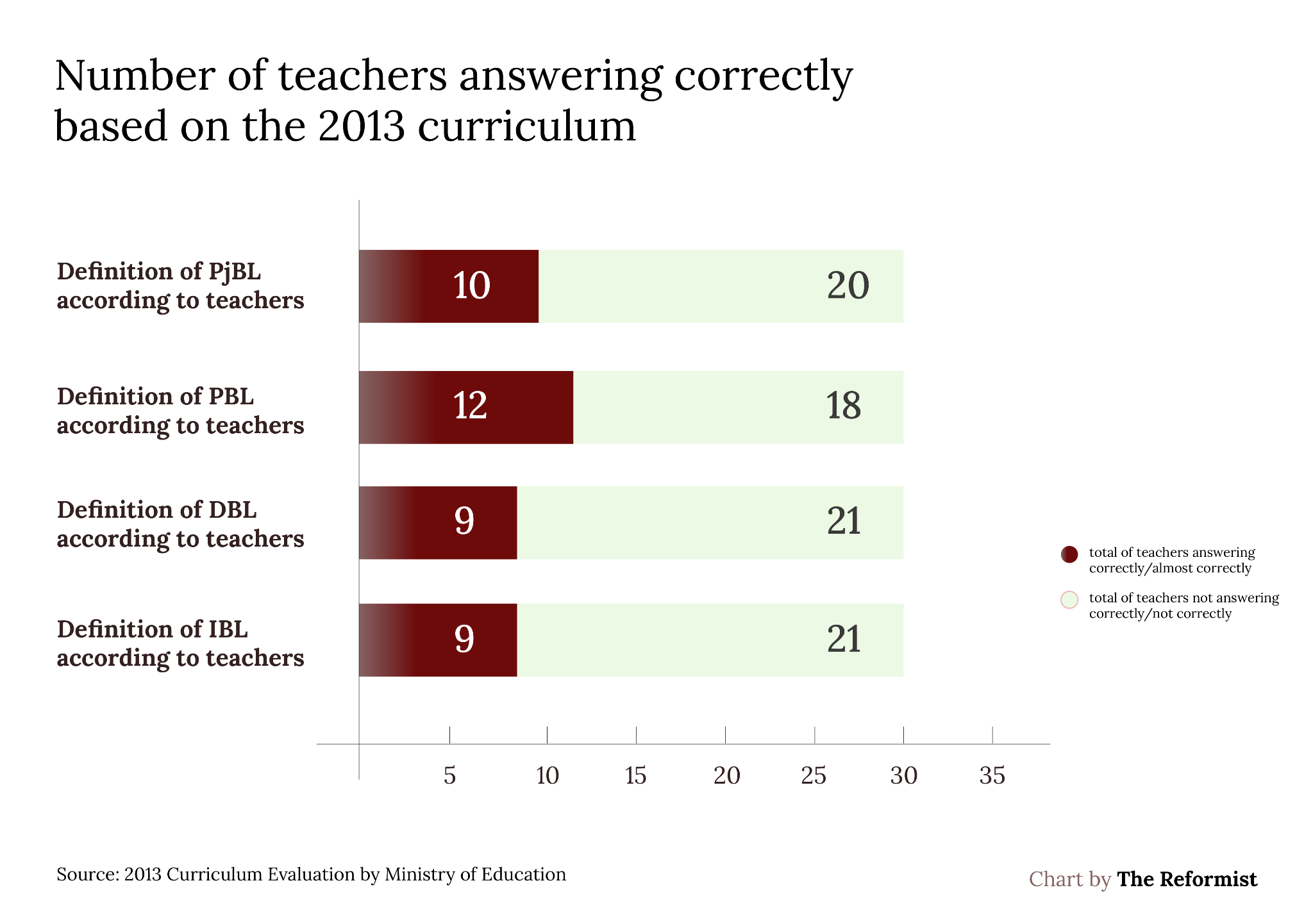
When evaluators examined the policy, they found that understanding of PBL varied widely among education office heads, school supervisors, principals, and teachers. Many leaders based their understanding on their own school days or a few books. They supported the policy but were often not informed about its details. The gap was most striking among teachers.
The same study found that most evaluated teachers could not explain what PBL is, let alone apply it in class. That gap between the ministry’s design and classroom practice deserves serious attention.
In the 2022 curriculum, Kurikulum Merdeka (Emancipated Curriculum), project-based learning was made central through the “Pancasila Student Profile” (known locally as “P5”) and Capaian Pembelajaran (Learning Outcomes). The emphasis falls on character and competencies rather than subject mastery alone. The curriculum also gives teachers and schools flexibility to ‘teach at the right level’ and provides teaching and learning guidance, as well as curriculum supplies such as teaching modules, textbooks, and microteaching resources.
In 2025, the new Primary and Secondary Education Minister Abdul Mu’ti incorporated a “deep learning” approach into the revised Emancipated Curriculum. The deep learning approach highlights a fun and motivating learning environment aimed at creating active learners who are able to self-regulate and to contextualize what they learn. The goal is to move from memorization to deep understanding of a concept.
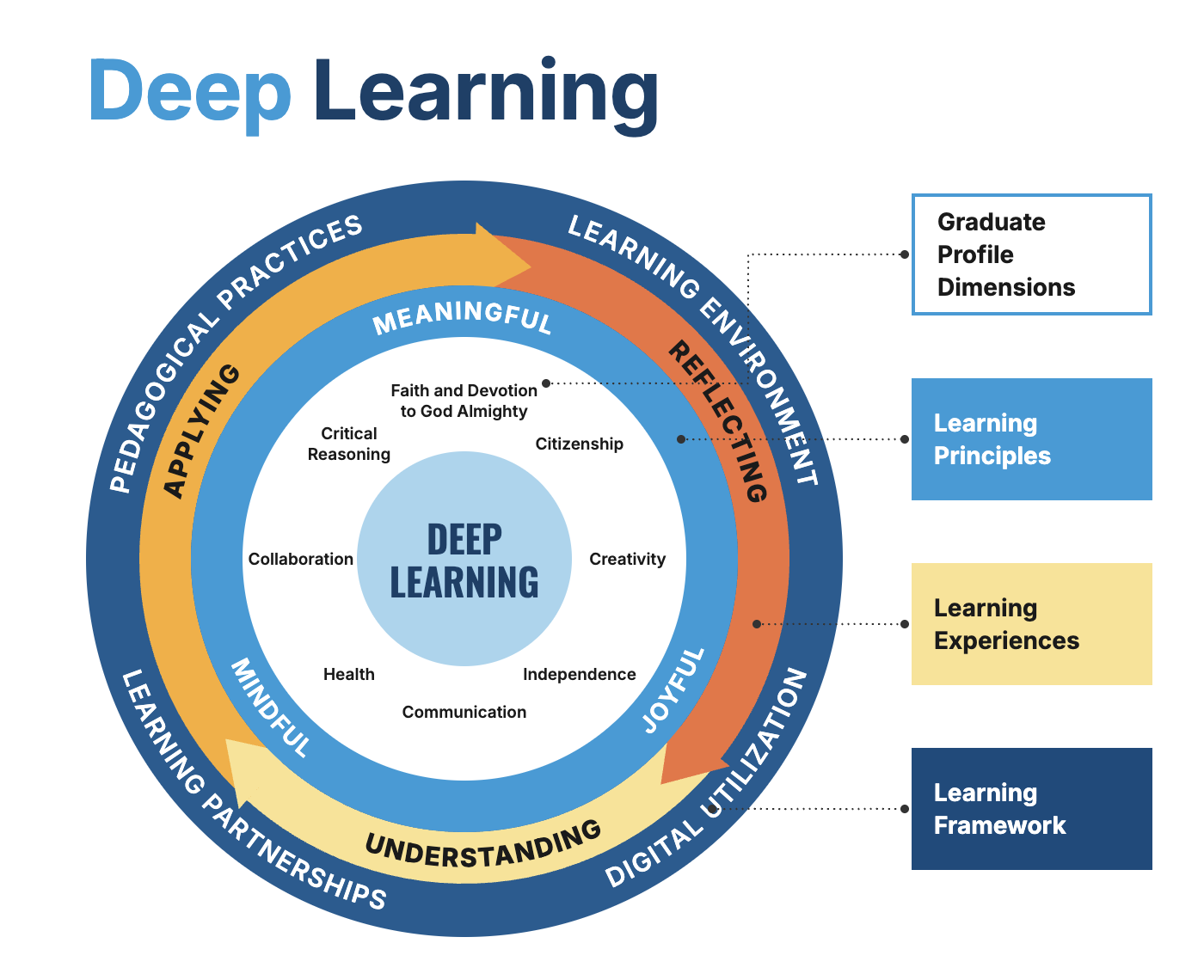
Although the minister’s presentation mentions several learning methods, in reality it comes down to teachers’ flexibility and ability to translate this grand idea into a feasible learning plan.
Throughout several changes of the national curricula to improve school performance since 1947, one question remains. Has any significant change happened in the classrooms? Are the policy changes well communicated to districts and schools? Are the schools ready to bring change every few years? Are teachers well equipped to translate these philosophical changes into working lesson plans and instruction?
Are Indonesian schools ready to incorporate PBL?
This is a big question, and it’s hard to answer.
First, ready in what sense? Are we talking about school leadership, teachers’ skills, facilities, the assessment system, or parents’ expectations?
Teachers are overworked and, in many cases, underpaid. PBL demands commitment from the teachers. Tailoring problems set for each lesson is a luxury many teachers cannot afford. The model also demands that teachers give up the role of sole source of knowledge that schools have held for a century. In an age of abundant information and AI, teachers need to become facilitators of learning who can explain what knowledge is and why the scientific method remains our most reliable tool. That requires us to unlearn our assumptions about what school is for.
This is where school leadership plays an important role. School leaders are guardrails for teachers and advocates for parents. Principals should provide proper academic supervision to teachers and offer professional development when necessary. At the same time, they should be able to convince parents that this is not a burden. Even more so, parents can be co-educators at home by supporting their children’s inquiry process.
Second, how does PBL fit with the national exam and school-based assessment?
In the United States, standardized achievement tests are seen to be the opposite of PBL when it comes to measuring higher-order skills. I suspect we may have a similar case with our own National Exam, first introduced in 1950.
Assessment takes time, and feedback is essential to learning. But PBL assessment is not standardized and is demanding. Still, it can measure what matters: the logic of root-cause finding, the evidence students use, and how they reach their conclusions. Teachers can stress-test a student’s proposed solution by asking what alternatives they considered, why they chose this one, and how they would implement it. What is important in PBL is students’ self-assessment, reflection, and feedback.
Third, what would a school need in order to be ready within a year or a few? What kind of policy is needed? PBL implementation requires coordinated institutional support to be sustainable. It shouldn’t rely only on teachers. Policymakers shouldn’t demand more of teachers without addressing the elephant in the room. Reducing administrative loads can do wonders. Teachers will have the headspace and time to really think through learning design that incorporates PBL. Support from district and school leaders will make it even more feasible.
It takes a village to raise a child – as it does to reform a nation’s education system
In reality, problem-solving is a lifelong skill that should be practiced everywhere. This means teachers cannot be the only ones to teach children this skill. Principals should take accountability in ensuring this value is incorporated into the curriculum plan. Then, teachers can translate it into their lesson plans and become active facilitators in the classroom.
Meanwhile, parents at home can ask what problem their child is working on that week, instead of focusing on their child’s test score. This conversation may help children to articulate their process in finding root causes. Hopefully, this will enable them to redefine what success looks like.
We need to really evaluate what we want to get out of this education grand plan.
For now, it seems we keep educating children to be compliant and follow instructions, not to be deep thinkers or innovators who can solve 21st-century intergenerational problems. If this continues, future generations will only become consumers of things and information. We will never truly be competitive in the global marketplace. Or worse, we will be easily manipulated with false solutions that solve nothing, no matter how good they look.


A new curriculum name won't produce critical thinking if students never get to try an idea and then review what happened. Kolb's cycle needs that loop of doing and reflecting, not another binder of outcomes. Project work can sit alongside clear instruction, as you already note. Drop by https://drkasperowitsch.substack.com if you'd like to follow notes on experiential learning.