


Online frenzy ensued soon after X (formerly Twitter) users discovered Israeli-owned restaurants, businesses, and community groups in Bali. This discovery prompted scrutiny and anger over how Israelis could open up an entire business, or even secure visas to enter the country, when the State of Israel isn’t even diplomatically recognized by Indonesia.
Social media users have also revealed that Israeli visa agency groups have been offering services to enter Indonesia for Israeli passport holders, suggesting a systemic practice.
Without an Indonesian counterpart to approve their documents, this practice would have been dead on arrival, and yet it is not.
Meanwhile, the Corruption Eradication Commission (KPK) made national headlines after it arrested then-Deputy Corrections and Immigration Minister Silmy Karim. The high-profile arrest was unknowingly timely — as if confirming that our immigration sector had been troublesome — since Silmy was arrested on charges of a graft scheme involving the extortion of illicit fees for visas and stay permits for foreign nationals in Indonesia.
Alongside the deputy minister, seven other ministry officials were arrested by the KPK, allegedly racking up Rp 145.6 billion over four years, from 2022 to 2026. In Bali, KPK investigators raided the island’s immigration office in connection with Silmy’s case, suggesting that his practices may have occurred there primarily.
While Silmy’s arrest and the online discourse are two separate instances, they are connected through the web of the problematic Indonesian immigration sector. The former is a formal authority whom the KPK claimed had misused its power for personal gain, while the latter is the presumed effect of the former’s corrupt practices.
But Indonesia’s immigration problem is far more complex than bribery and loopholes at the arrival gates. In this edition of The Reformist, we will uncover the patterns of graft in Indonesia’s immigration sector, its effects on foreign nationals entering the country, and question why this seemingly textbook public service has become a magnet for systemic corruption where the law becomes negotiable through layers of discretionary policies, payments for access, and a business model that rests on weak enforcement.
A playground for corruption
Despite Silmy’s high-profile arrest, his case is only the tip of Indonesia’s immigration corruption iceberg.
In the course of investigating Silmy’s syndicate, KPK cross-referenced the case with a financial intelligence report from the Financial Transaction Reports and Analysis Center (PPATK) that had been quietly accumulating evidence.
It found that 35 Immigration and Corrections Ministry employees had, between 2019 and 2025, controlled 96 bank accounts with a combined balance of Rp 366.7 billion. Only 3 percent of that sum came from their official salaries. The other 97 percent had to come from somewhere — and investigators believe it came from the same extortion scheme applied across years of permit applications.
KPK chair Setyo Budiyanto was explicit at Silmy’s press conference: the scheme operated with a clear division of labor, with some commanding, executing, collecting, and distributing. Commands flowed top-down. Money flowed bottom-up. Every Friday, Rp 100 million went to line Silmy’s pockets, routed through his subordinates, under the code name “malaikat” (angel).
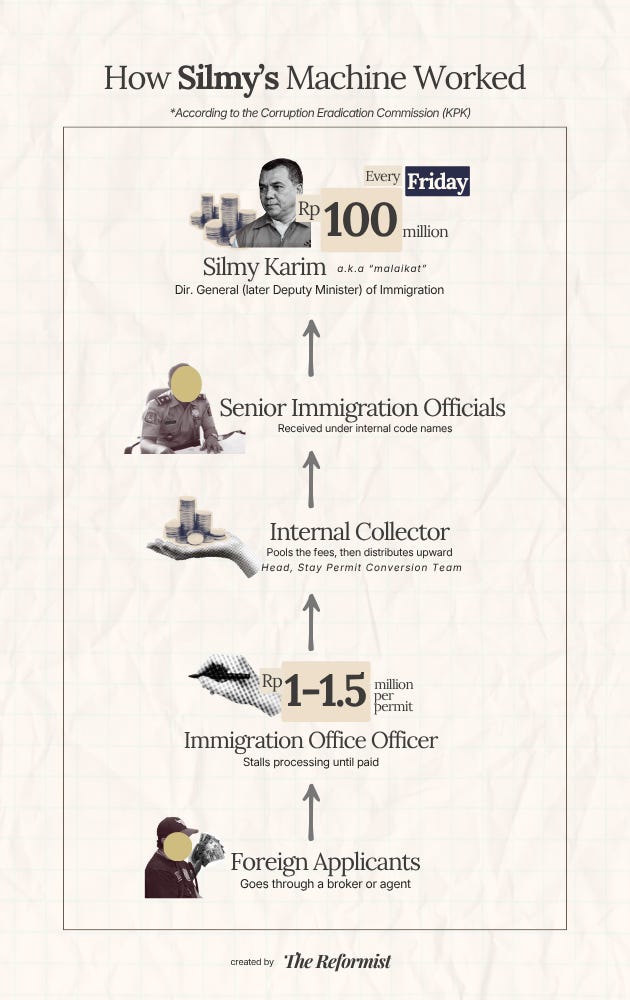
Silmy’s case, however, is not a story of bad apples. Two months before Silmy’s arrest, Suhartono, the Manpower Ministry’s former director general for foreign workers’ placement, was convicted and sentenced to four years in prison.
Suhartono’s crime was structurally identical. He extorted illicit fees from agencies processing the mandatory work plan document that a foreign national must submit before a stay permit application can even begin. His syndicate ran from 2017 to 2025, accumulated Rp 135 billion across eight officials, and at its most brazen, also accepted a Toyota Innova Reborn and a Vespa Primavera as tribute.
Last year, the graft commission uncovered another expatriate extortion scheme within the Manpower Ministry, in which eight ministry officials were arrested for collecting bribes totaling up to Rp 53.7 billion between 2019 and 2024. This particular case unveiled the rotten core of the whole organizational chart behind this graft, as the collected fees were found to have been “redistributed” progressively, with lower-ranking officials and office boys taking a cut of the stolen money.
The ironic gray area between legality and graft
Despite systemic corruption at every layer of the permit process, the number of foreign nationals in Indonesia has conversely grown year on year. An estimate of 184,000 foreign workers was on the Manpower Ministry’s books in 2024, up from 168,000 the previous year. Numbers not only increased but skyrocketed, since pre-pandemic levels had fewer than 100,000 foreign workers residing in the country.
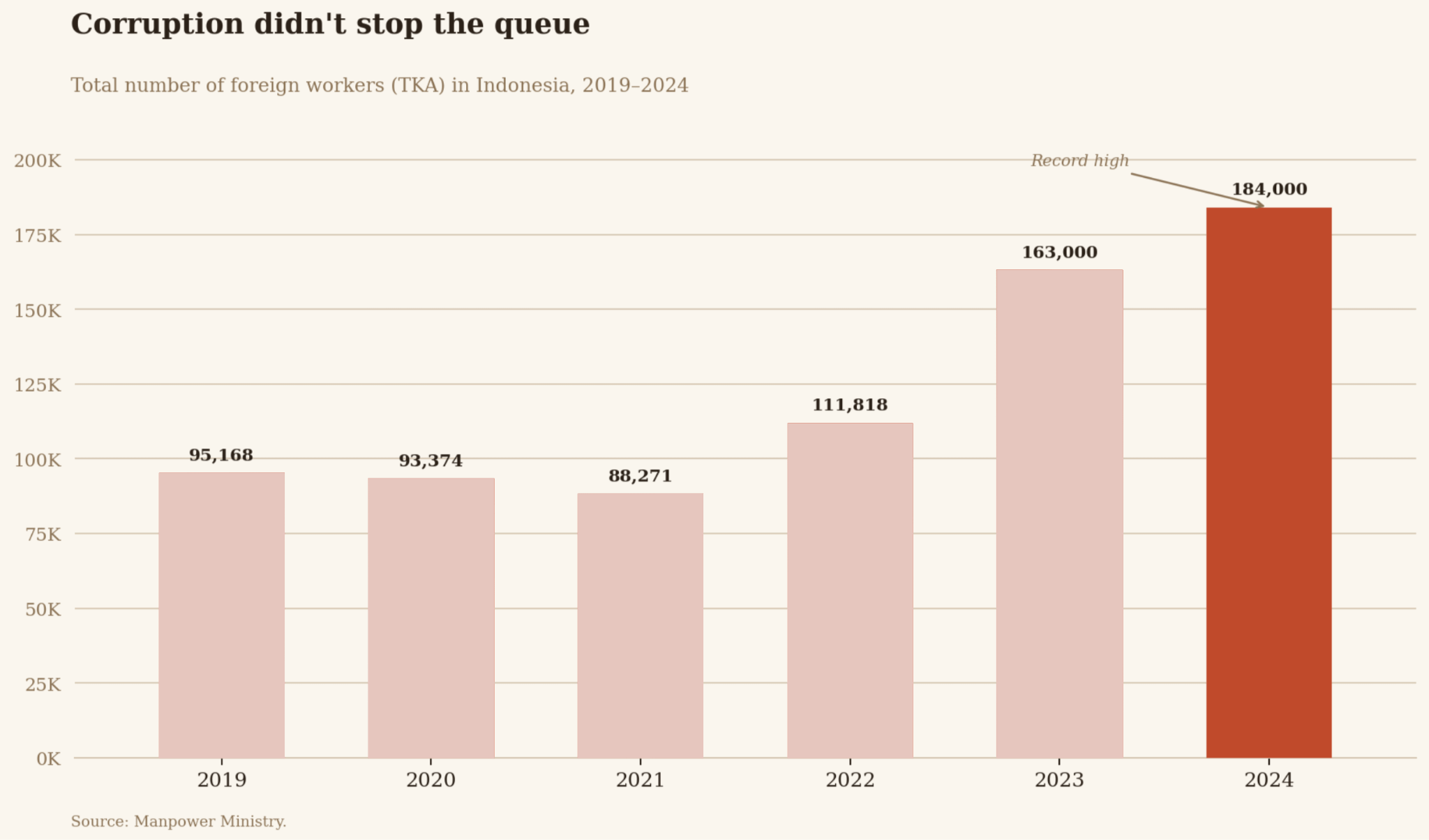
This highlights that foreign nationals and the companies employing them have largely absorbed the unofficial surcharges as a cost of doing business. As one Jakarta Post editorial article noted last year, many hiring companies and foreign workers “probably never knew they were paying bribes, or if they did, just dismissed it as a normal part of doing business in Indonesia.”
Regardless of how foreigners absorb these costs, the structural damage accrues to Indonesia. According to the 2020 World Bank’s Ease of Doing Business (EODB) index, Indonesia ranked 73rd globally, below countries such as Malaysia, Vietnam, and Thailand. Investors see this friction and inefficiency as a signal of where to allocate their capital. The more foreign investors see the rentier economy of immigration, the less likely they are to continue investing in Indonesia.
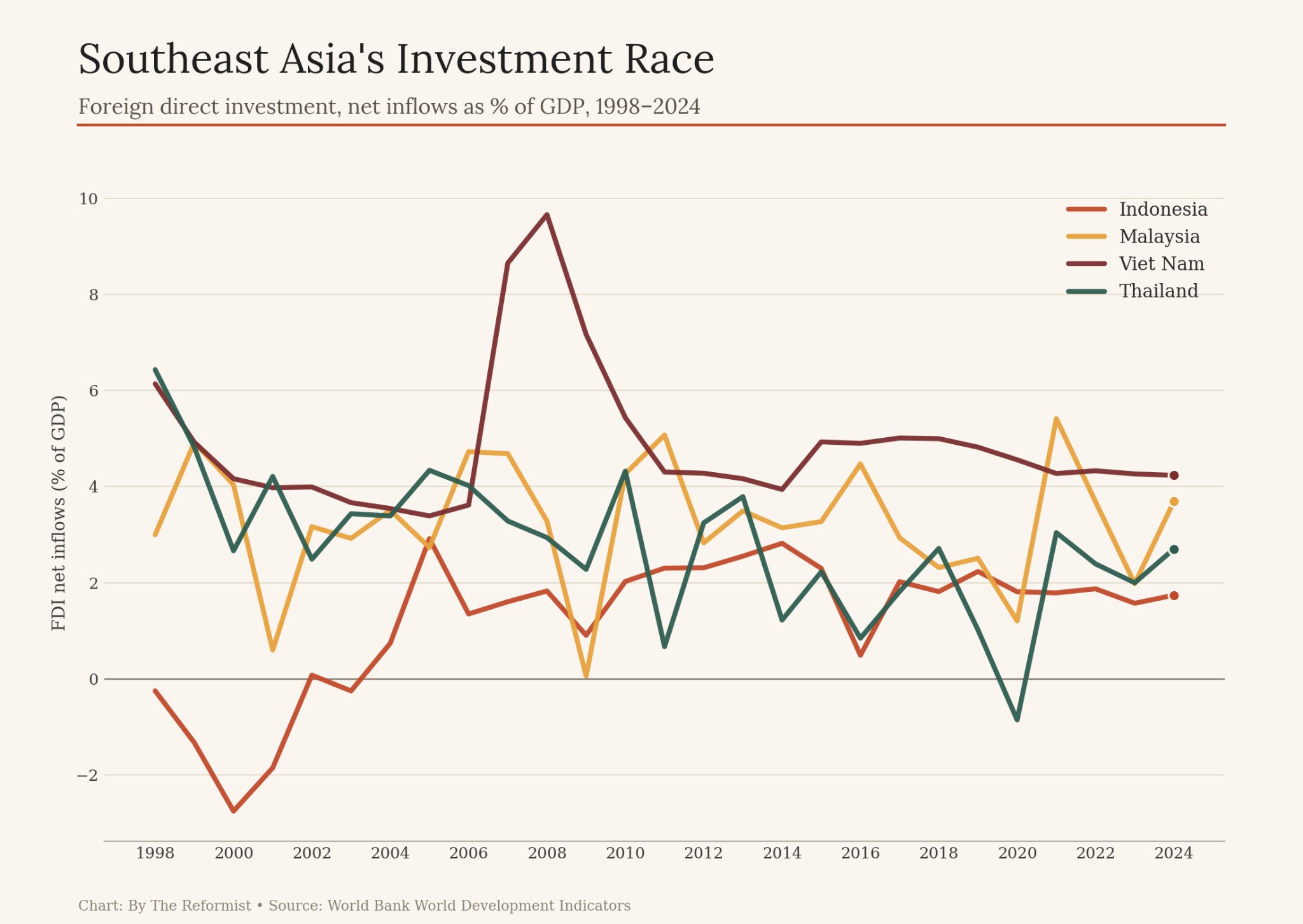
And while we acknowledge that the EODB is no longer considered the gold standard for measuring the investment climate today, it’s still a useful reference for showcasing how corruption in the immigration sector creates an unpredictable business environment. To support this claim, the chart above highlights how far Indonesia’s foreign direct investment (FDI) has lagged over the past 20 years, despite a strong recovery after the 1998 economic crisis.
From 2019 to 2024, Indonesia consistently hovered below 2 percent, while Thailand sharply bolstered its FDI after the 2020 pandemic, implementing sweeping reforms to boost FDI that were acclaimed by the Organization for Economic Co-operation and Development (OECD).
At the same time, Indonesia drew more criticism than praise from the international body. It highlighted how Indonesian “policymakers have yet to demonstrate their intention to establish a clear role for FDI in Indonesia’s development ambitions,” as well as “failing to live up to its potential as a host to FDI, despite its numerous attributes.”
When rules are applied arbitrarily and legal thresholds fluctuate depending on how much money changes hands, we’re basically telling foreigners who genuinely want to invest in Indonesia not to come here.
The workaround tourist economy
Going to Bali these days will have you marvel at the number of tourists enjoying the Island of the Gods. In 2025, close to 7 million tourists visited Bali, an increase of 9,7 percent from the previous year, with close to a quarter of them being Australian tourists.
But what about foreign businesses that have set up shop all over Bali without any explanation of their legal status?
Bali’s tourism agency estimates that over 4,000 accommodation units are listed illegally, out of the official total of 16,000. Last year, Bali Governor I Wayan Koster claimed that around 400 travel and vehicle rental agencies were illegally run by foreigners. “Many don’t even have offices, don’t reside in Bali, yet are still able to operate. This is clearly outrageous,” said Koster.
The formal foreign workforce may not care about Indonesia’s corrupt immigration process. But foreigners running informal businesses don’t just ignore it; they actively benefit from it.
Officially, foreigners are not allowed to own small-scale businesses. While this definition is loose, the threshold is clarified through Presidential Regulation No. 10/2021. In it, foreign nationals are only allowed to open businesses with a minimum capital contribution of Rp 10 billion or US$ 558 thousand at current exchange rates.
The Indonesian government has since updated this classification through Investment Coordinating Board Regulation (BKPM) No.5/2025, which reduces the required paid-up capital to Rp 2.5 billion or US$ 140 thousand, with the caveat that the minimum investment plan stays at Rp 10 billion.
It is unlikely that these foreigners, be they Israeli, Russian, or Australian, are spending over 140 thousand dollars, with a promise to increase it to 558 thousand dollars, to open a small restaurant in Bali.
To get around the formal requirements, foreign nationals have settled on two well-worn alternatives: marry an Indonesian (plus a few extra steps), or find one to front the business (a ‘nominee’).
The former is straightforward enough; a legal marriage to an Indonesian citizen secures a pathway to residency under immigration law.
But the latter has become a defining feature of Bali’s shadow economy, operating through what is commonly called a nominee structure, in which a foreign national partners with an Indonesian citizen who poses as the formal owner of the business or property while the foreigner retains beneficial ownership and economic benefit.
This grey area has not gone unnoticed. The current Balinese administration has publicly vowed to crack down on such practices. Last year, Bali Governor I Wayan Koster created a task force comprising the National Police, the Military, and local tourism associations to “discipline” the practice. The governor’s concern centers on the rentier dynamic these businesses create. Foreign operators, insulated from the full cost of doing business legally, drive up land prices and living costs for ordinary Balinese while contributing little to the formal tax base.
While Koster has been vocal, there has been little follow-up on how effective the task force has been in cracking down on this issue.
More recently, Koster pushed the national legislature to promulgate the Bill on International Private Law (HPI). The bill, if passed, would consolidate Indonesia’s currently fragmented legal framework on cross-border disputes, covering nominee property arrangements, mixed marriages, and inheritance conflicts, into a single statute, giving local authorities and law enforcement clearer ground to act on cases that today fall under legal uncertainty.
This one example alone tells us enough that corruption in the immigration sector is not a ‘bug’ in the system. Corrupt officials and their brokers design bottlenecks in immigration permit processing, which they then monetize. They did not just ‘stumble’ upon the opportunity by chance.
Multifaceted problems require multi-layered solutions
As is the case with many of Indonesia’s governance problems, the immigration issue won’t be solved simply by clean housing for the Immigration and Corrections Ministry or the Directorate General of Immigration at the Manpower Ministry alone. Solutions will only come when stakeholders from all levels of government take up responsibility and are convened to tackle the issue together.
Last year’s Manpower Ministry bribe case makes the point sharply. When graft commission purged the agency, they found that the illicit practice had been running since 2012, spanning three ministerial regimes. It’s hard to imagine how a scheme this structured, extracting bribes from foreign work-permit applicants for over a decade, could survive three changes in leadership without ever triggering an internal red flag.
What Silmy’s arrest, Suhartono’s conviction, and last year’s Manpower Ministry bribe scandal have in common cannot be simplified to routine graft. It is the entire architecture behind the country’s immigration governance that needs reform.
Indonesia’s system is built on a structure in which discretionary power over permit issuance is concentrated in individual officials and dependent on a chain of intermediaries, civil servants, and visa agents alike, who profit from opacity.
For illegal businesses, the remedy for all of this already exists in law, making the scale of the problem harder to excuse as an accident. Under Article 33 of the 2007 Investment Law, any agreement that puts share ownership in one person’s name for the actual benefit of another is void from the outset, making it legally nonexistent.
Article 146 of the Limited Liability Company Law lets a district court dissolve a company outright on a prosecutor’s or interested party’s petition if the company violates prevailing regulation or its founding deed is legally defective — which a nominee arrangement built to dodge foreign-ownership limits plainly is.
The tools to dismantle a nominee-run business exist from the district court up to BKPM in the capital. That thousands of these arrangements have been allowed to operate openly for years is a story about enforcement nobody chose to use, be it in Bali with their task force or higher up in the country’s law enforcement and executive branch.
An honest look into a dishonest sector
To provide an answer to Indonesia’s immigration problems is not what this article seeks to do. But what is clear from this discussion is that the issue is two-pronged: (1) formal authorities have misused their powers; (2) opportunity-seeking foreigners take advantage of the system’s lack of enforcement.
At the macro level, if immigration graft scandals continue to make national headlines, foreign investors may soon take their capital elsewhere as perceptions of Indonesia’s rule of law deteriorate.
At the micro level, tourists who have set up shop in the country’s tourist hotspot will continue to manipulate the country’s legal system so long as the system allows high-level public officials to abuse their discretionary powers.
Until these problems are confronted honestly, it shouldn’t come as a shock that Israelis have found a way to “infiltrate” Indonesian borders. Keep this up, and the system will keep producing exactly what it was designed to produce: a playground, as it has always been, for those who know how to play it.
What are your thoughts on this issue? Do you see these criminal syndicates and illegal businesses as a systemic problem or a simple case in need of a band-aid? Let us know in the comments what reforms should be made to Indonesia’s immigration sector!
Really good deep dive take. Before any solutions should be provided, I think a meta solution in some form would be nice: formalize the current corruption process. Legally allow officials to submit anon reports internally of how much is taken from who and for what steps in the process. This allows groups like yours to get more granular data, keep public officials out of direct scrutiny (or they will never submit info if they have their name attached), while recognizing that opportunity seeking foreigners are still providing resources for locals even amidst the legal minefield.
Perhaps, this could be a public frontend for people to report on what "corruption" they pay and for what (while uploading documents that redact names automatically, maybe as as well as any other PII info). Avoids needing the (corrupt) gov buy in in the first place to take detailed notes. And could construct a public cryptographically signed database of potential corruption anyone can analyze.