

It is the morning of the World Cup final, and while the entire globe is tuned in for the ultimate showdown, the tournament’s defining narrative was written during the Argentina-Cape Verde match. When Sidney Lopes Cabral curled the equalizing goal against the reigning champions in extra time, people were on the edge of their seats. Even though Lionel Messi and co eventually edged out the victory in the dying minutes, the game proved that any team — regardless of size or footballing stature — can compete against the very best in the world.
Watching this unfold on the global stage, we at The Reformist couldn’t help but look at our own national team. It’s a stark reality check on the morning of football’s biggest game: Indonesia failed to even qualify for the tournament, despite the massive amount of state resources poured into the national team. Since 2020, over 21 European-born players have been naturalized as Indonesian citizens to represent the national team, most of them hailing from the Netherlands and of Indonesian ancestry.
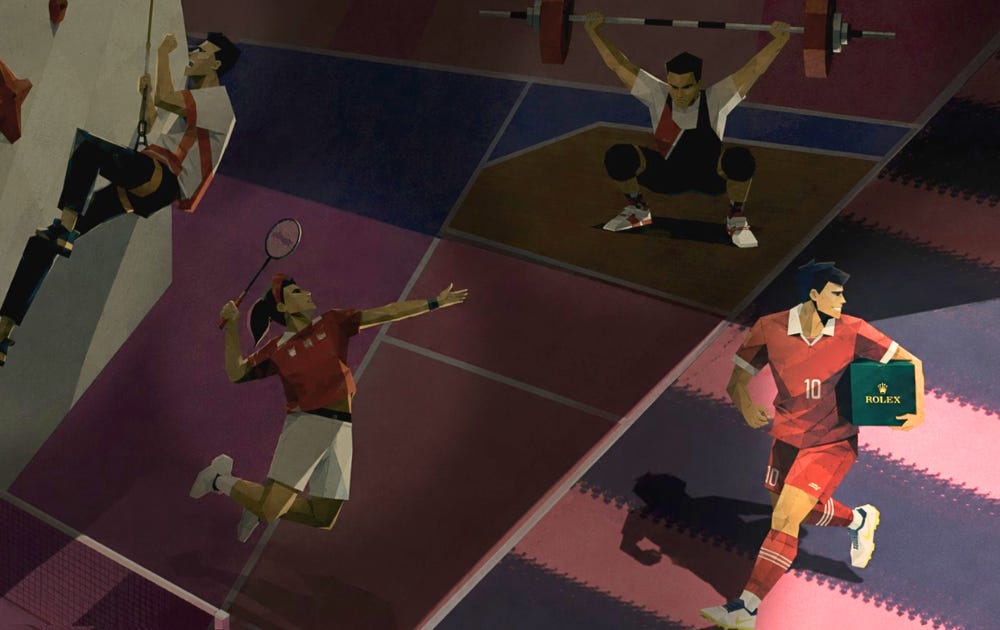
In 2025, the Indonesian government disbursed close to half a trillion rupiah to the Indonesian football team. Each time an international fixture rolls around, the squad stays in five-star hotels like the Fairmont in Senayan; Rolex watches on their wrists, gifted by President Prabowo Subianto, while their faces are plastered across every billboard in the country. All for a team that would fail to qualify for the World Cup by October.
Here is where the story should have turned toward introspection. Instead, the Indonesian Football Federation’s (PSSI) answer to this failure was the same as its answer to everything else: more naturalization.
The Youth and Sports Ministry has continuously called for increased grassroots development. But amid all the press statements, the search for more foreign-born talent never slowed down. This year, two youth players from Australia and the United States were naturalized, with PSSI’s scouts still working the diaspora for more.
Why is it so hard for the Indonesian government to look inwards and develop the human capital it has at home? The answer, again and again, is that long-term policies do not benefit politicians or leaders with short-sighted political goals. Development is all too long and tedious when “solutions” like naturalization can boost political capital in the short term.
In this edition of The Reformist, we go over the political-economic structure behind Indonesia’s sports governance, the government’s lack of support for sports other than football, and the low-hanging reform that nobody in power seems interested in picking up: prioritizing grassroots development over glamor.
Our sports management is short-sighted by design
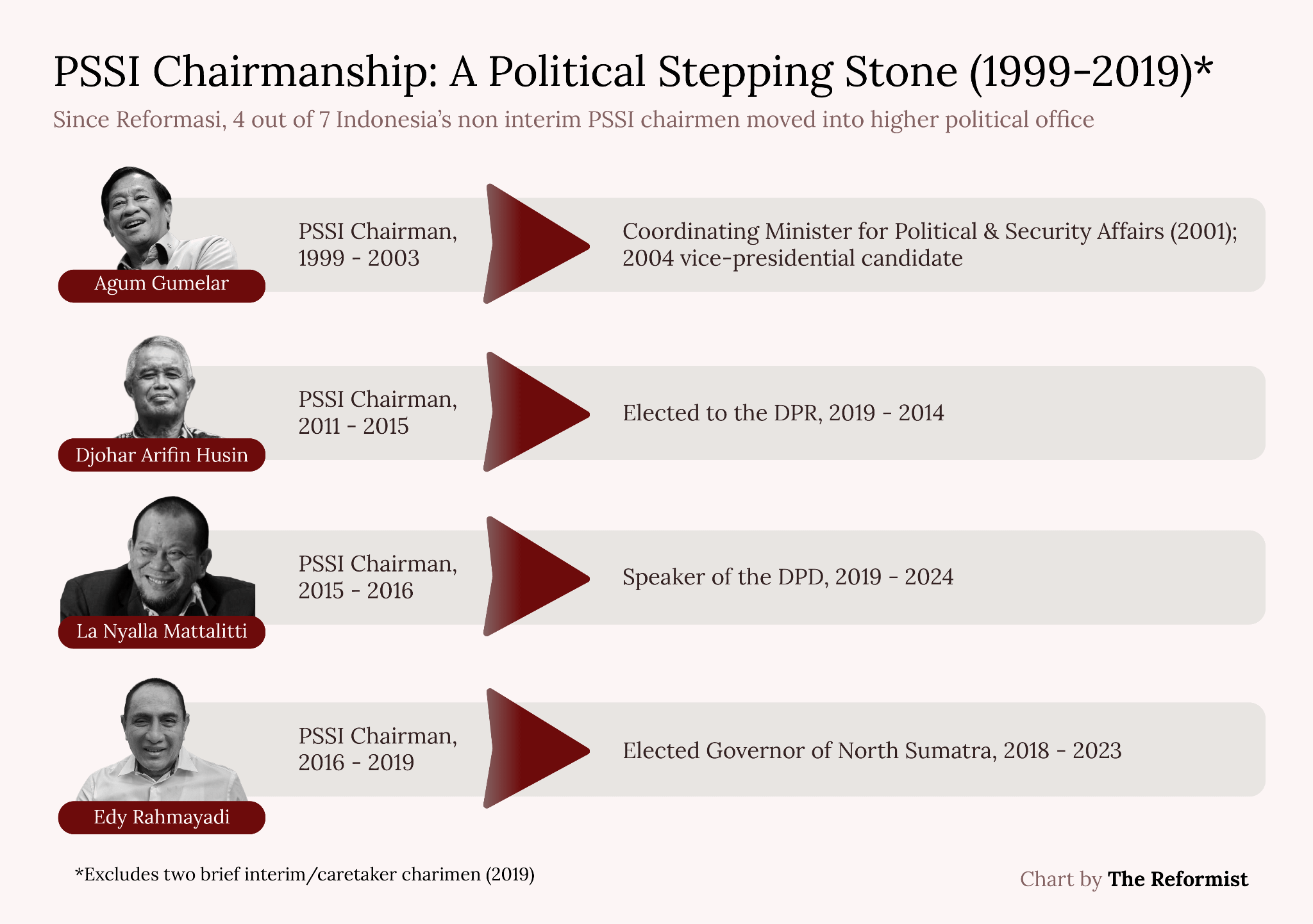
Running football in Indonesia has become a reliable stepping stone into national politics, which tells you plenty about why development gets sacrificed for spectacle. Since the Reformasi era, four of the seven substantive PSSI chairs have gone on to hold higher political office after their tenure.
This politicking isn’t even subtle. During Prabowo Subianto’s 2024 presidential campaign, Erick Thohir — current PSSI Chairman — openly said that if voters wanted Indonesian football to prosper, they should vote for Prabowo.
Whether his words actually meant anything is up to interpretation, but what is clear is that Erick was comfortable enough to use a sport, which reportedly has a supporter base of over 165 million people, as leverage to propel Prabowo’s popularity. Although he had already assumed the role of State-Owned Enterprises (SOEs) Minister at the time, he has since served as Youth and Sports Minister under the Prabowo administration.
Sports are a spectacle, and political elites use the moment to gain short-sighted political gains. Long-term development, much like in economics, is politically unpopular for politicians with short electoral cycles.
It’s worse everywhere else for everyone else
Football at least gets the government’s attention, however badly spent and short-sighted it may be. Most Indonesian sports, on the other hand, don’t get that much.
Think of any competitive sport Indonesians follow, and there is a corresponding federation that manages it: football has the PSSI, pencak silat has the Indonesian Pencak Silat Association (IPSI), and badminton has the Indonesian Badminton Association (PBSI). For the most part, federation budgets in Indonesia are overwhelmingly bankrolled by sponsors, broadcast rights, and private individuals who already have skin in the game.
The Djarum conglomerate, for example, has been a cornerstone in the development of Indonesian badminton through the creation of its own club, PB Djarum. It has also been endowing the badminton federation since the early 1970s due to owner Budi Hartono’s love and admiration for the sport. Their presence is felt to this day. A few months back, 34 of the 74 badminton athletes selected for the national training camp (Pelatnas) came through the ranks of PB Djarum.
When sports do end up getting state money, it either flows sporadically, depending on the success of an Indonesian athlete in international competitions, or it flows through one primary channel: the Youth and Sports Ministry’s annual Pelatnas fund, the national training budget meant to prepare athletes across all disciplines for international competition. This is where the state’s real preferences become visible.
In 2025, the Youth and Sports Ministry disbursed Rp 407.72 billion in Pelatnas funding across 13 sport categories. Football alone took Rp 199.78 billion of it — essentially half the entire pool, more than the other twelve sports combined.
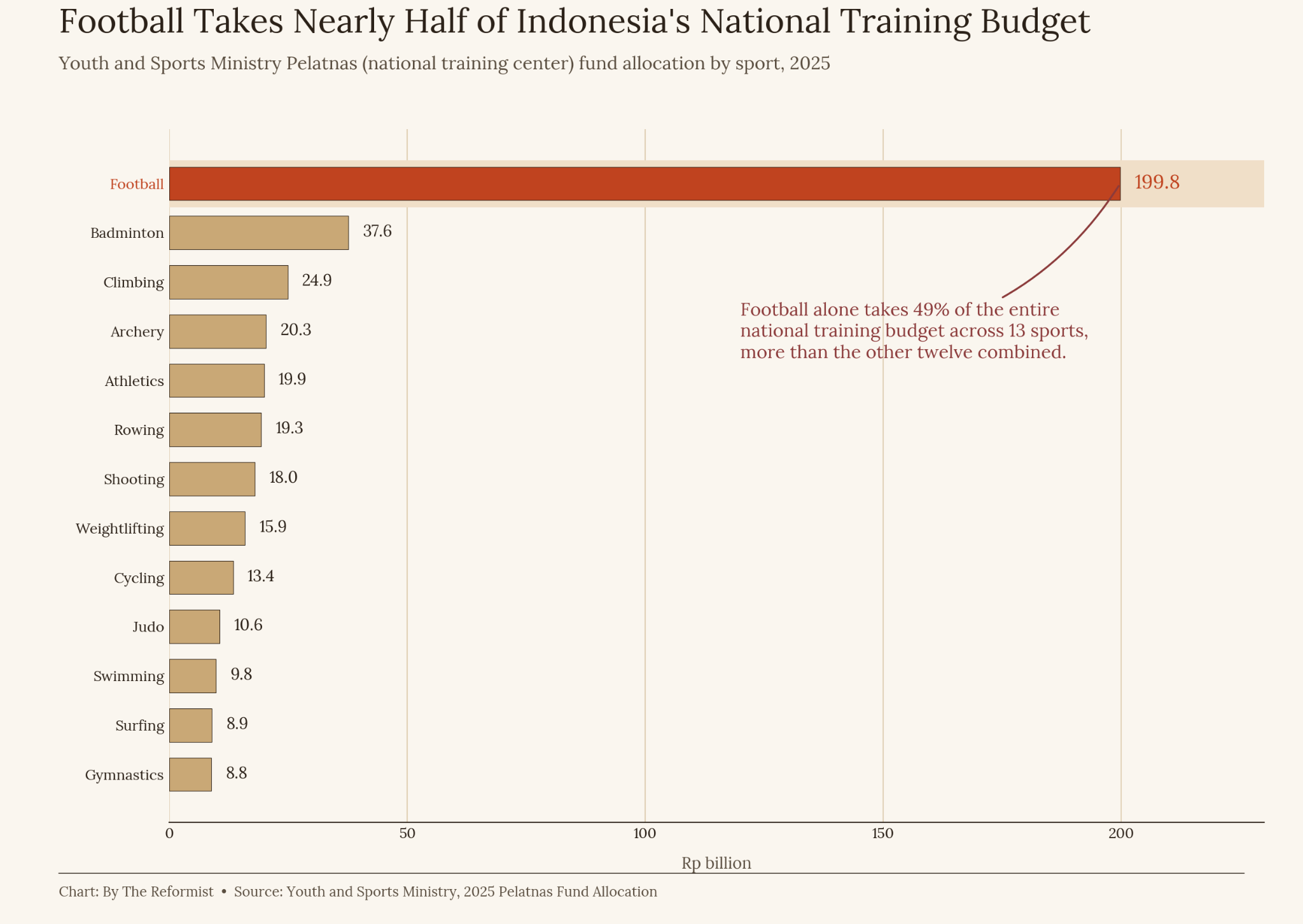
Athletics and archery — which delivered nine and six gold medals respectively at the 2025 SEA Games — received a combined Rp 40.2 billion, nearly five times less than football’s Rp 199.78 billion.
But it didn’t stop at the Pelatnas fund. In the same week Prabowo hosted the national football team for lunch and sent every player home with a Rolex, the Directorate General of Taxes of the Finance Ministry — weird, we know — announced a separate Rp 277 billion endowment from the 2025 State Budget for PSSI, justified under the mandate of Presidential Instruction No. 3/2019 to develop Indonesian football “as a whole,” not just fund its training camp. Add the two together, and the state committed close to half a trillion rupiah to football in a single year.
For non-football athletes without wealthy conglomerates backing them, financial concerns are a recurring grievance. Just a week ago, speed climber Desak Made Rita Kusuma Dewi made national headlines after winning gold at the World Climbing Series in Krakow. When asked by reporters about her feat, she thanked her team and the Indonesian fans for their support throughout the competition. She then opened up about her sorrows, explicitly calling out the Indonesian government for its lack of support in the competition.
“Before I came to Krakow, we had problems because the government didn’t support us. Now I hope the government will always support us for the next competition,” said the athlete.
Rizki Juniansyah, 2024 Paris Olympics gold medalist and world-record weightlifter, also called out his local government, Banten, and other governing bodies for showering athletes with support only after they’ve won international competitions.
“It shouldn’t just be at the Olympics. Even national championships deserve appreciation. Athletes shouldn’t be welcomed only once they’ve already returned to Indonesia, as if it’s just for show, so to speak. I’m sorry, it’s not that I’m upset or anything. That’s genuinely how it is,” said Rizky.
Tennis breakout star Janice Tjen drew international attention for her dark horse run in the 2025 Grand Slam, becoming the first Indonesian woman to win a Grand Slam match since Angelique Widjaja in 2003. Despite her accomplishment, Janice’s rise occurred despite Indonesia’s tennis infrastructure. Her coach, Chris Bilt, put it plainly:
“Coming from Indonesia has its challenges … there’s not really a player development plan from juniors to pros. So it’s been pretty tough financially for her,” said Bilt.
This norm of negligence continues to this day. This year, the Pelatnas fund has been slashed significantly in preparation for the 2026 Asian Games, from Rp 389.82 billion for the 2022 Hangzhou Games to just Rp 81.04 billion for this year’s Aichi-Nagoya Games. At the same time, President Prabowo joked that qualifying for the World Cup remains the hardest problem he has yet to solve, calling on Minister Erick and the Finance Ministry to find a way towards 2030.
He and his government, however, have not found the same urgency for climbers, swimmers, runners, and other athletes who have already made a name for themselves at the international stage but remain short on cash when support is needed most.
What state intervention in sports can look like
To learn more about what systemic support looks like, Indonesia could look to Germany for how its government reformed its football development system en masse.
After Germany crashed out of the 2000 European Football Championships at the bottom of their group — a nation that had reached the World Cup final six years earlier, only to be eliminated in the first round of the continental championship — the German Football Association (DFB) overhauled its entire development agenda.
Within two years, it had launched the most sweeping structural overhaul in the sport’s history: the Extended Talent Promotion Programme. The DFB and the German professional league jointly committed €48 million per year to it, building a two-tier development network of 366 regional coaching bases staffed by over 1,000 full-time coaches. The motto was simple: no talented child anywhere in Germany should live more than 25 kilometers from a proper training base.
Alongside the public investment, the DFB also made the reform binding on the clubs. Every first- and second-division professional team was required to build and staff a certified youth academy as a condition of its professional license. No academy, no license. Clubs that didn’t comply lost the right to play professionally. Professional clubs alone have since poured more than €1.5 billion into that infrastructure.
The result took fourteen years to materialize fully, but it did so unmistakably. When Germany lifted the World Cup in Brazil in 2014, the overwhelming majority of that squad — Thomas Müller, Manuel Neuer, Toni Kroos, Mesut Özil, Mats Hummels, Mario Götze among them — had come up entirely through the academy system built in the wake of Euro 2000’s humiliation.
For a more local comparison, grassroots development of a team sport can be seen through the rise of volleyball in Indonesia. Just last month, the Indonesian Volleyball Team won the Asian Volleyball Confederation Cup for the first time in national history, beating South Korea, the 26th best team in the world, whilst fielding a full team made up of local athletes. The national team has also been a constant force at the regional level, winning gold more than 12 times at the SEA Games.
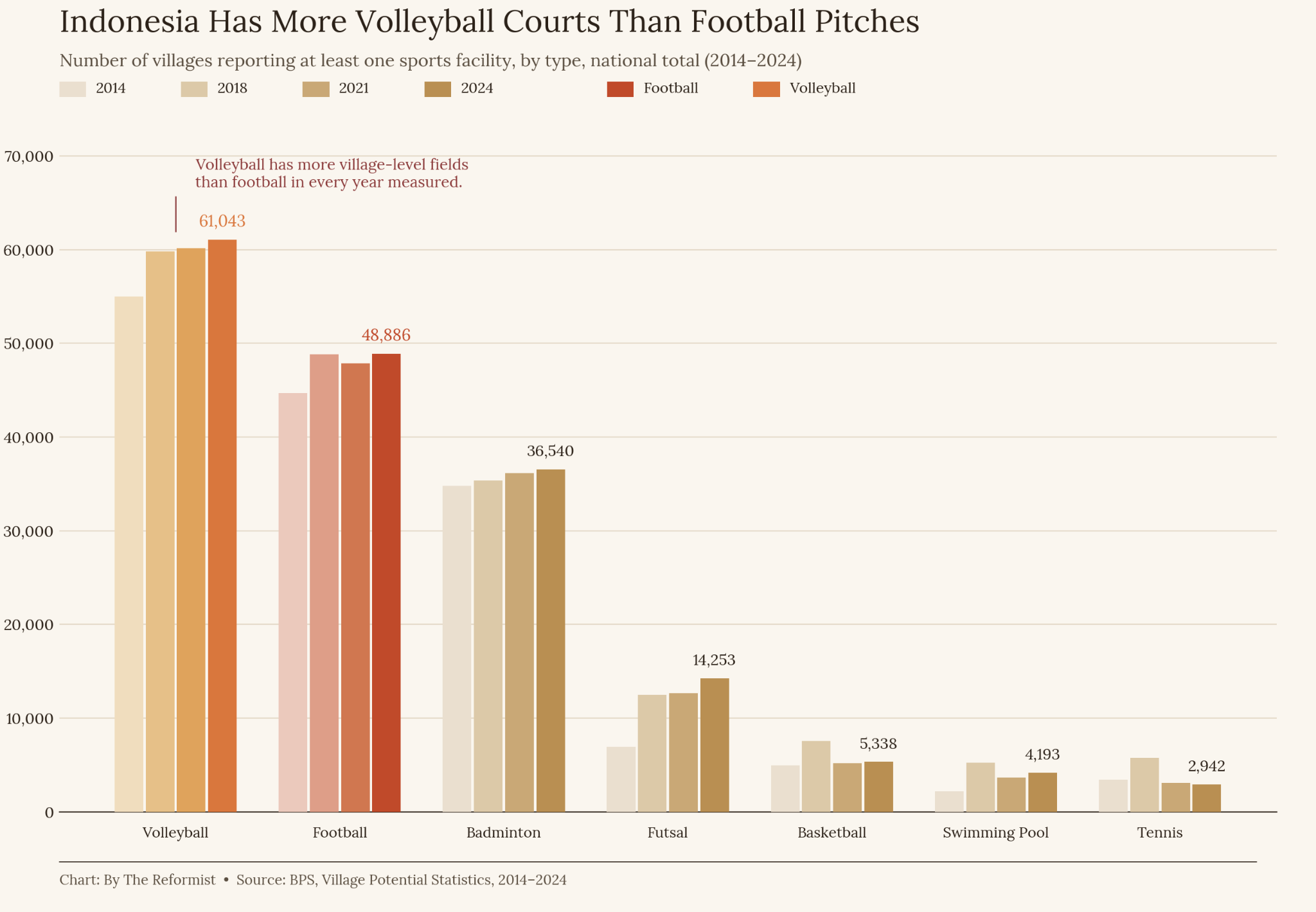
This isn’t a coincidence, though it’s also not quite a government success story either. Across tens of thousands of villages across Indonesia, volleyball courts are more prevalent than football pitches, infrastructure the state can at least partly claim credit for.
But the deeper pipeline here is civil society, not policy. Take Farhan Halim, a starter on the AVC-winning squad: he came up through Klub Voli Pasundan, a volleyball program run by a century-old community education foundation that offers players steep tuition discounts in exchange for training commitment. He was made captain at 16, and by 2022, his club team was fielding a fully homegrown, 100 percent Pasundan-product squad — the youngest in the country’s top domestic league — and winning anyway.
While impressive and inspiring, Indonesia’s sporting development shouldn’t have to be like this. State intervention, when done with intent and a shared vision of youth development and long-term growth, can lead the country to sporting stardom.
Indonesia needs to cultivate a sporting culture early on
If stories from athletes and a locally run community club aren’t enough to prove that Indonesia is severely lacking in grassroots development to cultivate sporting culture from the outset, then perhaps the numbers can shed another perspective. A 2022 global report on youth physical activity lists Indonesia as one of the worst-performing countries for children and adolescent physical activity. The Active Healthy Kids Global Alliance gave Indonesia an “F” grade across the board for its poor efforts in promoting overall physical activity and organized sports.
The overall grade draws on multiple Indonesian government surveys pooled together. Health Ministry data found just 12.9 percent of Indonesian adolescents aged 13–17 met the World Health Organization (WHO) benchmark of 60 minutes of daily moderate-to-vigorous physical activity on all seven days. Meanwhile, a separate Ministry of Youth and Sport survey data, sampling nearly 17,500 people aged 10–19, found that only 10.1 percent averaged more than 60 minutes a day.
The organized-sport grade is worse, highlighting the systemic failures in Indonesian grassroots development. The global report defines the indicator as capturing children who “officially engage in routine training activities and are registered members of sports clubs or related societies,” or, in other words, whether a child’s activity happens through an actual coached, sustained program.
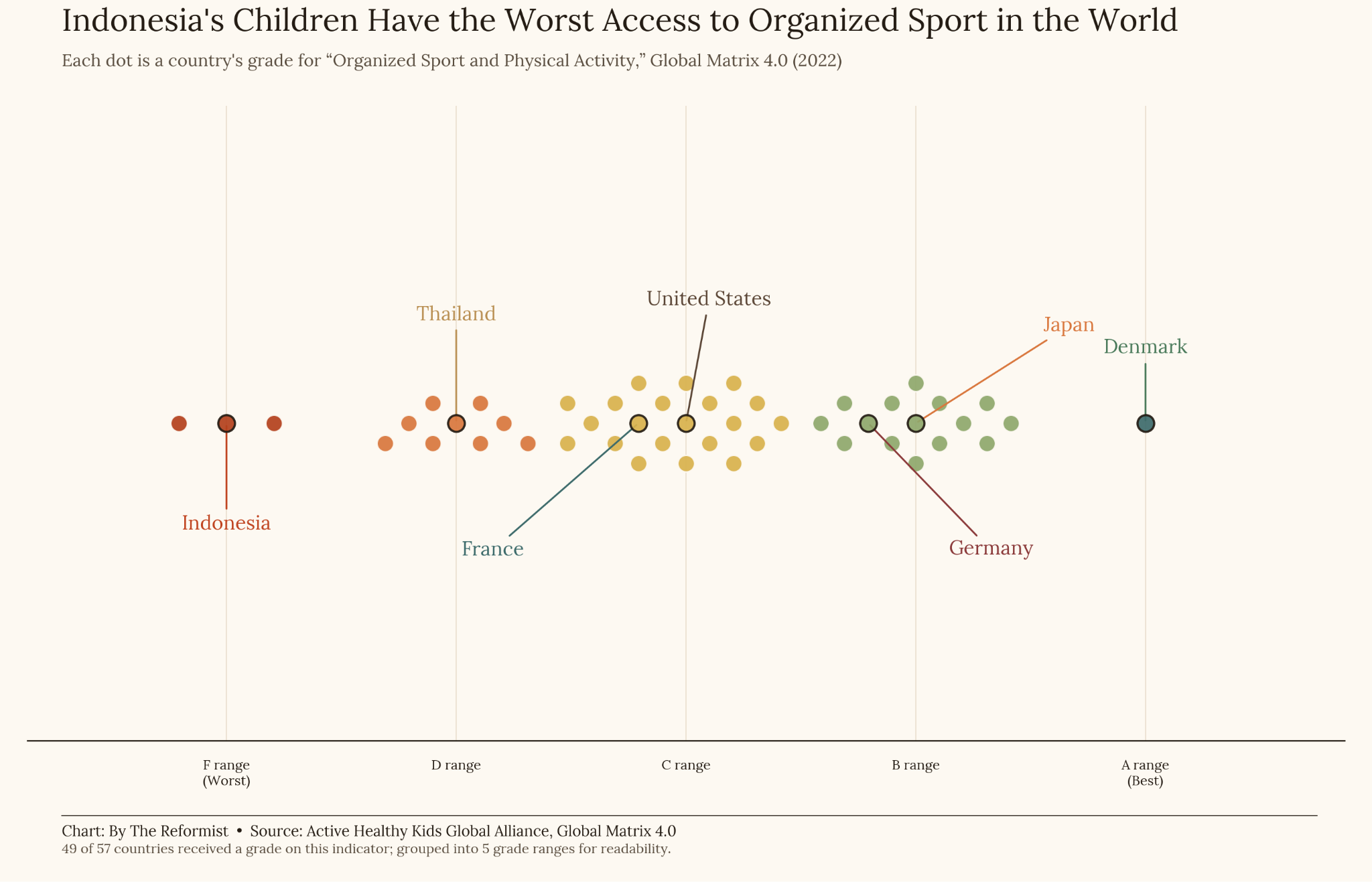
On this measure, the global report cited a 2018 Statistics Indonesia (BPS) study that found 3.54 percent of Indonesian children aged 5–17 were members of a registered sports club. Six years later, in 2024, that figure had stagnated at 3.66 percent, remaining functionally unchanged. Whatever Indonesian politicians have been claiming about youth sports development over the past half-decade, it certainly hasn’t shown up in the data measuring it.
So, the reform is actually not that complicated
This is exactly where the state must step in to intervene if it wants international glory in the long run, across all sports.
The infrastructure-centered German model and the subsidized system of the local Pasundan community club are blueprints the Indonesian government should learn from. The goal should be to move the 3.66 percent needle to develop homegrown stars, not to row through the canals of Amsterdam, praying that one more player who doesn’t make the cut with the Dutch national team would instead wear the red and white jersey and help Indonesia make it to the World Cup.
It doesn’t take far to see what this priority can produce. Look at Kylian Mbappé, the best footballer of his generation, who grew up in a low-income Paris suburb called Bondy, playing for a municipal club subsidized by his local government. Apart from Mbappé, over 53 other players participating in this year’s World Cup grew up and were built through the city of Paris and its suburbs.
If Indonesia wants to produce its own Mbappé, it needs to create versions of AS Bondy that could exist in every city, suburb, regency, and village in the country. This means that government leaders must come to terms with growth that is quietly funded but sustainable, and a belief that results will show in the long run — for football, for volleyball, for climbing, and for every other sport currently being asked to make do with a fraction of what football gets, and still somehow outperforming it.
Fantastic Read!