

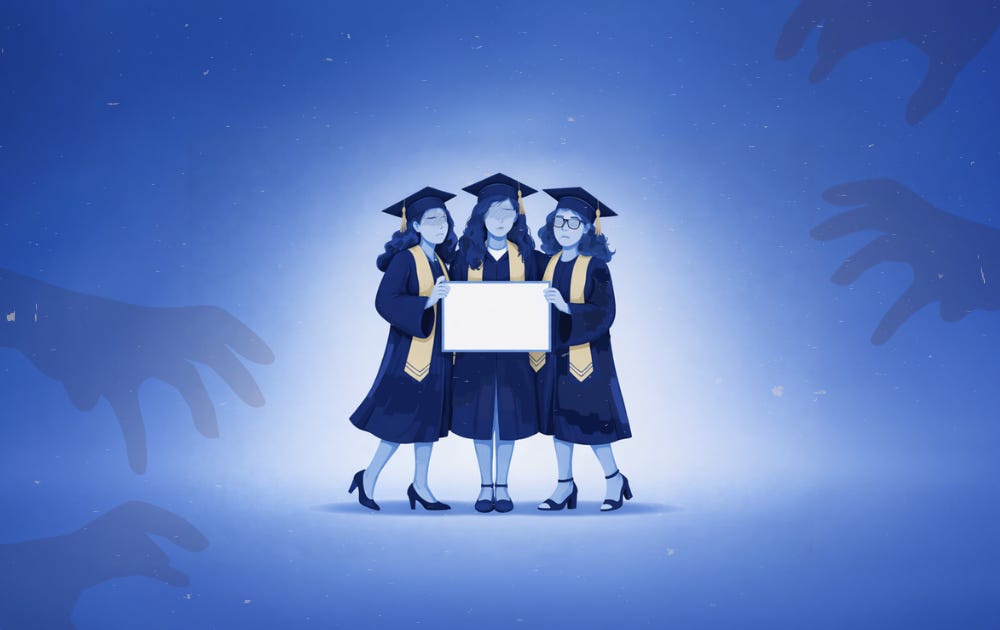
Last week, a social media post went viral after exposing a group chat of 16 law students from the University of Indonesia (UI) filled with lewd, objectifying comments about female students and teaching staff.
Shortly after, the Bandung Institute of Technology (ITB) was under fire after another viral post showed students singing ‘Erika’, a song with vulgar, degrading lyrics that has apparently been a staple on campus since the 1980s.
Has sexual harassment become normalized on campus? Or has it always been like this—and social media simply makes it easier for such cases to take a prime spot in public consciousness?
How can universities, where ethics and moral principles are taught as a mandatory course in the first year, become a fertile ground for rampant, largely unpunished sexual violence cases?
The Indonesian Education Monitoring Network (JPPI) recorded over 200 cases of violence in educational environments in January–March 2026 alone. Eleven percent of those cases occurred at the university level, and nearly half are sexual violence cases. JPPI national coordinator, Ubait Matraji, says that this shows what happened at UI is not an isolated incident but instead, a systemic phenomenon. In 2025, the National Commission on Violence against Women (Komnas Perempuan) recorded 1,091 cases of online gender-based violence (KBGO)—90 percent of which are sexual in nature.
Unfortunately, this isn’t a new occurrence. In 2019, The Jakarta Post, Tirto.id, and VICE Indonesia published a collaborative exposé dubbed ‘#NamaBaikKampus’ (‘#CampusReputation’), a jab at how many university administrators across the country actively conceal sexual violence cases to protect their so-called good reputation.
The investigation collected the data of over 100 cases of sexual violence that happened in 79 universities across 29 cities. Out of all victims that came forward, half confessed they did not file a report with the authorities. This indicates a system in which universities and the state are complicit in perpetuating rape culture by failing to set a norm that does not tolerate sexual violence.
When perpetrators of sexual violence get a slap on the wrist—or worse, get away with total impunity—the system is basically sending a message that it is okay to do it and there will be no consequences. Meanwhile, victims are afraid to report because their experience often gets denied or downplayed.
There is a real crisis: victims of sexual violence do not have a safe space where it is okay for them to speak out and file a report, whereas law enforcement operates with leniency towards perpetrators while being very strict towards victims. Ultimately, this creates a fear of ‘revictimization’.
What makes it disheartening is that sexual violence has continued to go largely unpunished even after the enactment of Law No. 12/2022 on the Crimes of Sexual Violence (UU TPKS). On paper, it provides a comprehensive legal framework that outlines a broad spectrum of sexual violence and stipulates robust provisions aimed at protecting the victims throughout and beyond the legal process. In practice, we have yet to see the law being implemented to the fullest extent possible.
According to the Indonesian Women for Justice Legal Aid Institute (LBH APIK), the police often refuse to use the full provisions of UU TPKS in handling sexual violence cases. Their monitoring shows that while UU TPKS is often invoked in the initial stage of investigations, the police would then rely on the Criminal Procedure Code (KUHAP), which treats sexual violence cases like any other criminal acts—ignoring UU TPKS stipulation for a distinct, victim-oriented evidentiary approach. This leads to sexual violence cases often being dismissed on the grounds that they fail to meet the procedural standards set by KUHAP.
But legal procedural issues are far from the only hurdle. It is the stubborn social ‘norms’ that have long normalized actions like catcalling and making objectifying comments on women’s bodies as ‘locker room talk’ or that ‘boys will be boys’. In a world where women’s perspectives are often missing in law enforcement practice and other positions of authority, it’s no wonder that victims of sexual violence are often discouraged from speaking out or filing a report in the first place.
Ironically, higher education institutions are already equipped with a progressive, victim-centered, gender-sensitive legal framework to prevent and handle sexual violence cases on campus. The year before UU TPKS was passed, the Education and Culture Ministry issued Ministerial Regulation No. 30/2021 (‘Permendikbud 30’) on the prevention and handling of sexual violence, detailing a reporting mechanism and mandating the establishment of Anti-Sexual Violence Task Forces on campus.
Former education and culture minister Nadiem Makarim, at that time, said the regulation was necessary because the Criminal Code and the Criminal Procedure Code had limitations in handling sexual violence cases. For example, the Codes only recognize rape and molestation as sexual violence. Meanwhile, he said, online gender-based violence was going rampant on campus.
Both UU TPKS and Permendikbud 30 recognize a broader definition of sexual violence—including ones typically normalized like verbal and online harassment. However, the fact that more and more cases continue happening reveals a pattern that both campus administrators and the state have failed to enforce the social norm required to create a safe environment for those most vulnerable to sexual violence.
The problem is that we know what must happen to put an end to this vicious cycle of impunity. It is one thing to have a mechanism, but a lot of work remains to foster a reliable, safe, and dignified enforcement model where victims can have trust in the system.
Law enforcement authorities can start by properly training their apparatus to understand how to handle sexual violence cases with an empathetic, gender-sensitive, and trauma-informed approach. They must also strictly punish and rehabilitate perpetrators. If not, the law will never effectively deter future offenders.
The viral UI law school case only sheds light on a system that has not batted an eye when sexual violence occurs. Leaders at the top, including the President, must take a firm stance against all sexual violence cases. Otherwise, it will only be a matter of time until the next scandal happens again. We deserve better.