


Economists at Bank Mandiri estimate that one out of three Indonesians (86 million people) belongs to the “transitional middle class.” They’re not poor, but also not resilient enough to overcome shocks, according to former finance minister Chatib Basri, who dubbed the lower end of this economic class ‘fragile’. A job loss, for example, could instantly send them into poverty.
Between 2019 and 2025, Indonesia lost over 11 million of its lower-middle class, with only 416,000 new members in the middle and upper classes. What happens to those 10.5 million whose mobility went on a downward trajectory instead?
One might think—no worries, we have a social safety net. But what’s the catch?
The Workers Social Security Agency (BPJS Ketenagakerjaan) is Indonesia’s social security agency. It follows a provident fund scheme in which both employers and employees contribute a portion of their wages to the agency, which then manages the pooled funds through investment. In return, members are eligible for five different protections: old age (JHT), pension (JP), death (JKM), job loss (JKP), and work-related injury (JKK).
As of this month, only 30.6 percent (47.4 million) of Indonesia’s 154.91 million total workforce is enrolled in BPJS Ketenagakerjaan. This means around seven out of ten workers remain vulnerable to the sudden, unfortunately imminent threats of economic shocks, especially now as the Rupiah continues to plunge.
Unlike its healthcare counterpart, BPJS Kesehatan, BPJS Ketenagakerjaan does not provide universal coverage if a worker loses their source of income.
Despite sharing the same BPJS name, they are two separate institutions with fundamentally different problems. BPJS Kesehatan is grappling with mounting annual deficits, while BPJS Ketenagakerjaan faces the opposite challenge: a coverage gap, with too few Indonesians enrolled in the program despite the country’s massive labor force.
Without proper reforms and stronger political will, the agency will begin to collapse financially under the weight of what some see as negligence. In this edition of The Reformist, we will uncover the history behind Indonesia’s social security system and why it’s a ticking time bomb.
How it started
Before BPJS Ketenagakerjaan came into existence, there had been attempts to establish a nationwide social security system. The earliest came shortly after independence, when the infant government passed a law in 1947 to protect workers from work-related injuries and death. Little is documented about compliance during this era, but the passage of this law demonstrated that the need for such protections was recognized as a priority from early on.
Under the New Order regime, the foundations of a more systematic program emerged. Then-President Suharto issued Government Regulation No. 33/1977, which established the Workers Social Insurance (Astek) program and required all private companies and state-owned enterprises (SOEs) to enroll their employees. It followed in the footsteps of PT Taspen, Indonesia’s first-ever social security fund exclusively made for civil servants, established in 1963.

Astek was renamed Jamsostek after the government enacted Law No. 3/1992 on Workers Social Security.
During this era, compliance and coverage were very minimal and non-beneficial for active members. According to a 2003 report by SMERU Research Institute, only 16.1 percent of Indonesia’s workforce was covered by Jamsostek by 1998.
Both employers and employees reported unsatisfactory service, including pension payouts equivalent to just 7 percent of a worker’s previous wage and the same old, sluggish bureaucracy that delays claim requests. Beneficiaries perceived Jamsostek obligations more as a hidden tax than a safety net, making the social security system unattractive.
It wasn’t until after the New Order regime was toppled that social security reforms became a priority in political discourse.
The reforms were reflected in the Constitutional amendments:
The second amendment in 2000 added Article 28H(3), which recognizes social security as a fundamental right of every citizen; and
The fourth amendment in 2002 further strengthened this commitment through Article 34(2), which mandates that the state establish a social security system to preserve human dignity for all.
Two years later, then-President Megawati Soekarnoputri fulfilled this mandate by passing the 2004 Social Security Law. But its implementation did not materialize until 2011, after the Constitutional Court ruled in favor of a petition filed by a federation of labor unions. The reform finally took place through the passage of Law No. 24/2011 on Social Security Administration, transforming Jamsostek into BPJS Ketenagakerjaan.
In 2014, both BPJS Ketenagakerjaan and BPJS Kesehatan began operation. The latter saw immediate success, enrolling over 140 million Indonesians upon launch and achieving over 95 percent population coverage today, while BPJS Ketenagakerjaan lags behind.
How sluggish progress exposed glaring problems
With sweeping reforms in place, it is a shame that BPJS Ketenegakerjaan has retained the same sluggish coverage problem seen during the New Order regime. Of its 47.2 million active members, 26.65 million (56.5 percent) are formal workers, 13.86 million (29 percent) are informal workers, 6 million (13 percent) are seasonal construction workers, and the remaining 691 thousand (1.5 percent) are migrant workers.
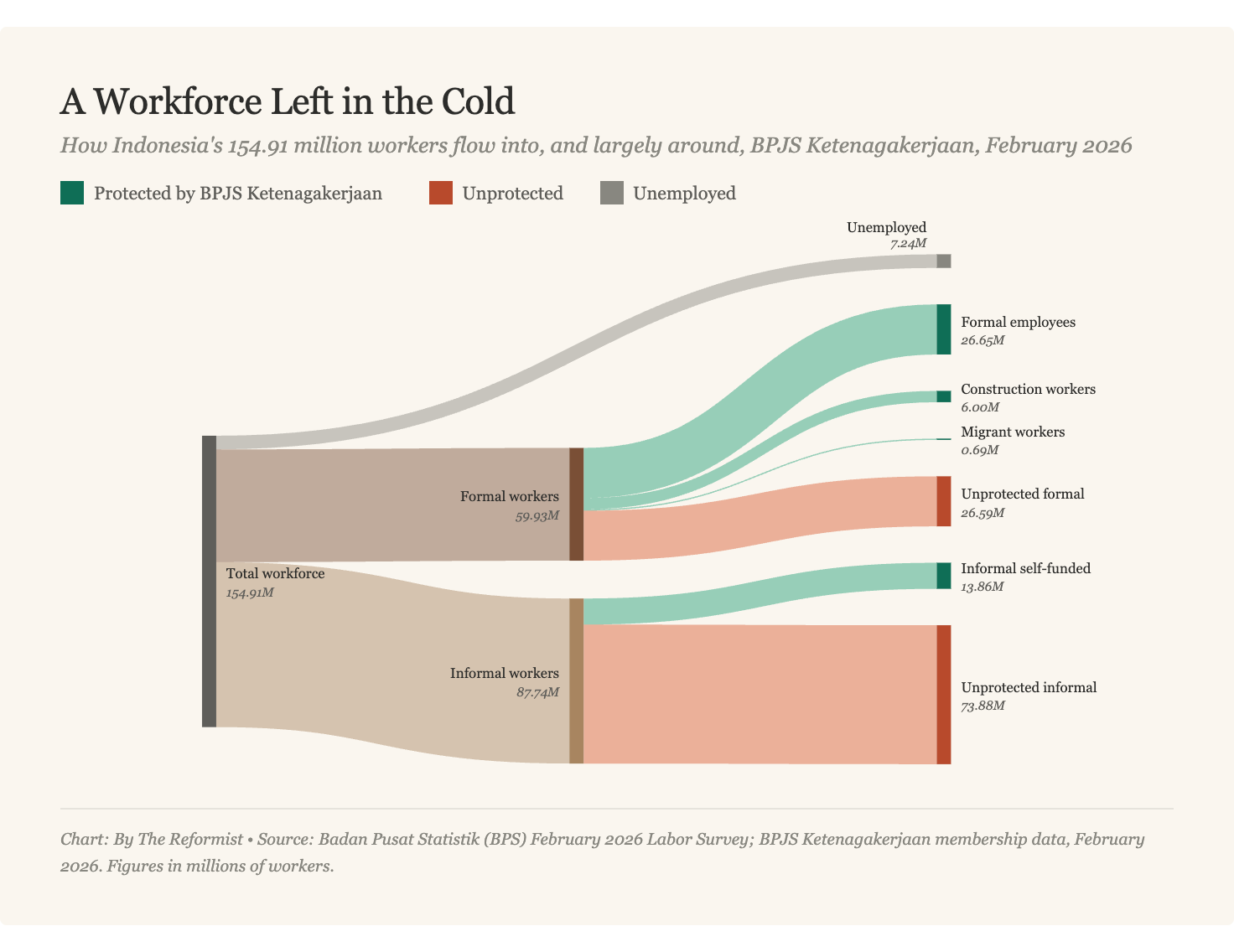
BPJS Ketenagakerjaan today covers only 30.6 percent of the total workforce, meaning coverage has increased by only 14.5 percentage points 28 years into Reformasi. This exposes two glaring problems:
I. The neglected informal sector
Although BPJS Ketenagakerjaan is most often associated with traditional employer-employee arrangements, it also covers informal workers through a separate enrollment track. Ride-hailing drivers, small and medium entrepreneurs, food stall workers, and virtually any occupation without a formal contractual agreement fall within this category.
With over 85 million (55 percent of the workforce) working in the informal sector, BPJS Ketenagakerjaan covers only 13.89 million today. That is less than two out of every ten, whereas these informal workers are the most vulnerable to economic shocks, given their income uncertainty. Unlike BPJS Kesehatan, which offers contribution assistance (PBI), BPJS Ketenagakerjaan offers no subsidies whatsoever.

With membership strictly tied to monthly premiums, social security protection remains a privilege for the large majority of informal workers. On top of that barrier to entry, those who fail to pay their dues also lose their protection altogether.
It certainly doesn’t help that there is persistent confusion between BPJS Ketenagakerjaan and BPJS Kesehatan, as many Indonesians assume the two are the same or are completely unaware of the difference.
But it’s not that they are not trying. Under Government Regulation No. 50/2025, monthly premiums for informal workers were slashed to Rp 8,400—a 50-percent reduction from the previous rate of Rp 16,800—to incentivize enrollment. The agency has also launched grassroots dissemination programs to increase membership, aiming to reach 63 million members overall by the end of this year.
How much of that targeted increase comprises the informal sector is a test of its commitment to protecting informal workers.
II. Non-compliant employers get away with it
With around 26.65 million (excluding construction and migrant workers) of 59.93 million formal workers enrolled, more than 55 percent of Indonesia’s formal sector remains without a safety net. This is despite the 2011 law obligating employers to register their employees with the agency or risk a hefty fine of up to Rp 1 billion or up to eight years of imprisonment.
We now get to the common denominator of virtually every good policy in Indonesia: weak enforcement. But political will only explains half of the root cause. In 2021, the Ombudsman flagged BPJS Ketenagakerjaan for failing to expand membership, citing both poor administrative performance and a shortage of personnel within the Manpower Ministry to address non-compliant employers.
The limited number of labor inspectors within the Ministry of Manpower, who only operate at the provincial level, results in weak supervision and inadequate handling of public complaints. This, in turn, leads to low compliance among employers in enrolling their workers as BPJS Ketenagakerjaan beneficiaries,” said Hery Susanto, a member of the Ombudsman.
By the end of 2025, the agency’s supervisory council announced that more than 523,000 employers had yet to register themselves and their employees with BPJS Ketenagakerjaan. On top of all that, over 490 thousand of the 878 thousand registered employers (55.8 percent) do not fully participate in all five programs offered by the agency.
If the government is serious about creating a protected and strong workforce, then both BPJS Ketenagakerjaan and the Manpower Ministry must take firmer actions against non-compliant employers. Otherwise, the social security system is at risk of structural failure, which leaves everyone worse off.
The time bomb’s ticking
Without reforms aimed to address these structural challenges, it won’t be long until BPJS Ketenagakerjaan hits its ceiling and eventually implodes. In his book, Paradoks Indonesia (The Paradox of Indonesia), President Prabowo Subianto seems to be aware that the so-called demographic dividend is as much a challenge as it is a ‘bonus’.
That bonus is projected to peak in 2045, after which Indonesia’s population will begin to age rapidly. As is true in many countries that have had their bonus, failure to build during the crucial period before the peak leaves them at an impasse, trying to construct a welfare state and pay out benefits at the same time. What is unfolding in France, with its mature pension system buckling under aging demographics, illustrates this scenario vividly.
Indonesia could be doomed to repeat France’s pattern unless we begin expanding social security coverage. Reports have revealed that, in its current form, BPJS Ketenagakerjaan is on track to incur financial deficits as early as 2038, a few years before Indonesia’s demographic bonus runs its course. As the current labor force ages, many more claims will be filed for BPJS Ketenagakerjaan payouts while it remains without a sustainable financial base.
The JKM program, for example, is projected to have a claim deficit of over 124 percent and rising by 2029, while JHT—the agency’s most expensive premium, collecting 5.7 percent of a worker’s monthly salary—is facing scrutiny amid an aging workforce.
Although the program’s name of old age security suggests that money would only be paid at old age, the agency allows workers to fully withdraw their JHT in a lump sum upon resignation or layoff. In 2023 alone, more than 1 million workers withdrew funds from their JHT accounts, either partially or completely. The Ministry of Finance projects that 100 million workers will be left with no pension by 2038.
Universitas Gadjah Mada’s labor expert, Qisha Quarina, says that there is currently no “comprehensive secondary data yet measuring whether the disbursement of JHT or other benefits genuinely improves the long-term welfare of their recipients.” As it stands, the JHT program serves more as a short-term severance safety net than a long-term retirement protection.
This is all happening despite the agency also administering separate protections for job loss (JKP) and pension (JP).
Towards a protected labor force
Manpower Minister Yassierli has framed these challenges in terms that gesture at the right diagnosis—that BPJS Ketenegakerjaan must be inclusive and equitable, measured by an increase in membership. But increasing membership alone, without improving enforcement against non-compliant employers, raising mass awareness among informal workers, and revisiting the agency’s fundamental policies, can only go so far.
Vice President Gibran Rakabuming Raka promised 19 million jobs during the 2024 elections campaign. President Prabowo Subianto has, on many occasions, positioned himself as an ally of the country’s labor union and workforce, including by hosting his own May Day rallies at the National Monument last year and this year. But promises of job creation and rally-day handouts cannot be the end of the story.
Are you a part of the protected or unprotected workforce? What do you think about BPJS Ketenagakerjaan - and how can it be made better, in your opinion?
The article is well-written and raises legitimate concerns, but by centering BPJS Ketenagakerjaan rather than the national policy ecosystem that governs it, it inadvertently lets the actual policymakers off the hook. BPJS Ketenagakerjaan can improve its outreach, service delivery, and administrative efficiency, but it cannot legislate its way to universal coverage. That requires political will at the level of the Ministry of Manpower, Ministry of Finance, DJSN, and Parliament.
The article's central weakness is that it positions BPJS Ketenagakerjaan as both the problem and the solution, when it is, in legal terms, neither. BPJS Ketenagakerjaan is a public implementing body (badan hukum publik) under Law No. 24/2011. It cannot set its own contribution rates, benefit formulas, or eligibility rules. Every one of those requires a Government Regulation (PP) or Ministry-level decision. Asking BPJS to 'do better' without naming the actual policymakers risks letting the real decision-makers off the hook.
A few specific gaps worth flagging:
1. The JHT early-withdrawal problem is framed as a design flaw of BPJS, but it was actually created by PP No. 60/2015. A government policy reversal made under political pressure from labor unions. BPJS had no authority to resist it.
2. Enforcement against non-compliant employers is exclusively the mandate of the Ministry of Manpower's labor inspectorate (Ditjen Binwasnaker), not BPJS. The Ombudsman's finding should have pointed the finger more precisely there.
3. The absence of subsidies for informal workers is not an institutional gap, it is a deliberate fiscal choice by the Ministry of Finance. The BPJS Kesehatan PBI comparison actually proves the point that universal coverage requires APBN commitment, not just operational reform.
4. The DJSN (National Social Security Council), which is legally mandated to coordinate and recommend policy reform, is entirely absent from the analysis.
5. The JKP (Job Loss Insurance) program that introduced under UU Cipta Kerja with significant design constraints deserves scrutiny, especially given that job loss protection is central to the article's thesis.
Again, the reform conversation this article wants to start is important. But it will be more powerful if it names the right actors: Ministry of Manpower, Ministry of Finance, DJSN, and Parliament, not just BPJS Ketenagakerjaan, which operates within the policy space these institutions define.