


Prologue
It was a fall evening in 2021. The credits just rolled at the screening of “Vengeance Is Mine, All Others Pay Cash” at the BFI London Film Festival. Audience members of various nationalities clapped, exchanging thoughts on the film.
Any Indonesian abroad sitting in that Southbank cinema hall, one of the biggest film capitals, with critics and viewers from around the world would perhaps feel a fleeting sense of pride; or at least that’s what one of our editors here at The Reformist, who was there at that time, felt.
Vengeance isn’t even the first Indonesian film selected for screening at an international film festival. Mouly Surya’s Marlina: A Murderer in Four Acts was selected for Cannes in 2017 — the first time in 11 years that an Indonesian film was featured.
A year later, Kamila Andini’s The Seen and the Unseen won Best Feature at the Berlinale. In 2022, a year after Vengeance, Makbul Mubarak’s Autobiography was screened in London after its stellar world premiere (and award win) at Venice.
This critical acclaim and global reception are only a small fraction of the larger discussion about Indonesian films. But if you’re like us — enjoy films and believe that the Indonesian film industry should thrive more — you might share our optimism that international recognition reflects the quality of our films, made by talented filmmakers on par with their international peers, but also, and most importantly, exhibits our confidence and audacity in telling stories that are distinctly Indonesian.
After all, aren’t films cultural artifacts that represent the Indonesian identity on the global map?
Let’s tread carefully here, because this notion has historically been wielded as a double-edged sword. The government, most notoriously under former President Suharto’s New Order, has used films to control official narratives and shape national identity. But after seeing Vengeance, for example, we might think our country’s history of state control over the film industry dissipated after the end of Suharto’s rule.
After all, a story centered on a man’s erectile dysfunction and his subsequent machismo is not exactly the kind of “Indonesian values” imagined by the architects of the authoritarian dictatorship to be depicted in a film. They probably didn’t want ‘impotent’ to represent our identity. And ‘violence’ is not exactly moral.
But a deep dive into the country’s current film policies shows that Suharto’s legacy still influences how film is governed today. And with the dictator long gone, this raises the question: how does the government currently govern the film industry, and what can be done to invest in the industry’s nascent global growth?
Read along as this edition of The Reformist examines how the Indonesian government treats the silver screen through policies that shape the industry’s fate today, and how examples of state-supported innovation like South Korea could be a model for Indonesian film.
Act I: The threat
The politics of State control in film content
It was interesting to see how the government has treated films from one regime to another. For a long time, Indonesia has kept films on the periphery of its priorities. It’s plausible to assume this may be the origin of the government’s neglect of the film industry, setting bad institutional precedents we’ve unfortunately come to inherit.
Until the past few decades, the state apparatus often viewed films as a “threat to the status quo and public order,” and a tool for establishing state narratives.
This is most apparent during the New Order, which was notorious for using films to assert state-approved history. A generation of adults reading this article is perhaps still traumatized by the gory details of Pemberontakan G30S/PKI (The Betrayal of the Communists), a film that set the official narrative of what happened before Suharto rose to power. But contrary to popular belief, the New Order didn’t invent strict film censorship or the use of film as propaganda. Both were legacies from the very regime that fell in Betrayal’s ending.
In 1964, Suharto’s predecessor Sukarno released Presidential Decree No. 1/1964, mandating the Information Ministry to “foster” films as a medium for “nation-building.” Article 9 required all Indonesian films to support the country’s ideology, Pancasila. A year later, the then-Information Ministry established the Film Censorship Body (BSF), supposedly to protect the people from the film industry’s bad influence and ensure all films serve their nation-building (uhm, propaganda) purpose.
When Suharto came to power, he shared the idea that films could influence order, so the government needed to assert control through censorship. But he had a slightly different approach, which resulted in a striking paradox:
In the 1970s, Indonesian cinema began to flood with bizarre, explicitly violent and sexual films — or what film scholars dubbed “exploitation films” and international distributors labeled as “cult movies.” Titles like Bernafas Dalam Lumpur (1970) and Primitif (1978) were box office hits despite their controversial portrayals of prostitution and cannibalism.
It might seem illogical that this kind of film would proliferate in a regime infamous for heavy censorship. What were the criteria that made films with depictions of gore and sex pass censorship?
The BSF, inherited from Sukarno’s regime, reviewed every film’s theme, dialogue, and visuals against five criteria: religion, socio-political content, culture, decency, and security. On paper, any exploitation film wouldn’t get a green light for its lack of decency.
But in Suharto’s New Order, a film’s “socio-political content” and “security” aspects seemed to carry more weight in the censorship process. Films wouldn’t pass when depicting something that might incite ethnic or class conflict, or any hint of disorder that might “destabilize” the regime.
Meanwhile, films with sex and violence had room for negotiation, allowing for trims and cuts of scenes instead of an absolute ban, because these films were deemed ‘apolitical entertainment’. This is not to say that the New Order never censored or banned films for indecency. The regime repeatedly tried to crack down on decency violations with its developing censorship regimes, but its enforcement was largely sporadic or reactive to public response.
In 1992, the government’s encroaching hands in the film industry were further formalized through the passage of Law No. 8/1992 on Film (1992 Film Law). The Law kept the New Order’s emphasis on censorship that film must “foster national culture”. Or as Australian scholar Krishna Sen put it: “[this law was written by] a state that sees itself as threatened by the cultural work of its own citizens.”
The 1992 Film Law also prompted the establishment of the Film Censorship Agency (LSF), formalized through Government Regulation No. 7/1994, which still exists today.
In 2009, the Susilo Bambang Yudhoyono (SBY) administration replaced the 1992 Film Law with Law No. 33/2009. While it was initially pitched as the reform Indonesian cinema had been waiting for, it delivered less than promised.
The LSF survived the transition intact, still a censorship body rather than the classification body that reformers had asked for. Every film policy since 1964 has renamed the justification for controlling what Indonesians can watch without ever seriously asking whether the government should be in the content-control business at all.
In 2026, the answer should be crystal clear: no, the state has no business controlling film content if it wants to elevate Indonesia’s film quality and help the industry flourish. In fact, the key emphasis should be for the government to exit content regulation entirely and shift toward investing in the industry with strong political will and institutional support.
Act II: The tug of war
The lethargic support for a promising industry
Since Reformasi, film policy has never lived in one ministry, and inconsistent jurisdiction has also limited the industry’s investment and growth potential.
Film has always been split between an institution governing content, like the LSF, and an institution governing industry, such as the Creative Economy Agency (Bekraf).
Between 1999 and 2024, film policy’s institutional home changed configuration at least four times. No single body has held jurisdiction over this policy continuously for more than roughly five years.
These changing hands have affected how the government prioritizes film. For instance, since 2015, the government’s language toward films has changed from “protecting” its people from film to acknowledging the industry’s economic and cultural potential.
This rhetoric shifted under Bekraf. Established in 2015, Bekraf’s mandate was to grow the funding, infrastructure, and market access, rather than the culture or moral instruction of creative fields. It operated under a different institutional logic than anything film had lived under before.
In 2019, Bekraf merged with the tourism ministry, becoming the Tourism and Creative Economy Ministry. This move drew significant pushback. Film director Ernest Prakasa, for example, was concerned about how the combined ministry would manage a budget for both tourism and the creative industry, which has 16 subsectors. His fear was not unfounded: the sector was largely ineffective for close to a year while budget lines were untangled.
The most recent reshuffle, in late 2024, is worth examining most closely, because it changed both halves of the content and regulation sides at once. The latest ministry to house film governance — the Education, Culture, Research, and Technology Ministry — was broken into three ministries, and under Presidential Regulation No. 190/2024, the Culture Ministry is now a standalone ministry that carries the mandate to govern film policy.
For the first time, the film industry’s regulatory home is not bundled with a general education portfolio.
Good news! But is it?
Well, it does, in theory, dismantle one specific, archaic bureaucratic entanglement: housing film policy inside a ministry whose main job is to oversee the nation’s schooling system.
In practice, the doctrine that film exists to serve state-approved values doesn’t appear to have gone anywhere. At LSF’s November 2024 national meeting, Culture Minister Fadli Zon defended the institution’s continued relevance in almost the same terms Sukarno’s 1964 decree used: protecting society from film content “contrary to the values of Pancasila and national identity.”
The other half of the duality split at the same moment. The Creative Economy Ministry becomes standalone, with film being explicitly named among the five priority programs across its seventeen subsectors.
So the industry now navigates between two singular ministries that didn’t exist in their current form a year ago: the Culture Ministry holds content regulation and licensing, while the Creative Economy Ministry holds industry development and access to financing.
The inconsistency may not be incidental to the film industry’s stall. Four ministerial configurations in twenty-five years signal continuous improvisation. Yet, every handover has cost the industry a transition year of reduced institutional bandwidth. An industry that runs on multi-year production and financing cycles has been governed under ministries that might change configuration every five years.
The country’s film industry has spent too long braving the country’s “wild west” ecosystem without any armor. No wonder observers noted that Indonesia’s film industry is increasingly successful not because of government policy, but despite it.
Act III - The neglect
Film’s economic contribution to Indonesia
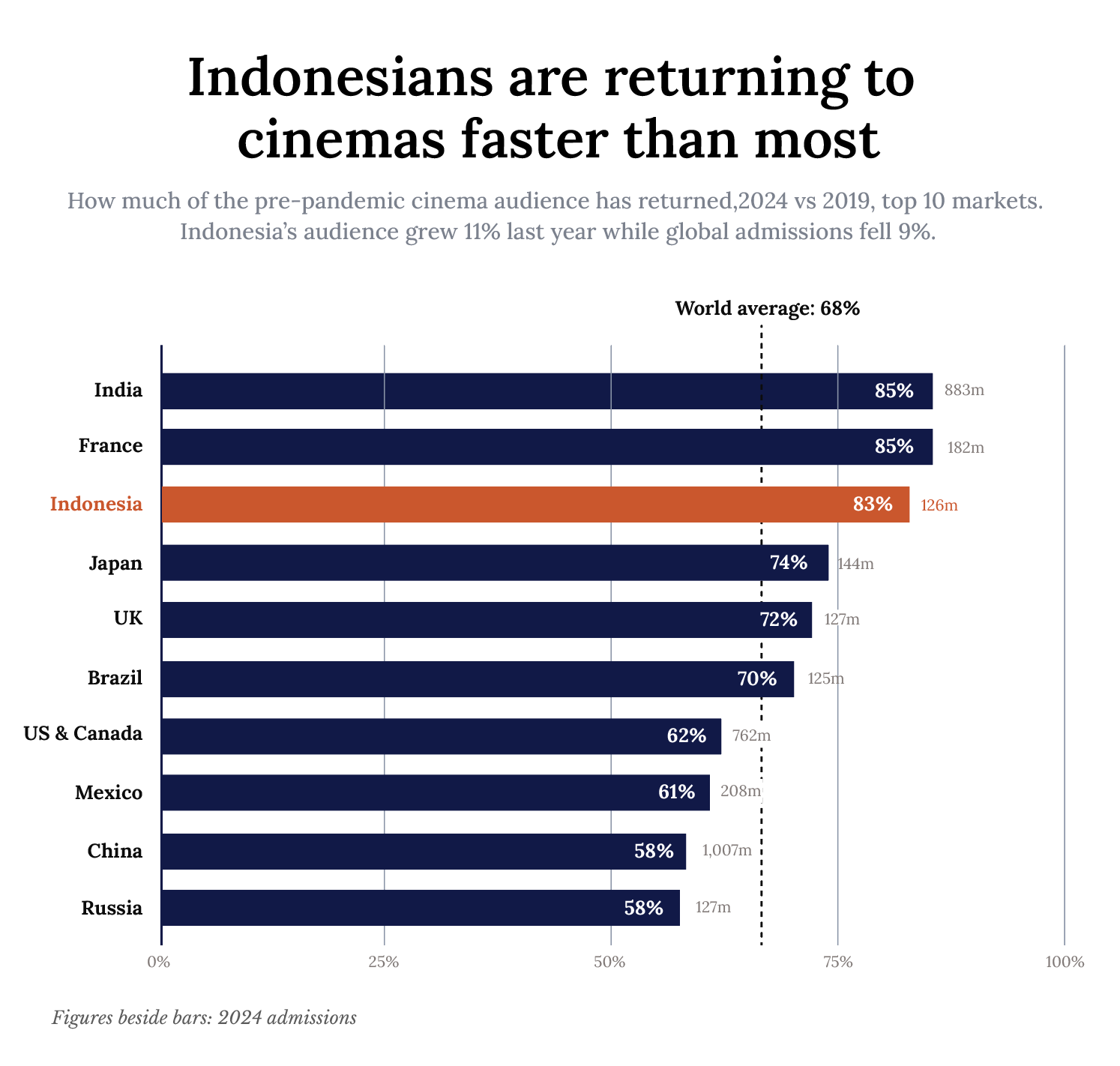
In fact, the country’s commercial moviegoing experience is defying global trends — recording new all-time highs of 126 million theatre admissions and 285 new feature titles produced in 2024, bouncing back stronger than expected after the pandemic comatose.
In 2024, Indonesia ranked 9th in theatre admissions worldwide. We recorded a new high of 126 million theatre admissions, the highest since 2019. As a share of admissions, Indonesia actually ranks third among the top ten market countries for regaining its pre-pandemic audience, beating out powerhouses like the United States, Canada, and the United Kingdom.
With at least 285 feature releases, we also produced 107 percent more films compared to 2023. Meanwhile, the rest of the world’s top 10, including China, the United States, India, Mexico, and Japan, saw only modest gains or even declines. Even more interesting, the Indonesian market has shown a preference for Indonesian films, with local production capturing 65 percent of the cinema market share that same year.
The industry almost has it all: it contributed Rp 81 trillion to Indonesia’s GDP and employed about 387,000 people in 2024 (according to a joint study by Netflix and LPEM UI). It has talented, award-winning industry players alongside a local consumer base with a growing movie-going culture.
But Indonesian films are still severely underscreened. With a population of 280 million, the fourth-largest in the world, the country has only 468 cinemas with 2,293 screens. This translates roughly to one screen per 120,000 people. By comparison, China (over 1 billion people) has a denser screen-to-person ratio than Indonesia, with about one screen per 15,000 people. The numbers are even staggering when compared to Indonesia’s regional neighbors. The graph below shows this discrepancy.
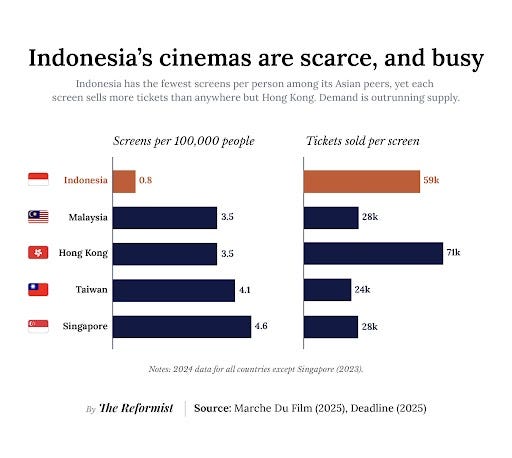
This shortage has left hundreds of Indonesian films competing for limited distribution slots. According to Yulia Evina Bhara of the Indonesian Producers Association (APROFI), about 400 local feature films were ready for screening in 2025, but only 150 secured slots for theatrical release because of limited available screens.
More screens would allow for more film production and for filmmakers to experiment with new themes and formats, with less worry about making “safe” films to fight for distribution slots (ones more likely to bring audiences to the cinema, which today are horror, comedy, and family drama).
But for this to happen, APROFI chair Edwin Nazir said in an interview with Variety magazine that the industry needs more players in distribution and exhibition so investors feel more confident investing. There are currently no distributors in Indonesia — strange — so film producers negotiate with cinema chains directly, and three big players make up over 80 percent of the whole country’s cinemas.
In an ideal world, our film ecosystem would allow enough screens to release both films that cater to market taste and preference and those that are bolder, whether in their themes or artistic expression, eventually converging the critical and commercial film tracks into one successful film industry.
Nazir put the industry’s own diagnosis on the record: “It’s about time for Indonesia’s film industry to have public production funds, tax incentives or rebate schemes, and other policies that will promote growth.” That is a producer, at the height of the industry’s best years on record, saying plainly that growth arrived ahead of policy, not because of it.
Act IV - The benchmark
Lessons from South Korea
If Indonesia were to choose a path to meet its potential, what would it look like?
South Korea offers a replicable model, not because its culture or market resembles Indonesia’s, but because its government solved its institutional problem. It governs film under a belief that film matters, economically and culturally, and invests in infrastructure that would outlast any administration.
In 2006, South Korea issued the Promotion of the Motion Pictures and Video Products Act, or the Yeong-Bi Act (yeong-hwa: film; bidio: video). This Act mandated the establishment of the Korean Film Council (KOFIC) to enhance domestic film quality and promote the film industry. Although housed under the Ministry of Culture, Sports and Tourism, it operates independently to manage the Motion Picture Development Fund.
With this fund, KOFIC develops policies and helps finance the country’s film industry across the board: surveys, research, education and training, production, infrastructure and technology expansion, export and overseas expansion, and even tracking cinema admissions and archiving films.
The fund has historically been a mix of government injections and a 3 percent levy on ticket sales. Although the Korean government abolished the levy to reduce ticket prices on top of significantly reducing its budget allocation to the film fund, KOFIC still managed over US$ 500 million in 2024.
Indonesia, in contrast, has it all mixed up. The country has had several film development institutions in place with no clear long-term objective. The now-defunct Bekraf once championed the Akatara program, an investor-filmmaker matchmaking forum, while the Creative Economy Ministry has only ever reported having “facilitated” or “helped expose” filmmakers to funding access.
Currently, there exists a Rp 6 trillion Cultural Endowment Fund managed by the Endowment Fund for Education Agency (LPDP). The fund, currently disbursed via Dana Indonesia Raya (previously Dana Indonesiana) under the Culture Ministry, is a culture-wide program and is capped at Rp 200 million per grantee for filmmakers. In other words, no dedicated endowment fund similar to KOFIC’s Motion Picture Development Fund currently exists.
Interestingly, the 2009 Film Law actually established an independent body akin, in principle, to KOFIC called the Indonesian Film Board (BPI). BPI is tasked with strengthening the foundation and advancing the film industry. It is formed and administered by industry representatives, and only “facilitated” by the government.
Article 69 of the 2009 Film Law gives BPI broad mandates to support film research and development, education and training, promotion, and financing; plus, to hold domestic and international festivals. But BPI isn’t equipped to carry out these mandates.
In fact, BPI’s own Head of the Public Policy Department, Rommy Fibri Hardiyanto, has written in Kompas.com lamenting the board’s lack of agency. He said that BPI doesn’t have the organizational design to do what it’s meant to do. It lacks a permanent organization, a sustainable funding source, and even the operational authority to function as the law mandates.
He urged that the ongoing revision to the 2009 Film Law learn from KOFIC’s model (he also mentioned France’s National Center for Cinema, or CNC) and consider rethinking BPI’s organizational model. It doesn’t need to be identical to KOFIC or CNC, but it should be an independent “film ecosystem manager.” It needs enough authority and funding to make decisions that sustain itself without being heavily influenced by regime change.
Giving BPI a larger operational mandate is imperative if we want a reliable governing body that can administer long-term programs, especially since it already sits independently outside any film policy-governing ministry. Meaning, future changes to the current ministry configuration won’t greatly affect the Board’s ability to continue supporting the industry.
The newly elected 2026–2030 BPI leadership echoed Rommy’s suggestion to start an Indonesian Film Endowment Fund. They suggested the fund could mirror South Korea’s initial model by sourcing funds from ticket-sales levies, noting that cinema tickets are currently taxed (PBJT), but the revenue flows to regional governments without a clear channel back to the industry. Rommy added that the fund could also be injected from the state budget, industry players’ and philanthropic contributions, and private investment.
Epilogue
It’s going to be a pity if Indonesia’s film industry continues to go to battle without sufficient State support. New titles and filmmakers keep emerging at international festivals, earning stellar reviews and promising futures. At home, domestic films continue to dominate the market, breaking admissions records when other countries are still struggling to recoup their pre-pandemic audience. All of this despite tepid government support and the absence of enabling policies.
Imagine the government finally waking up and seeing the industry’s importance. It’s not a pipe dream for our film industry to become the country’s thriving economic multiplier and a cultural powerhouse that marks our standing on the global stage. We’ve come a long way since film was seen as a threat to the nation, and it’s been a long time coming for Indonesia to prioritize film and invest in it so it can live up to its potential.
— Fin —
What are your thoughts on the state of Indonesia’s film industry? If you’re a passionate movie-goer like the author of this article, please leave your thoughts in the comment section below!
Correction: An earlier version of this article made a labelling error on the first graph, in which we incorrectly put “Indonesia” instead of “India”.